
Building an iOS app does not have one fixed price. The final cost depends on the app’s features, number of user roles, backend systems, integrations, design requirements, testing, and post-launch support.
As a practical planning range, a focused iOS MVP may cost around $15,000 to $50,000, while a more advanced app with payments, real-time features, custom backend development, or compliance requirements can cost $50,000 to $150,000+.
This guide explains what changes the budget, how long development usually takes, and what should be included in an iOS app proposal.
Calculator Formula for iPhone App Development Cost – Quick Analysis
Here is a quick breakdown of the cost calculator that will help you with the estimation associated with iOS app development.
iOS App Development Cost = UI/UX Development Hours + App Platform + [Hourly Rates of Developers x Development Time]
A useful estimate should show the work included in each stage. Two agencies can quote similar prices but include very different levels of design, testing, integrations, launch support, and maintenance.
Factors Impacting the iOS App Development Cost
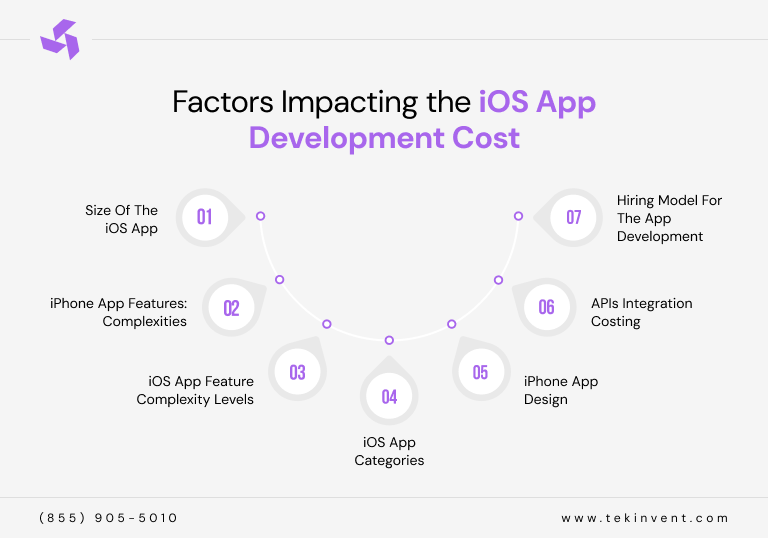
In this section, we are going to pen down the factors that impact the iOS app development cost:
1. Size of the iOS App
The size of the iOS app directly impacts the cost associated with the design and development. If it’s a large-scale app, then obviously it will have more features than a small-scale mobile app. The resources will have to spend more time on the development, which directly increases the LOE.
Whereas, contradictory to this, small-scale mobile apps are less expensive as they have limited functionalities. The size of an app can be optimised instantly as it balances the functionalities based on efficient coding.
So, here is a quick breakdown for you:
| Focused MVP | 2-4 months | $15,000–$50,000 |
| Standard business app | 4–7 months | $50,000–$100,000 |
| Complex or regulated app | 7+ months | $100,000–$150,000+ |
These are planning ranges, not fixed quotes. A healthcare, fintech, marketplace, or real-time app may require a larger budget because security, integrations, testing, and compliance add significant work.
2. iPhone App Features: Complexities
Features play a great role in determining the iOS app development cost. The basic mobile apps are more affordable because they focus on the essential features, whereas the medium or complex apps like gaming solutions require more time from the app developers and expertise. Here is a quick breakdown of the costing with features for you:
3. iOS App Feature Complexity Levels
We have discussed the different types of mobile apps with the features that impact the costing for a better overview:
Basic iOS App
- Simple user authentication
- Clean, minimal UI
- Core functionality (e.g., displaying information, basic tasks)
- Basic database integration
- Standard push notifications
Medium iOS App
- Advanced authentication (social login, biometrics)
- Custom UI components
- Added features (in-app messaging, search, payments)
- Advanced database handling
- Analytics integration
Complex iOS App
- Multi-factor and role-based authentication
- Highly customized UI/UX with animations and interactions
- Advanced features (real-time collaboration, AR, ML)
- Complex backend/API integrations
- Strong security (encryption, secure storage, compliance)
4. iOS App Categories
App category matters because each category has different workflows and risks. For example, a content app is not comparable to a healthcare app that needs privacy controls, patient records, and secure integrations.
You know, the cost for iOS app development varies from app category as well. The features, complexities, API integration, and other factors are considered to be a game-changer for businesses. The features added in the healthcare app will cost differently compared to those of an e-commerce app. Additional features like third-party integrations, regulatory compliance, and specialized expertise can also influence the development cost of iOS apps.
| iOS App Category | Typical Timeline | Planning Budget |
| Gaming app | 4-20 months | $30,000-250,000 |
| Business app | 2-10 months | $5,000-150,000 |
| Education app | 2-12 months | $10,000-80,000 |
| Entertainment app | 3-15 months | $15,000-100,000 |
| Travel app | 2-8 months | $5,000-50,000 |
| Shopping app | 3-8 months | $5,000-50,000 |
| Social networking app | 5-8 months | $10,000-60,000 |
| Health and fitness app | 1-15 months | $10,000-250,000 |
| Medical app | 2-6 months | $30,000-90,000 |
5. iPhone App Design
The other factor that impacts the cost associated with iOS app development is the design of the app. Perhaps, the iOS app design also impacts the development cost, like complex UI, custom animations, high-resolution graphics, multi-device compatibility, and adherence to the Apple design guidelines increase the expense massively.
How design affects iOS app cost
Design cost depends on the number of screens, user journeys, custom components, accessibility needs, animations, prototypes, and revision rounds. A simple app with a small design system costs less than an app that needs multiple user roles, complex dashboards, or custom visual interactions.
Before approving a design estimate, confirm whether it includes user flows, wireframes, high-fidelity screens, prototypes, design revisions, and developer handoff.
6. APIs Integration Costing
APIs and integrations can materially change an iOS app budget. Costs depend on the number of systems involved, API quality, authentication, error handling, testing environments, documentation, and ongoing support.
Payment gateway integration is another essential attribute for any e-commerce or financial app. Whereas the cost varies by provider, transaction volume, security requirements, and compliance standards like PCI, DSS, and ongoing maintenance.
Examples of cost-changing integrations include payments, maps, CRMs, appointment scheduling, inventory, shipping, analytics, notifications, and identity verification. Ask whether each integration includes testing, monitoring, and failure handling not just the initial connection.
7. Hiring Model for the App Development
On average, most companies go with the in-house app development model, whereas there are freelancers, staff augmentation, hybrid, and project-based working models available. All of these models come with different pricing associated and we are going to break it down for you:
-
In-House Developers:
The cost to build an iOS application depends on the type of mobile app and the resources who are working on it. Hiring an in-house team of iOS app developers offers complete control and direct communication, but it is usually more expensive due to the salaries that the company has to give every month. If you are a startup, then this model will be time-consuming and cost-ineffective for you.
| Hiring Model | Salary Range | Project Complexity |
| In-House | $100,000/annum | Simple |
| Developers | $120,000/annum | Complex |
-
Freelancers:
Freelancers offer more flexibility to the companies, and these models are cost-effective as well. It’s best for startups that are at an early stage and looking for ways that burden them less!
| Hiring Model | Hourly Rate Range | Project Complexity |
| Freelancers | $34-$79 | Simple |
| $20-$120 | Complex |
To compare skills, experience levels, and regional pricing, read our guide on the cost to hire an app developer
-
iPhone App Development Team Size
The size of the development team directly affects iOS app costs. Larger teams increase expenses but speed up development, while smaller teams cost less but may slow progress. App complexity and timelines determine the ideal team size, making balance essential for cost efficiency.
How the delivery model affects cost
A freelancer may suit a narrow task, while an agency or dedicated team is usually better for products requiring strategy, design, backend development, QA, security, and launch support. Compare proposals by included deliverables and ownership—not only hourly rate.
Ongoing Costs to Include in Your iOS App Budget
The initial build is only one part of the budget. Plan separately for hosting, third-party tools, monitoring, customer support, security updates, OS compatibility work, analytics, and future improvements.
Apple Developer Program membership is currently $99 per year for App Store distribution, although regional pricing and eligibility can vary. Apple’s official membership details
Detailed Comparison – Android vs iPhone App Development Cost
Whereas, if we refer to iOS app development, then the cost is around 10 to 15% more as compared to Android due to platform differences and other attributes. Whereas the design cost for iOS follows a standardized system that makes the UI simpler and cost-effective. On the other hand, Android’s flexibility across devices will increase the design expenses automatically.
The development cost varies by programming language and the guidelines provided. Whereas iOS uses Swift and Objective-C with a strict standard, Android uses Java and Kotlin, which require more optimisation for diverse devices. Perhaps, iOS apps are usually faster to develop as compared to Android, as it demands broader testing, and increase the time and cost curve.
App release costs also differ: Apple charges a $99 annual fee with stricter approval standards, while Google Play requires a one-time $25 fee with more relaxed guidelines.
If your business needs both iOS and Android, cross-platform app development may reduce duplicated development effort.
How to estimate your iOS app budget
Start by defining one core user journey, such as booking, ordering, messaging, or account management. Then list the screens, user roles, integrations, data requirements, and success conditions behind that journey.
A focused MVP may include one platform, basic sign-in, one core workflow, and limited admin controls. Budget increases when you add payments, live location, multiple roles, real-time updates, custom backend systems, regulated data, or advanced analytics.
Ask every development partner to state what is included in discovery, design, development, QA, App Store launch, warranty, and post-launch support. This makes quotes easier to compare.
Exceptional Tips To Choose iOS App Development Over Android
Here is a quick overview of the reasons why you should opt for iOS instead of Android.”
-
- iOS dominates the US market with 58.1% share, whereas it generates significantly higher app revenue than Google Play. iOS users spend more time on paid apps and in-app purchases, making the monetization strategies grow stronger.
- Whereas iOS apps offer robust data security and centralized device management with strong support for BYOD, making it ideal for business apps to grow and operate.
- Apple’s strict App Store review process ensures that high-quality apps perform better and come with a superior user experience.
- iOS users value the quality and reliability factor more as they are willing to pay for the premium app experiences, encouraging seamless and advanced user interface.
Collaborate with TekInvent for iOS App Development!
And we are done for the day. You may collaborate with TekInvent, your premium iPhone app development company, to discuss your app ideas and get started with the app design and development process.
With a diversified experience in Android and iOS app development across the United States, they understand how businesses function and focus only on delivering accurate cost estimates and coming up with efficient development practices tailored for each project.
Our iOS app cost estimation process is simple and transparent—starting with a consultation to understand goals, followed by a detailed project evaluation, a clear cost breakdown with architectural planning, and a final proposal outlining timelines, costs, and deliverables. This ensures clarity, alignment, and a smooth development journey from start to finish.

Build Smart with The Right Team.
We bring expertise, technology, and trust you look for in your digital journey.