Software development challenges become easier to address when the team separates the visible symptom from the underlying cause. A delayed feature might reflect difficult code, unavailable integration access, conflicting business rules, or a decision waiting for approval. Each needs a different response.
Adding developers or moving the deadline will not resolve every problem. Start by identifying which deliverable is blocked, what evidence explains the blockage, and who can take the next useful action.
This article focuses on diagnosing problems during a project. The aim is to restore a workable delivery plan without hiding uncertainty behind optimistic status reports.
Start with the blocked outcome
When a milestone slips, look at the behavior that remains incomplete. “The portal is behind” does not identify what the business cannot yet do.
A more useful statement is: customers can submit orders, but approved orders do not reach the fulfillment queue. That narrows the investigation to approval rules, integration, and record handling.
The team should then distinguish missing work from work that exists but fails verification. Those conditions produce different forecasts.
| Visible symptom | Possible cause to investigate | Useful evidence |
|---|---|---|
| Features repeatedly reopened | Acceptance rules were unclear | Requirement and review history |
| Integration remains unfinished | Access or data assumptions were wrong | Test connection and representative records |
| Work accumulates before release | Verification or deployment is blocked | Queue age and failed release steps |
| Estimates keep increasing | New scope or missing dependencies | Changes against the original assumptions |
| One person blocks many tasks | Concentrated knowledge or approvals | Ownership map and waiting decisions |
These are diagnostic possibilities, not conclusions. Review the evidence before choosing a remedy.
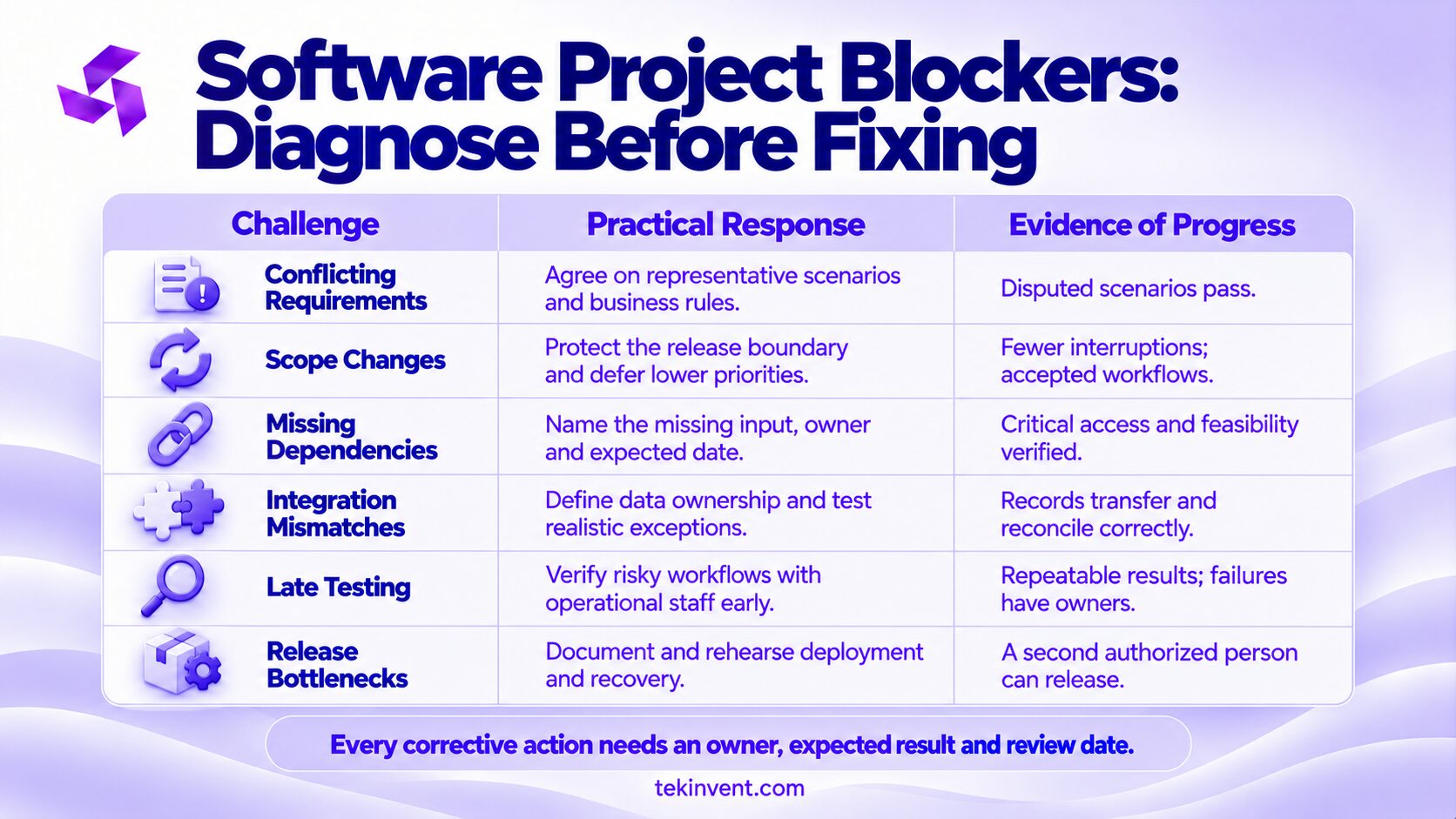
Challenge 1: conflicting interpretations of the same requirement
A feature may look finished to the developer while remaining unusable to operations. For example, “customers can cancel orders” does not establish whether cancellation is allowed after warehouse picking begins.
If one stakeholder expects automatic cancellation and another requires staff approval, the team is building against incompatible expectations.
Resolve the disputed behavior
Bring the relevant decision-makers together around a representative scenario. State the starting conditions, customer action, expected response, and operational consequence.
Record the agreed rule beside the requirement. Then review existing implementation against it and separate correction work from newly requested behavior.
Verification should include the disputed exception. A successful cancellation before fulfillment does not establish that the app handles a cancellation requested afterward.
Avoid expanding the discussion into every future feature. Resolve the rule that blocks the current deliverable and keep other decisions visible for later review.
Challenge 2: priorities change faster than work can finish
New requests are not automatically a problem. They become disruptive when work starts, stops, and restarts without a clear decision about what should leave the release.
A team may begin a reporting feature, switch to notifications, and then return to reporting after the underlying data model has changed. The business pays for coordination and rework as well as implementation.
Keep a visible first-release boundary and limit how much work is active at once. A proposed addition should state its purpose, connected changes, and effect on the forecast.
If the budget and date remain fixed, identify the work that will be deferred. “Make this a priority too” does not create capacity.
At the next review, check whether fewer tasks are being interrupted and whether completed workflows are reaching acceptance. A reorganized task board alone does not prove the problem is resolved.
Challenge 3: the schedule assumes every dependency is ready
A development task may require vendor credentials, approved content, a test device, or access to historical data. If these inputs arrive late, the original schedule may no longer be achievable.
The remedy begins with a dependency map. For each blocked deliverable, record the missing input, accountable owner, expected date, and alternatives.
A temporary substitute can permit some progress, but its limits need to be clear. Testing against invented sample records does not establish that the live data format is supported.
The custom software development timeline guide can help frame schedule discussions. Your actual forecast should show which dependencies have been verified and which remain assumptions.
When access becomes available, prioritize the smallest test that confirms feasibility. Waiting to test the connection until the surrounding feature is complete can leave more work exposed to rework.
Challenge 4: integrations disagree about the same record
A connected system can accept requests successfully while still creating incorrect business outcomes. Differences in identifiers, time zones, status meanings, or ownership can cause records to diverge.
For a hypothetical distributor, the portal may show an order as canceled while the warehouse still considers it ready to ship. The problem concerns shared state, not necessarily a broken screen.
Document which system owns each field and which events change it. Include how repeated updates, delayed messages, and conflicting edits are handled.
Test recovery, not just transmission
Use a representative record and follow it through each participating system. Verify both the initial transfer and a later change.
Then interrupt the process in a controlled test environment. Check whether the record can be reconciled without creating duplicates or losing the original transaction.
A durable fix includes an owner for investigating mismatches. Otherwise, employees may continue correcting records manually while the underlying cause remains unresolved.
Find the Blocker Behind Your Missed Milestone
Bring your incomplete workflow and project dependencies to TekInvent.
Challenge 5: testing happens after most decisions are locked
A project can accumulate completed tasks while carrying an unverified core workflow. Late testing then reveals a business-rule error that affects several features.
Move verification toward the riskiest behavior. For an approval portal, test who can approve, what happens after approval, and whether unauthorized users can bypass the normal interface.
The test plan should also cover interrupted work. A network failure after submission, an expired session, or a repeated click can expose behavior missed by a successful demonstration.
Have operational staff review outcomes early enough to influence the release. They may notice missing reference numbers or exception states that developers cannot infer from screen designs.
Progress is visible when important scenarios have repeatable results and failures have clear owners. A test count without an explanation of covered risks is incomplete evidence.
Challenge 6: releases depend on undocumented manual steps
If deployment succeeds only when one developer runs commands from memory, the project has an operational bottleneck. Another person may be unable to release even a small repair.
Write and test the release procedure in an approved environment. Record configuration requirements, dependencies, permissions, and verification steps.
The exercise may reveal an account only one person controls or a setup value absent from the documentation. Resolve those gaps before relying on the procedure during an incident.
Recovery needs its own review. Restoring an earlier application version may not restore data changed by the release. The technical team should explain what can be reversed and what requires another recovery method.
A successful deployment by a second authorized person provides stronger evidence than an untested instruction document.
Challenge 7: ordinary changes keep touching fragile code
A feature can become difficult to extend because responsibilities are entangled or important behavior lacks verification. The result is recurring uncertainty: nobody knows what a small change might break.
Avoid responding with an immediate whole-system rewrite. Begin with the workflow creating the most repeated difficulty and identify the specific obstacle.
A targeted improvement might separate a calculation from interface code and add tests for its business rules. Another might replace an unreliable dependency.
Give improvement work an expected outcome, such as making a pricing change independently verifiable. “Clean up the codebase” is too broad to support a useful estimate.
The legacy software modernization checklist is relevant when these difficulties extend beyond isolated modules. Use an assessment to compare staged improvements with a larger transition.
Challenge 8: decisions and knowledge depend on one person
The bottleneck may be technical expertise, business approval, or both. A developer may know the integration history while an operations manager alone understands exceptions.
Identify the tasks waiting on each person. Separate questions that require their decision from knowledge another team member can learn.
Paired reviews, worked examples, and short decision records can spread context. A backup approver needs authority and enough information to act; merely naming someone does not establish coverage.
Adding staff can help when there is a genuine capacity gap, but first determine whether the new contributor can proceed independently. If every task still requires the same unavailable specialist, the blockage remains.
Measure improvement through fewer waiting decisions and more tasks another authorized person can complete. Headcount alone is not evidence of reduced dependency.
Challenge 9: the forecast omits remaining operational work
A product may be functionally close to complete while still needing migration, training, support preparation, and release verification. If those tasks were excluded, the final forecast can appear to jump unexpectedly.
Create a remaining-work list organized around launch conditions. Include unresolved defects, business acceptance, account setup, migration rehearsal, and documentation.
Use actual estimates for those tasks and mark uncertainty. A general statement that the project is “90% done” does not explain the work preventing release.
The custom software development cost guide can support budget discussions across the remaining workstreams. Avoid applying a universal reserve when the known risks can be evaluated individually.
If funds are limited, defer optional functionality before removing the work required to operate and verify the core release.
Restore the plan in a sensible order
When several software development challenges appear together, resolve the conditions that prevent reliable decisions first. Clarify the blocked business behavior, verify critical access, and establish who can approve changes.
Then narrow the next milestone to a complete, testable workflow. For a stalled customer portal, that might be one order type passing through submission, approval, and fulfillment status.
Review what the milestone reveals before expanding scope again. If the integration fails on real records, address that finding rather than declaring progress based on finished interface screens.
A custom software development company discussion is more useful when you bring this evidence: the blocked outcome, known dependencies, disputed decisions, and remaining release conditions.
Track whether the correction worked
A corrective action needs an owner, expected result, and review date. Use evidence connected to the original problem.
If requirements were disputed, verify that the agreed scenarios now pass without repeated reinterpretation. If releases were blocked, check whether another authorized person can follow the procedure. If decisions were delayed, review the waiting time for the next set of approvals.
Some findings require revising the delivery date or release boundary. Make that change explicit rather than retaining a forecast the team can no longer support.
Software development challenges do not all need the same solution. A clear diagnosis lets the business fund the right corrective work and evaluate whether it restored progress. The next milestone should demonstrate a usable outcome, supported by evidence that the original blocker has been addressed.

Build Smart with The Right Team.
We bring expertise, technology, and trust you look for in your digital journey.