

To outsource software development successfully, keep ownership of business decisions while assigning clear delivery responsibilities to an external team. Prepare a usable project brief, evaluate the people doing the work, agree on acceptance evidence, and establish access and handover arrangements before development begins.
Outsourcing can provide capacity your business lacks, but it does not remove the need for timely decisions. A vendor cannot determine your refund policy, operational priorities, or acceptable launch trade-offs without an authorized business owner.
Use the checklist below to evaluate the engagement as a working relationship. The goal is to understand what will be delivered, how you will assess it, and how your business will operate the result.
1. Make the outcome clear enough to estimate
Start with the business task and its present limitations. For example, a distributor may need customers to place repeat orders without emailing spreadsheets. That is more informative than requesting a “modern customer portal.”
Describe the main user roles, current workflow, proposed first release, and required connections to other systems. Include a few representative records with sensitive information removed.
Your brief should also explain what is outside the first release. If sales forecasting and supplier ordering are deferred, say so. Otherwise, vendors may make different assumptions and return estimates that cannot be compared.
Separate known requirements from open decisions
Some questions will remain unresolved, such as whether an existing accounting tool permits the needed integration. Record those questions and give someone responsibility for resolving them.
A discovery engagement can be useful when uncertainty is substantial. Its deliverables should include documented workflows, tested integration assumptions, and a release scope that can support an estimate.
Avoid paying for discovery that produces only broad recommendations without resolving the decisions blocking development.
2. Match the engagement model to your management capacity
Staff augmentation adds people to a team you manage. A dedicated external team provides ongoing capacity, with responsibilities divided according to the agreement. A project engagement places delivery of a defined scope with the vendor.
| Model | Your business needs to provide | Suitable situation |
| Staff augmentation | Technical direction and day-to-day coordination | Existing team needs additional skills or capacity |
| Dedicated team | Product decisions and agreed delivery oversight | Roadmap requires continuing development |
| Defined project | Approved scope, timely feedback, acceptance decisions | Bounded release with clear deliverables |
No model eliminates oversight. If your organization has no technical lead, hiring individual developers may leave architecture, code review, and release responsibility unfilled.
TekInvent’s staff augmentation services are relevant when you already have the management structure to direct external contributors. A full project discussion should instead clarify who supplies design, testing, coordination, and deployment.
Geography is a separate decision. Compare working-hour overlap, communication habits, and actual delivery evidence instead of assuming a location guarantees quality or savings.
3. Evaluate the proposed team, not only the sales presentation
A portfolio can establish that a provider has completed software projects. It does not show who will work on yours or whether they understand your main risk.
Meet the proposed delivery lead and discuss a representative scenario. For a customer portal, this might be an order submitted while the accounting system is unavailable.
A useful response explains assumptions, recovery behavior, and what needs investigation. Be cautious if every question receives an immediate promise without discussion of dependencies.
References can help when they address similar delivery conditions. Ask about scope changes, communication during setbacks, and the quality of handover. A positive launch review may say little about support six months later.
Clarify team substitution rules. If a named senior engineer helped win the project, find out how their continued involvement is defined and what happens if they leave.
4. Compare total delivery cost
The relevant comparison includes vendor labor, internal review time, external tools, migration work, and ongoing services. An hourly rate alone cannot establish value.
Suppose one hypothetical proposal lists 800 hours at $100 per hour and another lists 1,000 hours at $80. Both equal $80,000 in labor. They still may cover different work, revisions, and release responsibilities. These are arithmetic examples, not market quotes.
Create a comparison sheet with scope, assumptions, exclusions, acceptance testing, deployment, and support. Resolve material differences before ranking the prices.
The custom software development cost guide can help frame the workstreams you need to compare. Use the actual project brief to obtain estimates for your business.
Understand how uncertainty is priced
Fixed-price work requires a sufficiently defined boundary. If a major integration remains unknown, a fixed total may contain a large reserve or exclude the difficult part.
Time-and-materials work can accommodate changing priorities, but needs spend visibility and clear authorization limits. Agree on when the team must report a forecast increase and who can approve additional capacity.
A payment schedule should correspond to reviewable deliverables. A calendar date is not evidence that a milestone is complete.
Bring a Clear Brief to Your Vendor Discussion
Share your software outcome, dependencies, and release priorities with TekInvent.
5. Document owners hip and access arrangements
The agreement should explain source-code delivery, rights to custom work, third-party components, documentation, and account control. Have the relevant terms reviewed for your situation before signing.
During delivery, your business needs agreed visibility into work and appropriate access to project records. Avoid an arrangement where the only evidence of progress is a presentation prepared by the vendor.
Repositories, hosting accounts, domains, and deployment credentials need explicit ownership and administration rules. A company-controlled account with approved vendor access can make future transitions easier.
List exceptions, including tools licensed by the provider and components that cannot be transferred. Those exceptions may be acceptable, but they should be visible before you depend on them.
Do not assume an exit package will materialize at the end. Define its contents and keep documentation current as the work proceeds.
6. Agree on data access and development practices
External contributors should receive access appropriate to their tasks. Development and testing can often use sample or anonymized records rather than live customer data.
The project should state who authorizes access, how access is recorded, and how it is removed when a contributor leaves. Shared credentials make individual accountability harder.
Discuss how the team reviews changes, handles dependencies, and responds to discovered vulnerabilities. Request evidence of the workflow rather than accepting “we follow best practices” as a complete answer.
For software that handles sensitive business information, define the relevant review requirements with your internal specialists. A vendor’s general assurances do not replace decisions about your actual data and operating obligations.
Security work belongs in the delivery scope. It should not appear for the first time after the product is ready to launch.
7. Set a decision and communication rhythm
A predictable review schedule lets the team obtain feedback before an assumption turns into extensive rework. Short demonstrations of working software are useful when tied to specific requirements.
Assign one person to resolve conflicting business feedback. If sales wants maximum flexibility and operations wants strict order rules, the developer should not have to choose between them.
Decisions should be written where the team can find them. A chat message can start a discussion, but approved scope and acceptance conditions need a durable record.
Working-hour overlap matters most for blocked decisions and incidents. Agree on response expectations and a backup contact rather than assuming everyone will remain available all day.
The custom software development timeline guide provides context for planning dependencies. Your own review availability should appear in the delivery plan alongside vendor tasks.
8. Review complete workflows early
A visually polished dashboard may not demonstrate the most uncertain part of the project. Prioritize demonstrations that expose integration and business-rule risks.
For a distributor portal, an early milestone could show a customer order reaching the internal system, receiving a status, and appearing correctly to staff. This reveals more than several disconnected interface screens.
Use approved acceptance scenarios. Include failures such as unavailable stock, insufficient permissions, repeated submissions, and an external service outage.
Define what acceptance actually means
A deliverable can be accepted when agreed behavior has been demonstrated and remaining issues have been classified. The exact conditions should be written before the milestone review.
Do not use “no bugs” as an undefined promise. State which known defects prevent acceptance and how lower-impact issues will be handled.
Acceptance testing requires internal availability. The employees who understand real workflows should participate; a business sponsor alone may miss operational exceptions.
9. Handle changes with visible consequences
A scope change should explain the requested behavior, why it matters, and its effects on cost and timing. The business can then approve it, defer it, or exchange it for another feature.
For example, adding customer-specific pricing can affect catalog display, cart totals, order exports, and reporting. The estimate should reflect those connections rather than charging only for an additional screen.
Correcting work that fails an approved requirement should be distinguished from adding a new requirement. Establish that distinction in the agreement and use the requirement record to resolve disagreements.
Keep a current release boundary. An approved change that never reaches the scope document can create confusion during acceptance and billing.
10. Plan launch, support, and transfer before the final milestone
Release preparation needs owners for deployment, migration, staff training, monitoring, and communication. If the product replaces an existing workflow, describe how unfinished work will move across.
Support terms should state service hours, escalation, included fixes, and billing for new work. Defect coverage and continuing maintenance may be separate arrangements.
Test the handover rather than accepting a folder of documents. An authorized person should be able to follow the instructions to build or deploy the software in an approved environment.
A custom software development company discussion should cover these operating responsibilities as well as the initial build. The product needs an owner after the final demonstration.
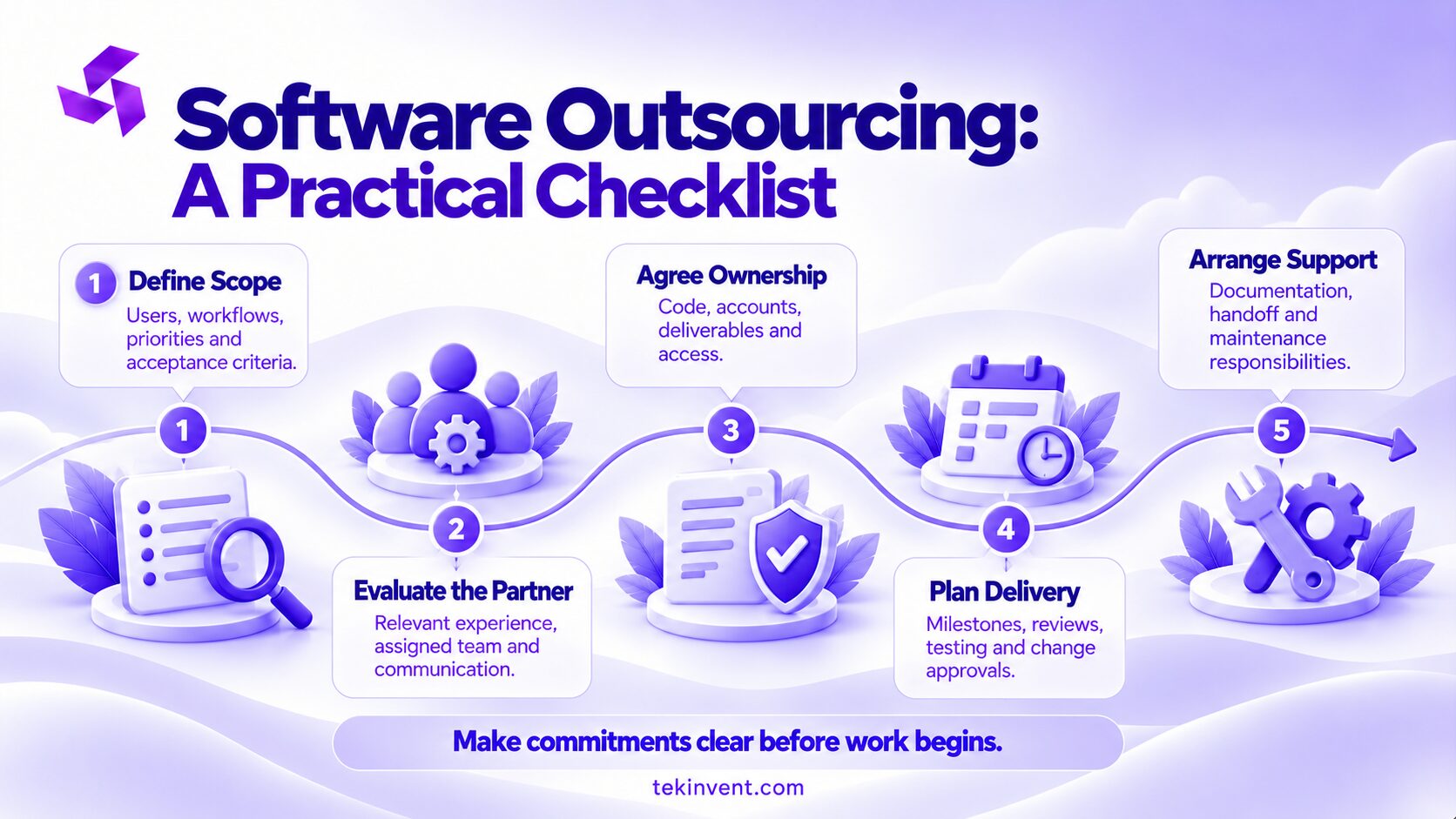
A final readiness checklist before you commit
Review the engagement against a small set of concrete questions:
- Does the scope explain the first release and its exclusions?
- Are unresolved integrations visible, with investigation planned?
- Have you met the people accountable for delivery?
- Can you compare the price against included work and assumptions?
- Are ownership, account access, and exit deliverables documented?
- Does each milestone have observable acceptance conditions?
- Can your staff provide decisions and review workflows on time?
- Are launch and ongoing support responsibilities assigned?
A missing answer does not always require rejecting the vendor. It requires resolving the gap before the dependent work begins. Outsourcing is easier to manage when both sides can point to the same expectations, inspect progress, and make changes with full knowledge of their consequences.

Build Smart with The Right Team.
We bring expertise, technology, and trust you look for in your digital journey.