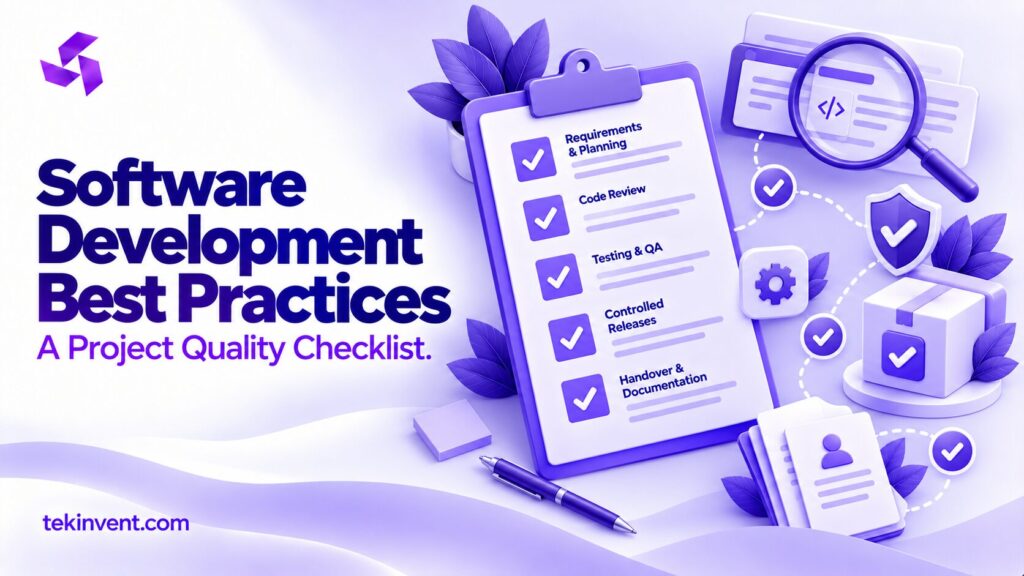
Software development best practices are useful when they produce evidence that the product works, can be changed safely, and has an owner after launch. A business does not need to inspect every line of code, but it should be able to review the important behavior and understand how the team verifies it.
Use this checklist at project milestones and before release. It focuses on observable controls rather than asking a vendor to promise that it follows a collection of technical principles.
The right depth depends on the product. An internal approval tool and a customer payment platform have different risks. Apply the checks to the actual workflow, data, and consequences of failure.
Begin with the conditions that define quality
Quality is partly a business decision. A technically functioning application can still fail to support the task it was commissioned to perform.
For a hypothetical purchase-approval portal, the core outcome may be that an employee submits a request, the correct manager reviews it, and finance receives the approved record. The project should demonstrate that complete sequence.
Other conditions might include who can see the request, what happens during absence, and whether an approval can be withdrawn. These details influence what the team must test.
A written acceptance record should distinguish required behavior from desired improvements. Without that distinction, reviewers can disagree about whether a release is ready.
Evidence to review before development
Look for an approved first-release boundary, representative workflows, permission rules, and an open-question log. Each unresolved question should have an owner and a decision path.
The requirements do not need unnecessary technical detail, but they should let someone determine whether the delivered behavior matches the agreement.
1. Keep a traceable record of changes
Version control records changes to code and other project assets over time. For the business, the practical benefit is a reviewable history of what changed, why it changed, and which version was released.
The project should use a company-approved repository and an agreed access process. Source code should not exist only on a contributor’s laptop or arrive as occasional compressed folders.
Request a demonstration of one completed change. The team should be able to connect the requirement or issue to the reviewed code and released version.
This connection also helps resolve scope questions. If behavior changed without approval, the record provides a basis for understanding where the decision occurred.
Sensitive credentials require separate handling. They should not be stored casually inside the project history, where removing them from the latest file may leave earlier copies accessible.
2. Review changes in manageable units
Code review gives another qualified person an opportunity to inspect a proposed change before it becomes part of the shared application. The review should focus on correctness, maintainability, and relevant risks.
The business can verify the process without judging the code itself. Look for recorded review, resolved feedback, and an explanation of exceptions.
A large batch containing several unrelated features can make review difficult. Smaller, coherent changes give the reviewer a clearer purpose and make later investigation easier.
Review capacity belongs in the schedule. If only one specialist can review every change, that person may become a bottleneck. The team should have an appropriate coverage plan.
For a solo developer engagement, agree on an alternative for important changes, such as periodic external technical review. The responsibility should remain visible rather than disappearing because the team is small.
3. Test the risks that matter to the workflow
Automated tests can provide repeatable checks, but a high test count does not establish that important behavior is covered. Review which failures the tests are intended to catch.
For the purchase portal, useful scenarios include the correct manager receiving a request, an unauthorized employee being denied access, and approval not being recorded twice after repeated submission.
Tests may operate at different levels. Some check individual calculations; others check interactions between components or a full user journey. The mix should reflect where the business could experience a meaningful failure.
Combine automation with business review
Operational staff should verify that the result supports their work. A report can contain technically correct values while omitting the reference number finance needs to match records.
Keep acceptance scenarios understandable to nontechnical reviewers. State the starting conditions, action, and expected result. Record failures in a shared queue with impact and ownership.
After a change, rerun the relevant checks. Yesterday’s evidence may not cover today’s alteration to permissions or data handling.
4. Build and verify the shared application consistently
An automated build process can help establish whether the current code can be assembled and checked in a controlled environment. This reduces reliance on one person’s workstation setup.
Ask the team to explain which checks run when changes are integrated and what happens when they fail. A permanently failing check provides little useful assurance.
The process should identify the version under review. Otherwise, business staff may test one version while the release uses another.
Configuration also matters. The application should use the intended service addresses, permissions, and settings for the environment. A successful test against the wrong system is misleading evidence.
Before release, confirm that the build and deployment procedure can be reproduced by an authorized person using current instructions.
Review Quality Through Evidence, Not Assurances
Bring your project milestones and acceptance requirements to TekInvent.
5. Address access and dependencies during development
Access controls and third-party components deserve review before launch. They affect which people can perform actions and which external code or services the application relies on.
For permissions, test both allowed and denied actions. Hiding an administration button does not establish that the underlying operation is protected from an unauthorized request.
The team should maintain awareness of its dependencies and a process for investigating relevant updates or discovered weaknesses. Record responsibility for that work after release.
Development access also needs an owner. Contributors should receive the access necessary for their tasks, and the business should know how it is removed when the engagement ends.
Review data handling with the people accountable for the information. Use representative test records appropriate to the project rather than exposing live business data by default.
6. Verify integrations using realistic exceptions
A successful connection test establishes only part of the required behavior. The project should demonstrate what happens when information is delayed, repeated, invalid, or unavailable.
For an approval portal connected to accounting software, check how the system records a failed transfer and prevents an approved request from being lost.
The integration brief should name the authoritative source for shared fields. If both systems permit edits, the team needs an explicit conflict rule.
Representative records can reveal assumptions about identifiers, optional fields, dates, and status meanings. Use actual format information with sensitive details removed where necessary.
Acceptance should include a recovery scenario. The business needs to know how staff can identify and reconcile a record that did not complete the expected transfer.
7. Plan a controlled release and a usable recovery route
Release quality includes the transition into use. Document required approvals, deployment steps, data changes, communication, and verification of the business workflow after deployment.
A recovery plan should explain what can be restored and how. Returning to an earlier application version may not undo a database change or an external transaction.
Agree on who can authorize a recovery decision. During an incident, unclear authority can delay action even when the technical procedure exists.
A rehearsal in an approved environment can reveal missing permissions or outdated instructions. For a migration, also verify record counts and representative business results rather than assuming that a completed import means the data is correct.
The legacy software modernization checklist is useful when release involves transitioning away from an existing application.
8. Set quality targets with realistic conditions
Performance, reliability, and usability need conditions that make results interpretable. A fast demonstration on a developer’s machine may not represent your employees’ devices or workload.
Specify the action, data volume, expected usage, environment, and acceptable result. The team can then assess feasibility and the cost of meeting the target.
For example, a hypothetical requirement could measure the request list using a defined dataset and network profile. The exact threshold should follow the workflow’s needs rather than a universal number copied from another project.
Accessibility review should likewise use agreed criteria and an appropriate verification method. User-interface quality includes more than appearance; people need to complete the task under the conditions in which they use the product.
Record the method alongside the result so later reviewers can reproduce or appropriately interpret the evidence.
9. Leave documentation another person can use
Useful documentation explains how to run, release, operate, and change the software. It also records business rules and significant decisions that are difficult to infer from the interface.
Test instructions rather than counting pages. An authorized person should be able to follow the build or release procedure in an approved environment.
Keep known limitations and workarounds visible. If a report excludes archived records, staff should not have to discover that omission through inconsistent totals.
Ownership information is part of the handover. Identify who controls repositories, accounts, integrations, and operational support.
A custom software development company discussion should include these ongoing responsibilities. Documentation is more useful when it is maintained during delivery than assembled from memory at the final milestone.
10. Turn findings into decisions
A quality checklist should generate action rather than a score without context. For each gap, record the consequence, proposed response, owner, and review date.
Some gaps should block release. Others can be accepted with a documented workaround and a plan to address them. The business and technical team should agree on that distinction using actual impact.
If an optional report lacks a convenience feature, deferral may be reasonable. If unauthorized users can access another customer’s records, the decision carries a different level of consequence.
The custom software development cost guide can help frame the work needed to close gaps. Include verification and release effort in the estimate, not just implementation.
Use a concise milestone review
At each meaningful milestone, select a complete workflow and review its supporting evidence:
| Review area | Evidence to request |
|---|---|
| Required behavior | Demonstration against approved acceptance scenarios |
| Change history | Requirement linked to reviewed implementation |
| Verification | Relevant test results and unresolved defects |
| Integration | Representative transfer and recovery results |
| Release | Reproducible deployment and recovery instructions |
| Ownership | Named operational and technical contacts |
This review should fit the milestone. An early design review will not provide final release evidence, but it should identify the gaps still expected to be resolved.
Software development best practices work when they become consistent, observable habits. Start with the product’s most consequential workflows, verify the evidence, and make unresolved risks visible. That gives a business owner a practical basis for approving progress and funding the remaining work.

Build Smart with The Right Team.
We bring expertise, technology, and trust you look for in your digital journey.