
Hiring Flutter developers in Austin starts with defining the work you need them to own. Building interface screens, rescuing an unfinished app, and leading a production release require different levels of responsibility.
A useful hiring process evaluates how candidates reason about app behavior, handle platform differences, and explain trade-offs. A polished demo or a long list of framework packages cannot establish whether someone can maintain your product.
For an Austin team, office attendance and working-hour overlap may matter. Make those requirements explicit. They should support collaboration, not serve as substitutes for evidence of technical ability.
Confirm that Flutter fits before opening the role
Flutter supports sharing application code across platforms, but shared code does not eliminate platform-specific requirements. Review the features your product depends on before treating a single developer as coverage for every technical task.
Specialized hardware, background activity, and third-party software kits deserve early investigation. A short feasibility exercise can establish whether an available integration meets your needs or requires custom native work.
Existing code matters, too. If your team already maintains an app in another framework, migration adds work beyond hiring. Compare improving the current product with replacing it.
TekInvent’s Flutter app development company page is a relevant starting point for discussing a Flutter-specific build. Bring the difficult features and existing technical constraints to that conversation.
Define the actual ownership boundary
Your role brief should say whether the developer owns only the mobile app or also backend services, design implementation, automated testing, and release preparation.
A business hiring its first technical contributor may also need architectural review and product coordination. These responsibilities should not be assumed to come automatically with the title “Flutter developer.”
For an existing team, describe who makes technical decisions and reviews changes. A capable contributor can still struggle if nobody owns the interfaces between mobile, backend, and operations.
Match the hiring model to the work ahead
Use an employee role when there is ongoing work and a reason to retain product knowledge internally. A freelancer can suit a bounded task with defined inputs and acceptance conditions.
Staff augmentation adds capacity to a team that already provides direction. A project team may be useful when the business needs design, development, testing, and delivery coordination together.
| Hiring route | Business responsibility | Main issue to resolve |
|---|---|---|
| Employee | Management, tools, roadmap, coverage | Sustainable workload and supporting skills |
| Freelancer | Scope and timely review | Availability, handover, and ongoing support |
| Staff augmentation | Technical leadership and task direction | Integration with your team’s practices |
| Project team | Product decisions and acceptance | Included roles and delivery boundaries |
The right model can change over time. A contractor might deliver a narrowly scoped integration while an employee handles the continuing roadmap. Document the handoff so neither assumes the other owns release readiness.
TekInvent’s staff augmentation services are relevant if your team can direct the work and needs additional Flutter capacity.
Write a role brief that filters for useful experience
Describe the product, supported platforms, existing architecture, integrations, and expected responsibilities. Separate required skills from preferences that the team can teach.
For a hypothetical Austin field-service app, the central requirements might be reliable form submission, local drafts, photo uploads, and readable screens used outdoors. Decorative animations would not be the main hiring criterion.
An app rebuilding its release process needs another brief. Experience with signing, automated builds, store submissions, and troubleshooting platform-specific failures becomes more relevant.
Be clear about collaboration. If workshops happen in person, state their expected frequency. If the role is remote, define Central Time overlap for reviews and urgent decisions.
Candidates should understand what success looks like in the first several weeks. A bounded outcome, such as shipping a tested scheduling change, gives both parties a clearer expectation than “improve the app.”
Evaluate skills through behavior and reasoning
The interview should reveal how a candidate approaches uncertainty. Strong answers connect implementation choices to user behavior, testing, and maintenance.
Dart and asynchronous work
A candidate should be able to explain how the app handles operations that finish later, including network requests and local storage. Use a practical scenario rather than relying entirely on language trivia.
For example, a customer changes a search term while the earlier request is still running. How does the app prevent an old response from replacing the current results? The answer should address application behavior and verification.
Null handling and error handling also belong in the discussion. A missing optional field should not produce the same response as a failed authentication request.
State and application structure
State is the information that determines what the interface displays. The developer needs to explain where that information lives and how changes remain consistent across screens.
A shopping cart provides a useful example. If an item changes in one screen, what updates elsewhere? What happens after restarting the app? Which values come from the server, and which are temporary local choices?
The name of a state-management package is less informative than a clear explanation of those decisions. A reasonable approach should fit the team’s existing code and expected complexity.
Platform integration
Flutter can communicate with native platform code through platform channels. When a required capability is not adequately covered by an existing package, a developer may need to work with platform-specific APIs.
Assess this skill in proportion to your app’s needs. A basic catalog app may require less native integration experience than a product using specialized device hardware.
A useful candidate can describe what they would investigate, where their expertise ends, and when another specialist is needed. That honesty helps you plan team coverage.
Testing and release judgment
Flutter testing includes unit, widget, and integration tests. In plain terms, these can check individual logic, interface components, and interactions across a larger workflow.
The candidate should select tests that address meaningful risks. A checkout calculation and an interrupted submission need different evidence from a decorative icon.
Release judgment includes recognizing what automated tests cannot establish. Device behavior, accessibility, and production configuration may require additional verification.
Define the Flutter Skills Your Product Needs
Discuss your app’s difficult workflows and team responsibilities with TekInvent.
Use a short, representative assessment
A practical assessment should resemble the work without becoming an unpaid production assignment. Keep the scope bounded and agree on compensation when the exercise requires substantial time.
One example is a small appointment screen using a provided mock service. The screen must show available slots, handle a failed request, and preserve the selected slot while the user navigates back.
Then introduce an exception: the selected appointment becomes unavailable before confirmation. The candidate should explain how they would communicate that change and test the behavior.
Evaluate the submission using criteria shared in advance:
- Does it satisfy the stated behavior, including failure conditions?
- Can another developer understand the structure and run it?
- Are assumptions and limitations documented?
- Do the tests address the important behavior?
- Can the candidate explain a trade-off and an alternative?
A follow-up discussion is often more useful than adding more features. It can show whether the candidate understands their own choices and can respond constructively to review.
Review previous work without demanding confidential code
Published apps can establish that a candidate has participated in real delivery. Ask what they personally owned, what constraints affected the project, and which problems required coordination with others.
A candidate may be unable to share client repositories. They can still discuss a sanitized example, a public contribution, or a technical decision without exposing private material.
Explore maintenance experience. What changed after launch? How did the team find defects? What did they learn about an integration that seemed straightforward initially?
For a senior role, discuss code review and mentoring. Your team may need someone who improves shared decisions, not just a person who completes isolated tickets quickly.
Estimate the full hiring cost
Employee cost includes compensation, applicable employer expenses, equipment, tools, recruiting, and management time. Contract cost includes billable work, review effort, and any separate testing or release services.
Use actual offers and proposals rather than treating a published Austin average as a quote for your role. Seniority labels can hide different responsibilities.
For a hypothetical comparison, 100 contractor hours at $110 per hour equal $11,000 in labor. If your team also spends 20 review hours valued internally at $80, another $1,600 belongs in the planning model. These inputs are examples, not recommended rates.
The point is to compare delivered work and supporting effort. A less expensive contributor who needs more direction may be suitable if you have that capacity. Without it, progress can stall.
For a complete build, a cross platform app development company discussion should clarify whether design, backend integration, testing, and release coordination are included. Those roles should remain visible in the estimate.
Set code, account, and handover expectations
Before work begins, document repository access, custom-work ownership, third-party dependencies, release credentials, and documentation requirements. Obtain appropriate review of contractual terms for your arrangement.
Your business needs a practical way to continue development if the contributor becomes unavailable. That requires more than receiving source files at the end.
Build instructions should work in an approved clean environment. The release process should identify required accounts and who controls them. Sensitive credentials should use the team’s approved access process.
For contractors, agree on what happens at the end of the engagement: final documentation, unresolved issues, access removal, and any continuing availability. An assumed maintenance commitment is a potential gap.
Make onboarding a working exercise
The first assignment should test the environment and review process without putting a critical release at unnecessary risk. A modest defect repair or small established workflow change can serve that purpose.
Provide sample data, a test account, design references, and a person who can answer business questions. Missing inputs should not be mistaken for poor developer performance.
The first review can reveal friction in build setup, unclear acceptance criteria, or conflicting coding conventions. Resolve those problems before adding more tasks.
An Austin team should also establish practical meeting arrangements. In-person access has value only if it helps people make decisions; remote contributors need equivalent access to context and feedback.
Use a hiring decision checklist
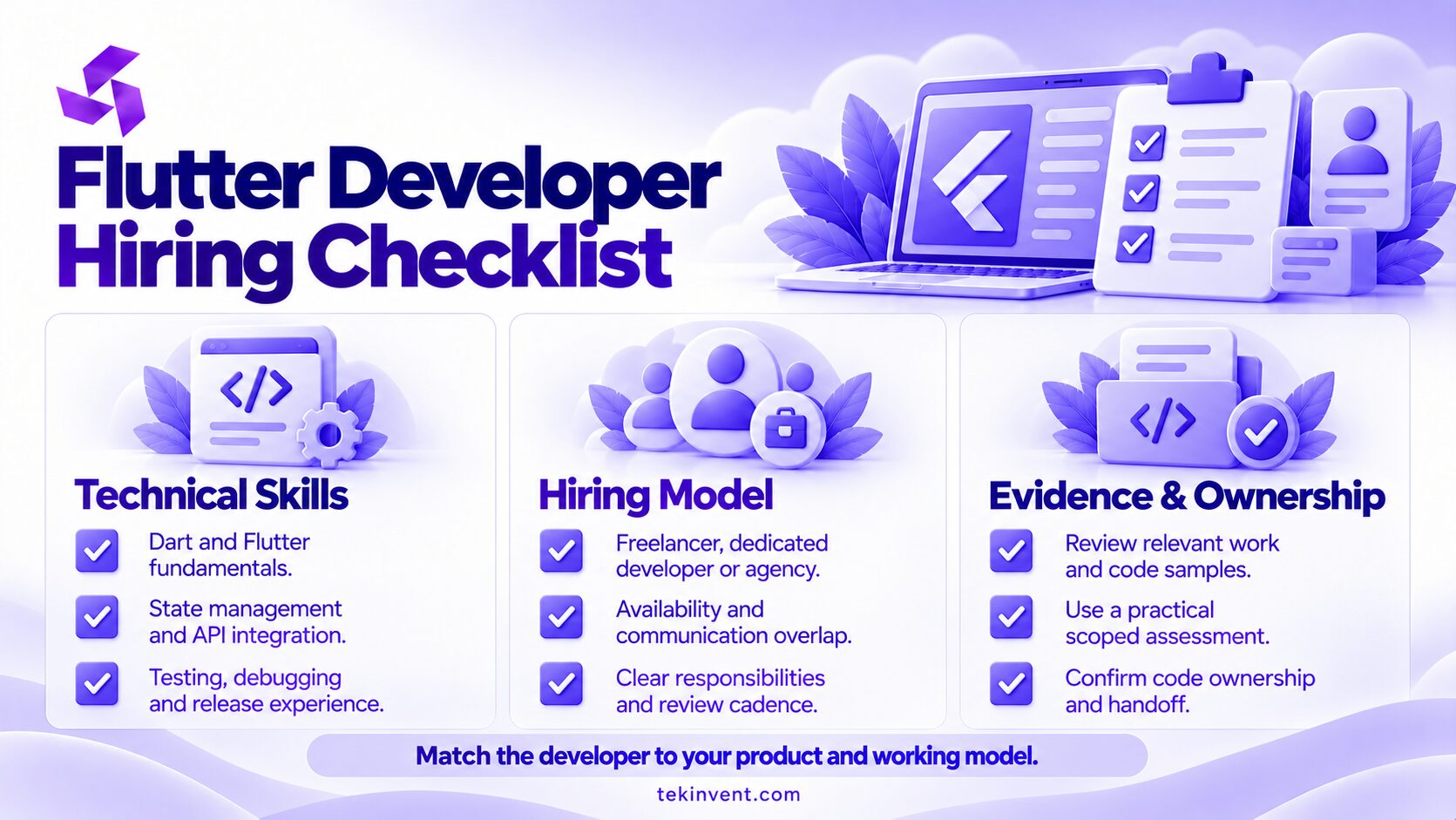
Before making the offer or signing the engagement, confirm that the evidence matches the role:
- The candidate understands the app’s primary workflow and exceptions.
- Their assessment demonstrates readable work and useful verification.
- Platform-specific requirements have an owner.
- Your team can provide the direction the hiring model requires.
- Estimated cost includes review, testing, and release responsibilities.
- Code access, accounts, documentation, and transition terms are clear.
- Working hours and decision availability fit your delivery process.
Hiring Flutter developers in Austin becomes a more defensible decision when the process tests actual responsibility. Select someone who can explain the product’s behavior, deliver work your team can review, and leave the application maintainable after the next release.

Build Smart with The Right Team.
We bring expertise, technology, and trust you look for in your digital journey.