
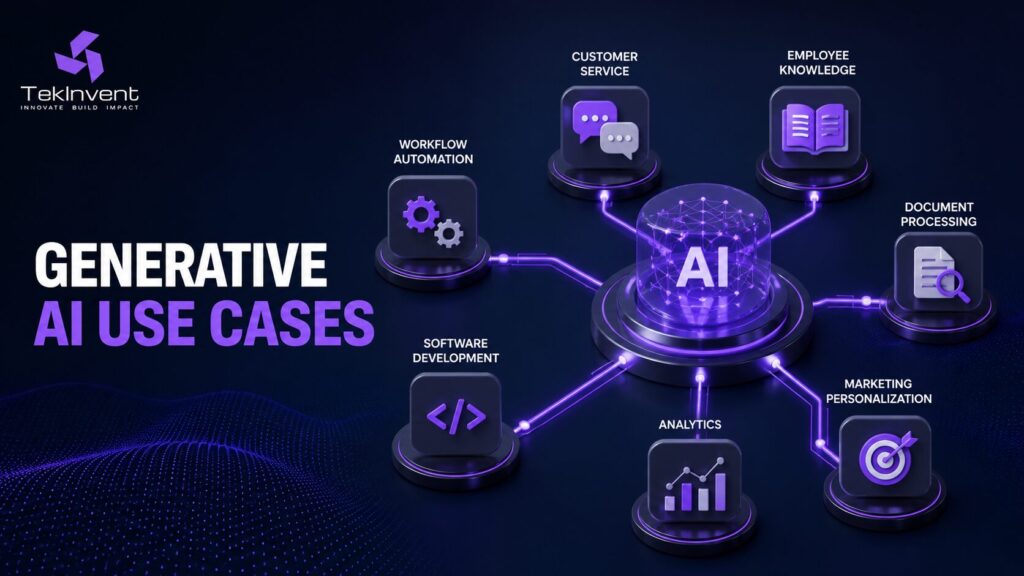
Generative AI can create text, images, audio, video, software code, summaries, and structured information from natural-language instructions and business context.
Its flexibility creates opportunities across almost every industry, but it can also make project selection difficult. A company may identify dozens of possible applications without knowing which one should receive investment first.
The strongest generative AI development use cases do not begin with the technology. They begin with a valuable workflow where people spend significant time reading, searching, summarizing, drafting, organizing, or coordinating information.
A suitable use case should have accessible data, a measurable outcome, manageable risk, and a realistic process for human review.
This guide explores high-value applications and explains how businesses can select a focused starting point instead of creating an unfocused collection of AI features.
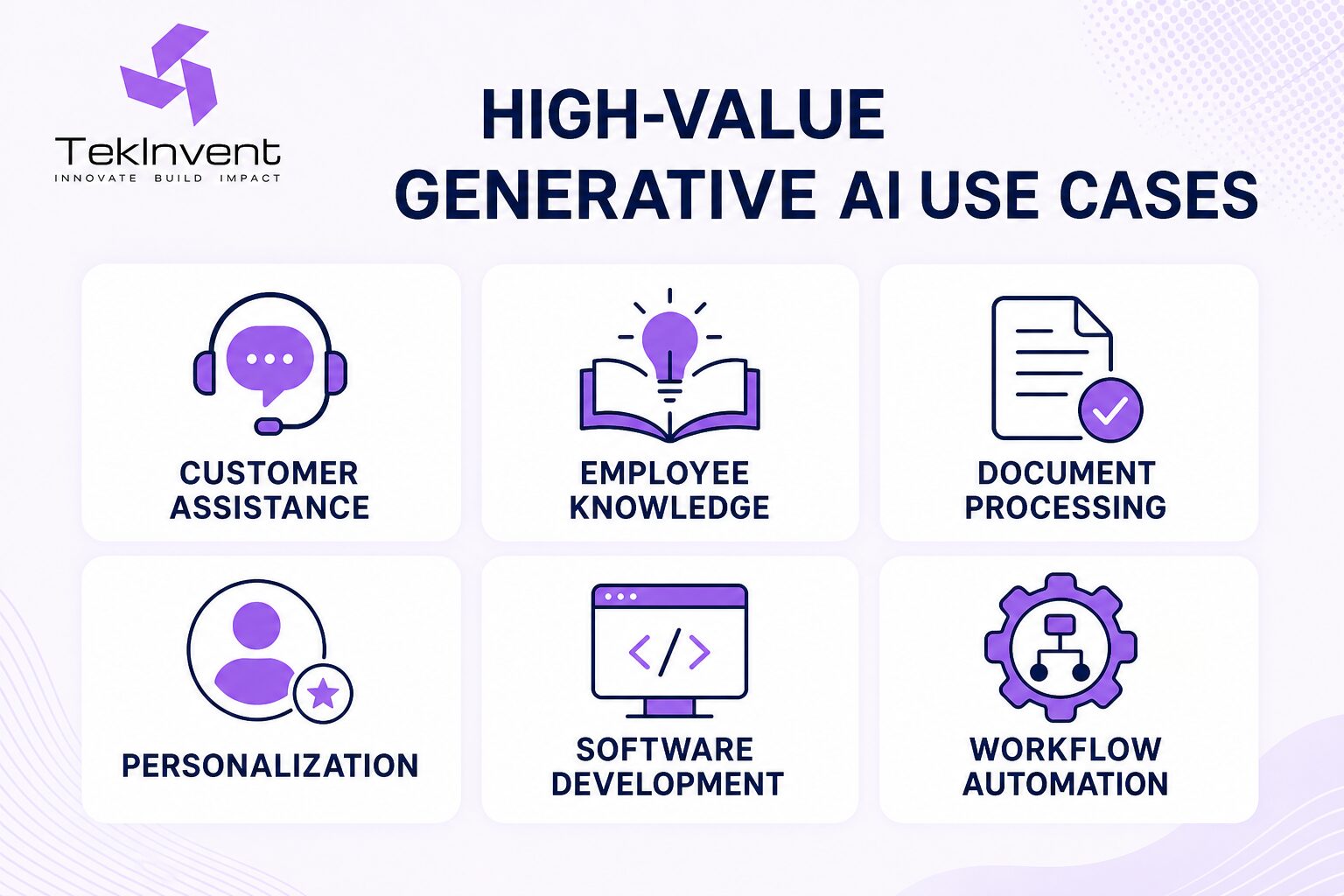
What Makes a Generative AI Use Case Valuable?
A valuable use case improves a meaningful business outcome rather than simply producing content faster.
For example, generating unlimited marketing copy has limited value if employees must spend more time correcting inaccurate claims. A knowledge assistant can be valuable when it reduces search time while maintaining accurate sources and permissions.
The business should understand the current workflow before proposing an AI solution. It should know who performs the task, how frequently it occurs, where delays happen, and what quality standard the result must meet.
The outcome also needs to be measurable. Useful metrics may include time saved, successful resolutions, document-processing speed, employee adoption, conversion rate, correction rate, or cost per completed task.
High volume alone does not make a workflow suitable. The potential impact of an incorrect result must also be considered.
Customer Service and Agent Assistance
Customer service is one of the most practical areas for generative AI because support teams work with large volumes of language and repeated information.
A customer-facing assistant can answer documented questions, guide users through processes, and collect the details needed for an employee to investigate a case.
An employee-facing assistant can summarize conversations, retrieve approved policy, suggest a response, and prepare structured case notes.
The goal should not be to prevent customers from reaching people. AI should resolve suitable questions efficiently while recognizing when an issue requires human judgment.
Account changes, refunds, medical concerns, financial decisions, and emotionally sensitive situations may require approval or direct employee involvement.
Quality should be measured through resolution success, escalation accuracy, correction rate, customer satisfaction, and response time—not only the number of conversations handled automatically.
Employee Knowledge Assistants
Employees often spend significant time searching through policies, shared drives, portals, technical documents, and internal messages.
A generative AI knowledge assistant can provide a conversational entry point into approved business information. It can retrieve relevant evidence, explain a process, summarize a document, and cite its sources.
Permissions are critical. Employees should only receive information they are authorized to access. Access restrictions should be enforced during retrieval rather than relying on the model to remember a written rule.
The assistant also needs a dependable content-update process. If a policy changes, the old version should not continue appearing as current guidance.
The strongest knowledge assistants communicate when evidence is missing and direct users to the appropriate expert instead of generating an unsupported answer.
Intelligent Document Processing
Businesses manage invoices, claims, contracts, forms, reports, applications, and correspondence. These documents often arrive in different structures and require employees to extract, compare, summarize, or reorganize information.
Generative AI can support document classification, data extraction, summarization, comparison, and preparation for review.
A system could identify relevant clauses in a contract, summarize an insurance claim, organize information from an application, or prepare a structured record from an unformatted document.
Important values should be validated before entering another business system. Dates, financial amounts, customer identifiers, and legal terms should not be accepted solely because a model produced them.
Human review should remain part of workflows involving legal obligations, healthcare decisions, payments, employment, or other high-impact outcomes.
Personalized Customer Experiences
Generative AI can adapt content and interactions according to customer context, preferences, and behavior.
An e-commerce platform may provide conversational product discovery, create relevant comparisons, or explain why an item fits a customer’s stated needs.
A financial application might explain product features in accessible language while avoiding personalized advice beyond its authorized scope.
Personalization should help the customer complete a goal rather than creating artificial familiarity. The application must explain how information is being used and respect consent, privacy, and communication preferences.
TekInvent’s ecommerce development capabilities can support personalized shopping experiences connected with dependable storefront, inventory, payment, and customer-management systems.
Sales Enablement
Sales teams work with research, meeting notes, product information, customer communications, and CRM records.
Generative AI can summarize calls, prepare account briefs, identify unanswered questions, draft follow-up messages, and turn unstructured notes into structured records.
The system should distinguish between verified customer information and model-generated suggestions. Employees must review communications before they are sent, especially when they include pricing, commitments, or regulated claims.
A sales assistant creates the most value when it reduces administrative work and helps representatives prepare more effectively. It should not generate high volumes of generic outreach that damage customer trust.
Marketing and Content Operations
Marketing teams can use generative AI for research assistance, campaign variations, outlines, creative concepts, content adaptation, and production workflows.
The technology can transform one approved source into platform-specific drafts or create variations for different audience segments.
Human editorial control remains important. AI-generated content may include inaccurate claims, weak differentiation, inconsistent brand language, or material too similar to existing sources.
The business should establish approved sources, review standards, brand rules, and fact-checking responsibilities. Quality should be judged through audience response and business impact rather than the volume of content produced.
Software Development and Modernization
Generative AI can assist software teams with code explanation, test preparation, documentation, debugging, migration planning, and repetitive implementation tasks.
It can help developers understand unfamiliar code or convert natural-language requirements into an initial implementation.
Generated code still requires professional review. It may contain security weaknesses, outdated dependencies, licensing concerns, inefficient logic, or behavior that does not match the product requirements.
AI coding tools can accelerate parts of development, but architecture, security, quality assurance, user experience, and accountability remain human responsibilities.
TekInvent’s software development company services can combine AI-assisted engineering with the product discipline needed to build reliable applications.
Reporting and Business Intelligence
Generative AI can make reports and analytics more accessible by allowing users to ask questions through natural language.
A business leader might request a summary of performance changes, ask for an explanation of unusual activity, or generate a narrative around approved metrics.
The language model should not calculate important figures independently when authoritative values exist in a database. Conventional analytics or code should perform the calculation, while the model explains the result.
Every generated insight should remain traceable to its underlying data. Users need to distinguish measured facts from model-generated interpretation.
Workflow Automation
Generative AI becomes more powerful when it participates in a controlled workflow.
A system can interpret an incoming request, extract important details, retrieve relevant knowledge, prepare a response, and route the work to the correct team.
More advanced agents may use approved tools to complete parts of the task. However, each action needs validated inputs, permissions, audit logs, and appropriate human approval.
The best workflow automation does not remove people indiscriminately. It reduces repetitive coordination while preserving human authority for exceptions and important decisions.
Industry-Specific Generative AI Applications
Healthcare organizations can use generative AI for administrative summaries, patient-information navigation, employee knowledge, and documentation support. Clinical decisions require qualified professional oversight and strong privacy safeguards.
Financial organizations may use it for document analysis, employee assistance, investigation preparation, and customer-service support. TekInvent’s fintech solutions can connect intelligent features with secure financial application architecture.
Real-estate businesses can use AI for listing assistance, property-information search, document summaries, and customer-query support. TekInvent’s real estate development capabilities can support these features within property platforms and mobile experiences.
E-commerce companies can apply generative AI to conversational discovery, product support, personalization, and content operations.
The technology may be similar across industries, but the data, user expectations, risk, and compliance requirements are different.
How to Select the Right Generative AI Use Case
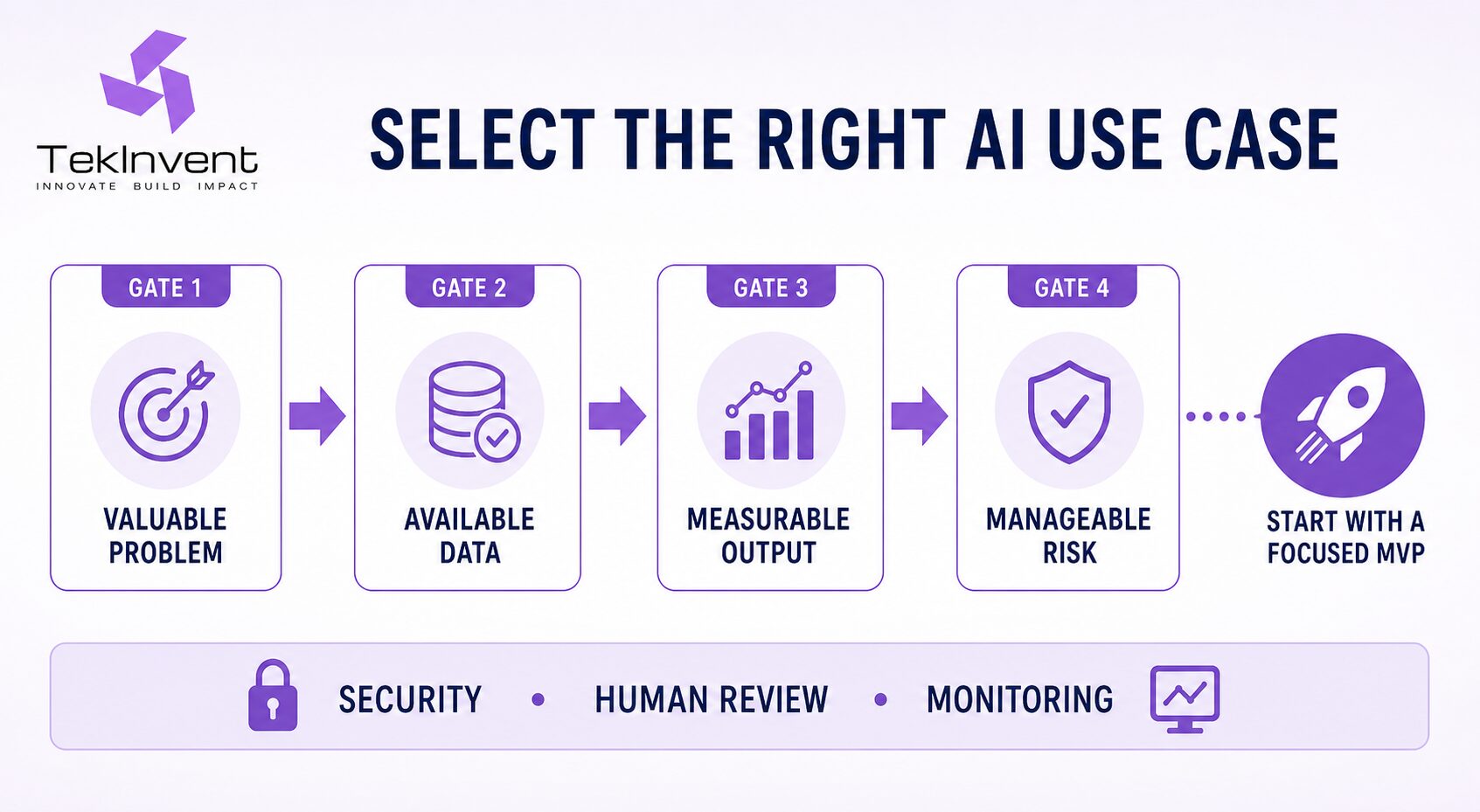
A strong opportunity should pass four decision gates.
First, it must solve a valuable problem. The business should be able to explain what delay, cost, risk, or customer frustration will improve.
Second, the required information must be available, permitted, and sufficiently reliable. A project cannot produce dependable results from inaccessible or untrusted data.
Third, the outcome must be measurable. The team needs a way to determine whether the system is more useful than the current process.
Fourth, the risk must be manageable through permissions, validation, guardrails, human review, and monitoring.
When an opportunity passes these gates, begin with a focused MVP. Test one workflow for one user group before expanding to additional departments or autonomous actions.
Generative AI Implementation Process
Development begins with discovery and workflow mapping. The team identifies users, inputs, expected outputs, data sources, integrations, and approval points.
A feasibility prototype tests whether existing models can meet the core quality requirement. The team then creates an evaluation dataset based on realistic work.
MVP development includes the model, application interface, backend services, authentication, data pipelines, integrations, analytics, and feedback controls.
A controlled pilot reveals how the system behaves with genuine users. Performance, cost, failures, and corrections should be monitored before wider deployment.
An experienced AI development company should help the organization connect generative capability with product engineering, data governance, evaluation, and ongoing operations.
Risks That Need Active Management
Generative AI may create unsupported information, misunderstand instructions, expose sensitive content, reproduce bias, or generate unsafe output.
These risks cannot be eliminated through one prompt. They require layered controls across data, application logic, model behavior, permissions, user experience, and operations.
The business should maintain clear ownership for incidents, evaluation, data updates, and model changes.
Users should understand when content is generated and when professional review is required. Trust grows when the product communicates its boundaries honestly.
Turning Use-Case Potential Into Operational Value
Generative AI offers many possibilities, but business value comes from disciplined selection rather than maximum experimentation.
The strongest starting point is a frequent, information-heavy workflow with a measurable outcome and manageable risk. The organization can then combine trusted data, secure engineering, human expertise, and continuous evaluation around that workflow.
Once the first use case proves its value, the underlying knowledge, security, monitoring, and integration foundation can support future applications.
This approach creates more than an isolated AI feature. It establishes a reusable intelligence layer that can expand across the business while remaining connected to evidence, accountability, and genuine user needs.

Build Smart with The Right Team.
We bring expertise, technology, and trust you look for in your digital journey.