
A general-purpose AI model can write fluent responses, but it does not automatically know a company’s current policies, product documentation, customer records, or private operational knowledge.
Retrieval-augmented generation, commonly known as RAG, addresses this limitation by connecting a language model with approved external information at the moment a user asks a question.
A RAG chatbot searches relevant knowledge, retrieves supporting evidence, gives the strongest context to a language model, and produces an answer grounded in that information. The interface may also show citations so users can verify where the answer came from.
This architecture is valuable for employee knowledge assistants, customer support, document research, product guidance, compliance operations, and other information-heavy workflows.
However, uploading documents to a vector database does not automatically create a dependable knowledge assistant. Production RAG chatbot development requires document governance, retrieval engineering, permissions, evaluation, security, user feedback, and continuous monitoring.
What Is a RAG Chatbot?
A RAG chatbot is a conversational AI application that retrieves information from external sources before generating an answer.
The external information may include company policies, product manuals, contracts, knowledge-base articles, technical documentation, customer records, or structured databases.
A traditional chatbot may rely on static responses or the general knowledge contained within a model. A RAG chatbot can use current, private, or specialized information without retraining the entire language model whenever a document changes.
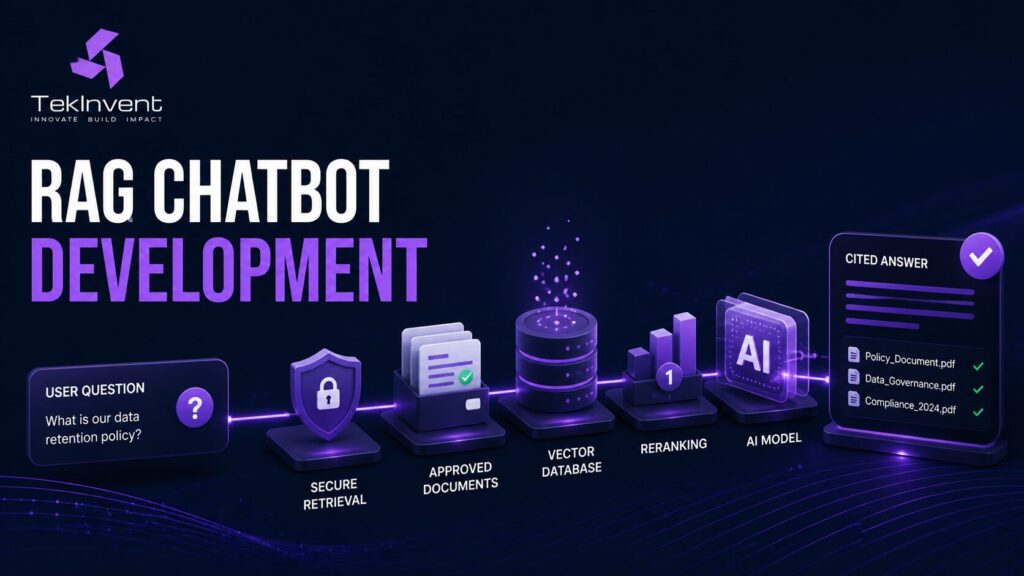
Suppose an employee asks about the company’s latest travel-expense policy. A RAG chatbot can search the approved policy library, retrieve the relevant section, generate an understandable response, and cite the source document.
The application should not answer from general model knowledge when reliable company evidence is unavailable. It should clearly state that it could not find sufficient information or route the question to an appropriate person.
How Does a RAG Chatbot Work?
The process begins when a user submits a question through a conversational interface.
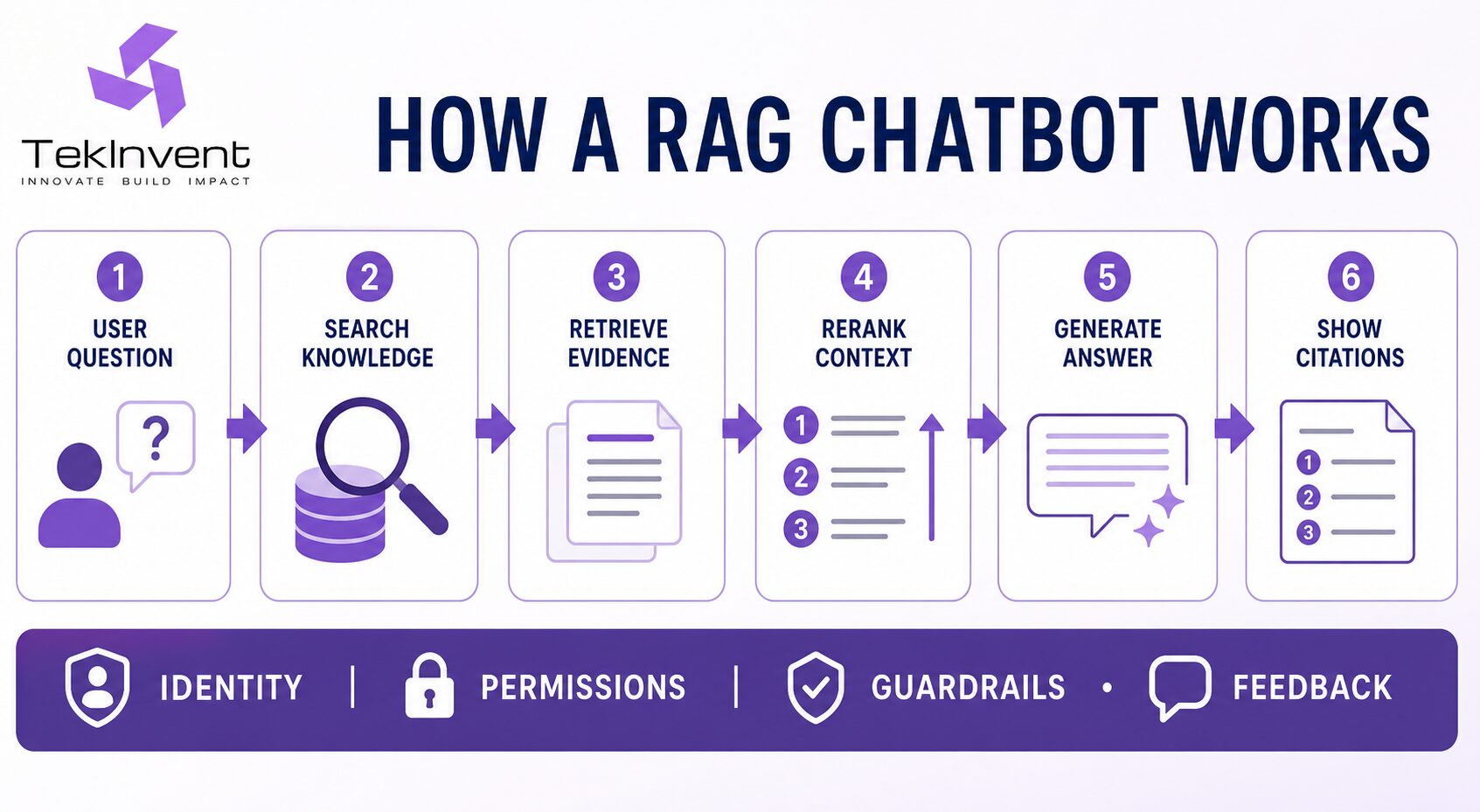
The system interprets the request and searches the knowledge index. It retrieves passages that appear relevant, applies filters such as department, region, language, date, and user permission, and then ranks the strongest evidence.
The selected information is added to the model’s context with instructions describing how it should answer. The language model uses that context to create a response, while the interface can display links or references to the supporting sources.
The complete flow can be summarized as:
User question → Search knowledge → Retrieve evidence → Rerank context → Generate answer → Show citations
Identity, permissions, guardrails, and feedback must support the entire process. They are not optional features around the final response.
RAG Chatbot vs a Standard AI Chatbot
A standard chatbot usually answers from predefined flows, model knowledge, or information manually added to its prompt.
That approach may work for simple public questions, but it becomes unreliable when answers depend on large collections of private or frequently updated information.
A RAG chatbot searches for evidence at request time. This allows businesses to update the knowledge source without retraining the language model.
RAG can improve grounding, but it does not guarantee accuracy. The retriever may select the wrong passage, the source document may be outdated, or the model may misunderstand the evidence.
The system must therefore evaluate retrieval and answer generation separately.
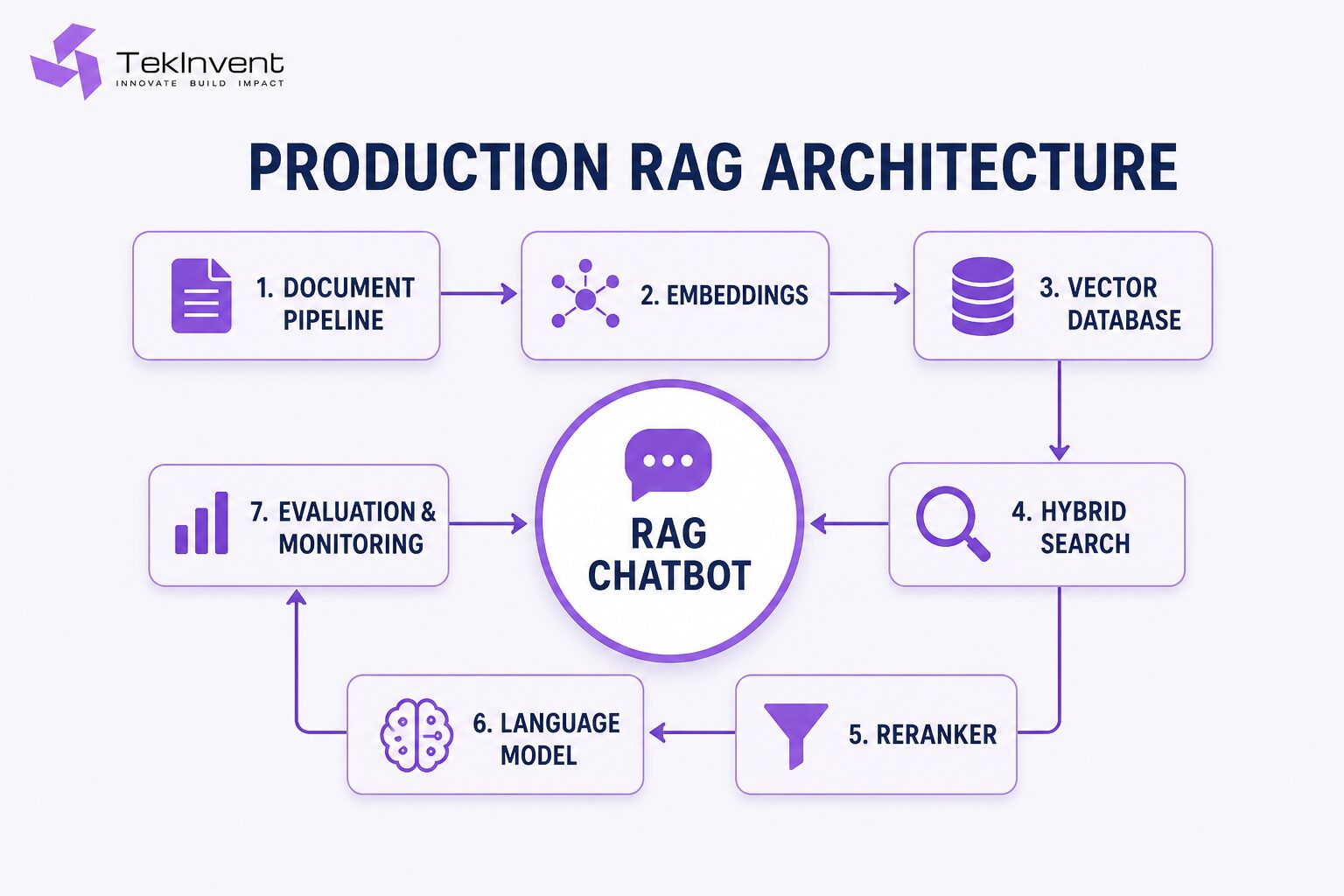
Production RAG Architecture
A production RAG chatbot includes a document pipeline, embedding model, searchable index, retriever, reranker, language model, application backend, identity system, interface, evaluation framework, and monitoring.
Document pipeline
The document pipeline collects approved information and prepares it for retrieval.
Files may require text extraction, optical character recognition, cleaning, deduplication, and restructuring. The pipeline should preserve useful elements such as titles, headings, tables, dates, product names, departments, and access levels.
Every knowledge source needs an owner and update process. A chatbot that confidently retrieves an expired policy can be more dangerous than one that admits it does not know.
Embeddings and vector database
An embedding model converts text into numerical representations that capture aspects of meaning. These embeddings are stored in a vector database optimized for semantic search.
The index should also preserve the original text and metadata. Metadata allows the system to filter results according to language, product, region, document version, or user permissions.
Hybrid search
Semantic search can identify conceptually related information even when the user and document use different wording.
Keyword search is stronger for exact product names, policy codes, legal phrases, and identifiers. Production systems often combine both methods through hybrid search.
The correct balance should be tested with actual user questions rather than selected according to a generic configuration.
Reranking
Initial search may return several possible passages. A reranker evaluates those candidates and places the strongest evidence first.
Better ranking can improve answer quality while reducing the amount of unnecessary context sent to the model. Supplying more text is not always helpful because irrelevant passages can distract the model and increase operating costs.
Language model
The language model receives the question, instructions, and retrieved evidence. It then creates an understandable response.
Model selection should consider accuracy, speed, privacy, context limits, availability, and cost. A smaller model may perform well when the retrieval system supplies clear evidence.
Evaluation and monitoring
The system needs a repeatable evaluation dataset containing real questions, expected evidence, and acceptable answers.
Monitoring should track failed searches, unsupported answers, incorrect citations, user corrections, latency, cost, access denials, and document-update failures.
TekInvent’s software development company services can support the application architecture, integrations, authentication, and operational systems surrounding a RAG chatbot.
Preparing Documents for RAG
Document quality strongly affects retrieval quality.
Large documents covering unrelated topics should be divided into smaller, self-contained sections. Clear headings and concise language make information easier for users and retrieval systems to understand.
Abbreviations and company-specific terminology should be defined. Important information contained only inside charts or images may require structured text descriptions.
Chunking should follow meaning rather than splitting every file at an arbitrary character count. A policy condition, table, or procedure may need to remain together to preserve its context.
Each chunk should carry metadata linking it to its source, title, section, date, owner, and permission level. This information supports filtering, citations, updates, and deletion.
Enforcing User Permissions
A RAG chatbot must never depend on a prompt instruction to protect confidential information.
The application should authenticate the user and enforce authorization in the retrieval layer. Unauthorized information should not enter the model context at all.
If two employees have different permissions, the same question may need to return different evidence. Access rules from the source system should remain connected with every indexed passage.
Embeddings, logs, feedback, cached responses, and conversation histories may also reveal private information. They require encryption, access controls, retention policies, and deletion procedures.
The system should record which user requested information, which sources were retrieved, and what response was produced.
Evaluating Retrieval Quality
A chatbot cannot produce a well-grounded answer when the correct evidence was never retrieved.
The evaluation process should begin by measuring whether the system finds the expected passage and where that passage appears in the ranked results.
The test dataset should include straightforward questions, conversational wording, misspellings, abbreviations, multi-part requests, ambiguous queries, outdated assumptions, and questions that have no supported answer.
Developers should change one retrieval variable at a time. This makes it possible to determine whether an improvement came from chunking, embeddings, metadata filters, hybrid search, query rewriting, or reranking.
A system tested only with questions written by its developers may perform poorly when exposed to real users.
Evaluating Generated Answers
After retrieval works reliably, the team should assess the generated response.
The answer must be factually supported, relevant to the question, complete enough to help the user, and concise enough to remain useful.
Citation accuracy deserves separate testing. A source link should genuinely support the statement next to it. Displaying a related document does not make an unsupported answer trustworthy.
The chatbot must also respond correctly when evidence is missing. Inventing an answer is a failure, while communicating uncertainty and offering escalation is appropriate behavior.
Human reviewers should evaluate tone, clarity, context, and domain-specific correctness. Confirmed failures should become regression tests for future releases.
Business Applications of RAG Chatbots
An internal knowledge assistant can help employees locate policies, processes, technical information, and operational guidance from approved sources.
A customer-support chatbot can answer product questions, explain procedures, and help users navigate documented services while escalating account-specific or sensitive cases.
Sales teams can use RAG to locate product specifications, case material, and approved messaging without searching across disconnected repositories.
Legal and compliance teams may use controlled RAG systems to explore policies and documents, but qualified professionals should remain responsible for important interpretations and decisions.
Afintech RAG solution may help employees locate approved financial procedures or product information while maintaining strict role-based permissions and human review.
RAG Chatbot Development Cost
A focused RAG chatbot MVP may cost approximately $25,000 to $70,000. A production application with permissions, multiple knowledge sources, integrations, evaluation, and monitoring may range from $70,000 to $200,000.
Enterprise systems can exceed $200,000 when they involve regulated information, high traffic, multilingual content, legacy integrations, advanced security, and complex data governance.
Ongoing costs include model inference, embeddings, vector storage, document processing, monitoring, cloud infrastructure, maintenance, and technical support.
The cheapest prototype may not provide the best route to production if the document pipeline and permission architecture must later be rebuilt.
Common RAG Development Mistakes
One common mistake is indexing every available document without determining whether it is accurate, current, authorized, or useful.
Another is using arbitrary chunking and expecting the language model to resolve missing context. Weak metadata, no reranking, and excessive retrieved text can also reduce quality.
Some teams evaluate only the final answer and never test whether retrieval found the correct evidence. Others launch without an update process, allowing obsolete documents to remain searchable.
RAG does not remove the possibility of unsupported output. A production application still needs guardrails, citations, realistic evaluation, feedback, and human escalation.
An experienced AI development company should treat knowledge governance and retrieval quality as core product responsibilities rather than secondary model settings.
Building a Knowledge Experience Users Can Trust
The next generation of business knowledge systems will not require users to remember where every policy, manual, or record is stored.
A dependable RAG chatbot can transform scattered information into an accessible experience while preserving its source, permissions, and operational context.
That future depends on more than fluent answers. It requires current documents, precise retrieval, accurate citations, secure access, measurable quality, and a clear path to human expertise.
When these components work together, the chatbot becomes more than a conversational search box. It becomes a governed knowledge layer capable of helping people move from a question to a supported decision with greater speed and confidence.

Build Smart with The Right Team.
We bring expertise, technology, and trust you look for in your digital journey.