
Security work rarely waits for the hiring market. A cloud migration needs an identity specialist before production access expands. A software release needs secure code review before launch. An audit uncovers control gaps that the existing team cannot resolve while also managing daily incidents.
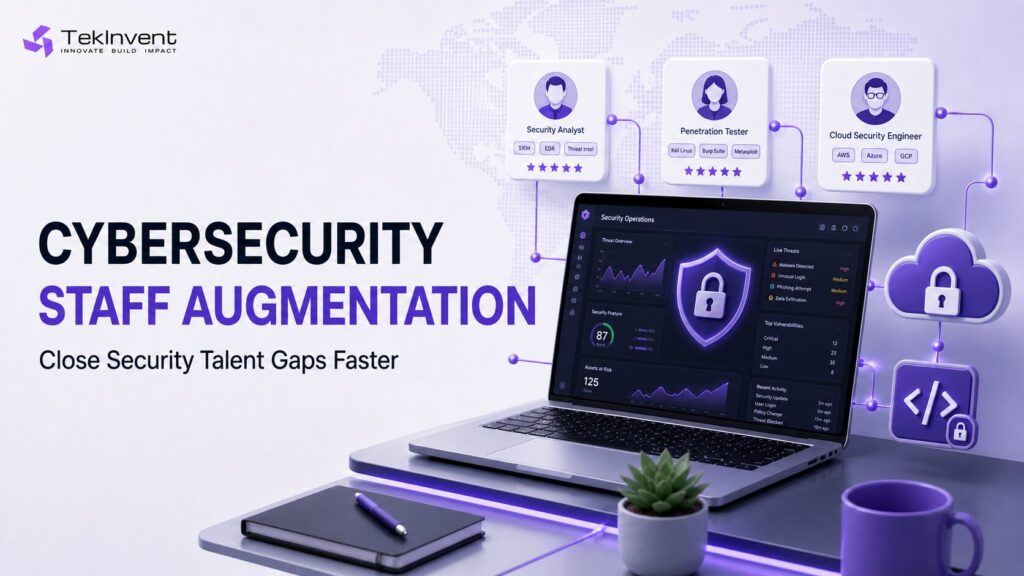
Cybersecurity staff augmentation gives US companies a practical way to add specialized security professionals to an existing team for a defined need or period. The client retains control of priorities, systems and security decisions, while an augmentation provider helps source and screen professionals with the required experience.
The model is not a substitute for security leadership or organizational accountability. It is a way to close a specific capability or capacity gap without waiting months to create and fill every permanent role.
Why Cybersecurity Skills Are Becoming Harder to Secure
Cybersecurity demand is being driven by cloud adoption, artificial intelligence, expanding software supply chains and increasingly connected business operations. Security teams must protect more identities, applications, vendors and data flows without blocking delivery.
The US Bureau of Labor Statistics projects employment of information security analysts to grow 29% between 2024 and 2034, compared with 3% across all occupations. BLS expects approximately 16,000 openings per year during that period and attributes demand partly to the growing frequency of cyberattacks, AI adoption and e-commerce. US Bureau of Labor Statistics
Demand alone does not explain the hiring difficulty. “Cybersecurity” covers many different responsibilities. A strong governance, risk and compliance analyst may not be the right person to secure Kubernetes workloads. A penetration tester may not have the experience to build a secure identity architecture.
Hiring becomes slower when a company advertises one broad security role but expects several unrelated capabilities. The first step is therefore to define the work, environment and outcome before searching for talent.
What Is Cybersecurity Staff Augmentation?
Cybersecurity staff augmentation is an engagement model in which external security professionals work within a client’s existing organization. They may join a security, infrastructure, product or software engineering team and operate under the client’s management and policies.
The engagement can involve one specialist or several complementary roles. A company might add a cloud security engineer during an AWS migration, a DevSecOps specialist to improve the software delivery pipeline or a security analyst to increase monitoring coverage.
This differs from handing complete responsibility for security operations to a managed provider. In an augmented arrangement, the client usually continues to decide what work is performed, how priorities are set and who approves security changes.
That control makes the model suitable for companies that already have internal leadership and institutional knowledge but need additional expertise or capacity.
When Should a Company Augment Its Cybersecurity Team?
Augmentation is most effective when the security gap can be connected to a specific risk, initiative or operating requirement. Adding general capacity without defining ownership often creates confusion rather than protection.
Common triggers include a cloud migration, security remediation program, compliance deadline, application launch, merger integration or prolonged vacancy in a difficult-to-hire role. It can also support temporary monitoring requirements or provide expertise while permanent recruitment continues.
A company should consider an augmented specialist when delay has a measurable consequence. That consequence might be an exposed system, a blocked release, an overdue remediation item or an internal team spending too much time outside its core responsibilities.
Augmentation is less suitable when no internal person can own security decisions. An outside professional can advise, implement and document, but the organization must retain accountability for risk acceptance, business priorities and access approval.
Cybersecurity Roles That Can Be Augmented
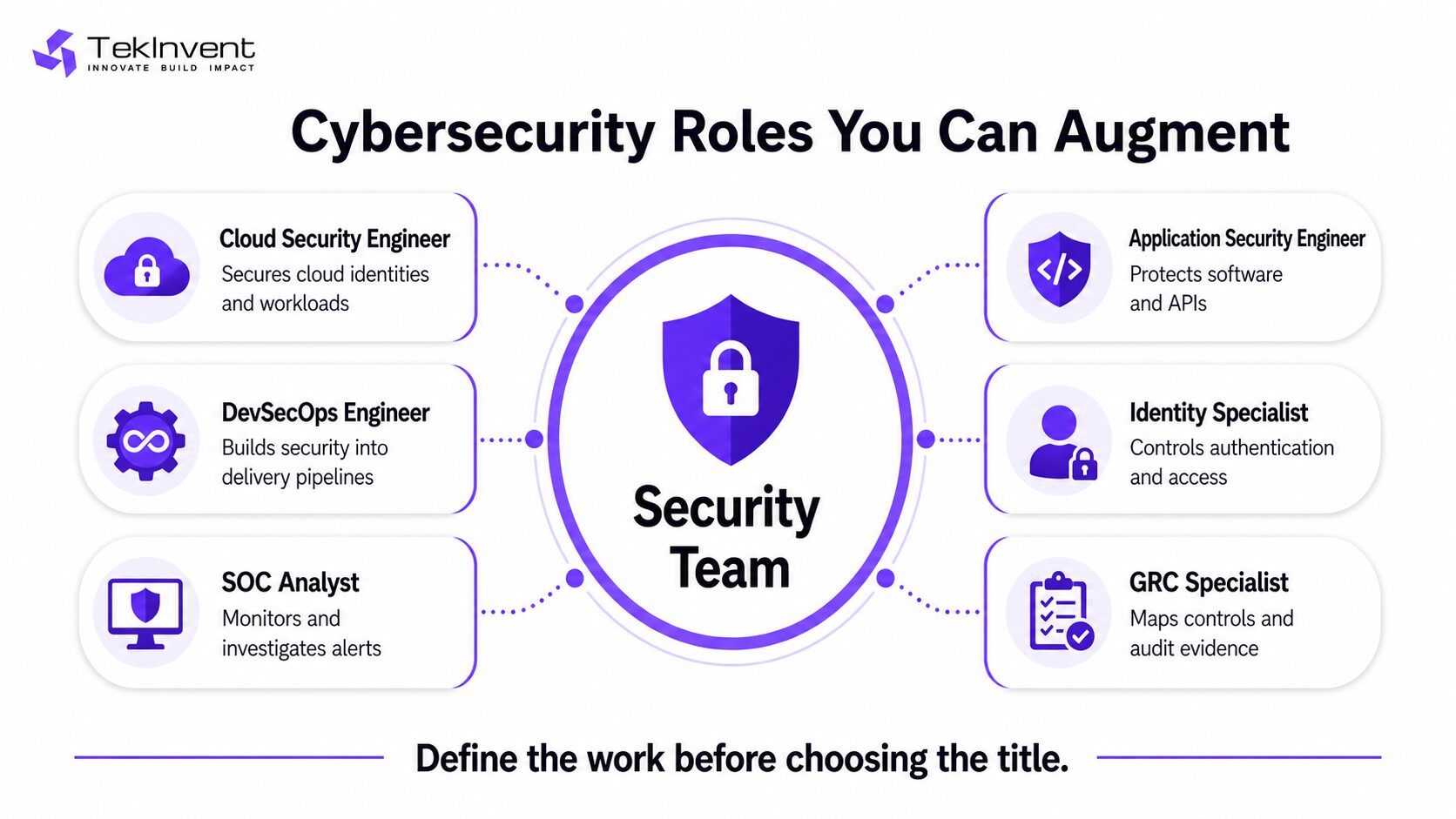
The right role should be selected from the work that must be completed, not from a generic job title. NIST’s NICE Workforce Framework provides a common language for describing cybersecurity work through tasks, knowledge and skills.
Organizations can use that structure to create clearer role requirements and evaluate candidates more consistently. NIST NICE Framework
| Role | Typical contribution | Useful when |
| Security engineer | Implements technical protections and resolves control gaps | Systems require hands-on hardening or remediation |
| Cloud security engineer | Secures identities, workloads, networks and cloud configurations | Migrating to or expanding AWS, Azure or Google Cloud |
| DevSecOps engineer | Adds security testing and policy controls to delivery pipelines | Security checks are slowing releases or happening too late |
| SOC analyst | Monitors alerts, investigates events and supports response | Existing monitoring coverage or investigation capacity is insufficient |
| Application security engineer | Reviews architecture, code and application vulnerabilities | Building or releasing customer-facing software |
| Identity and access specialist | Designs authentication, authorization and privileged access | Access has grown complex across cloud and business systems |
| Governance, risk and compliance specialist | Maps controls, gathers evidence and coordinates remediation | Preparing for audits or regulated customer requirements |
| Incident response specialist | Supports containment, investigation and recovery | Responding to an active event or strengthening readiness |
Some initiatives require a combination. A secure cloud migration, for example, may need a cloud security engineer for architecture, an identity specialist for access and a compliance professional to connect implementation with control evidence.
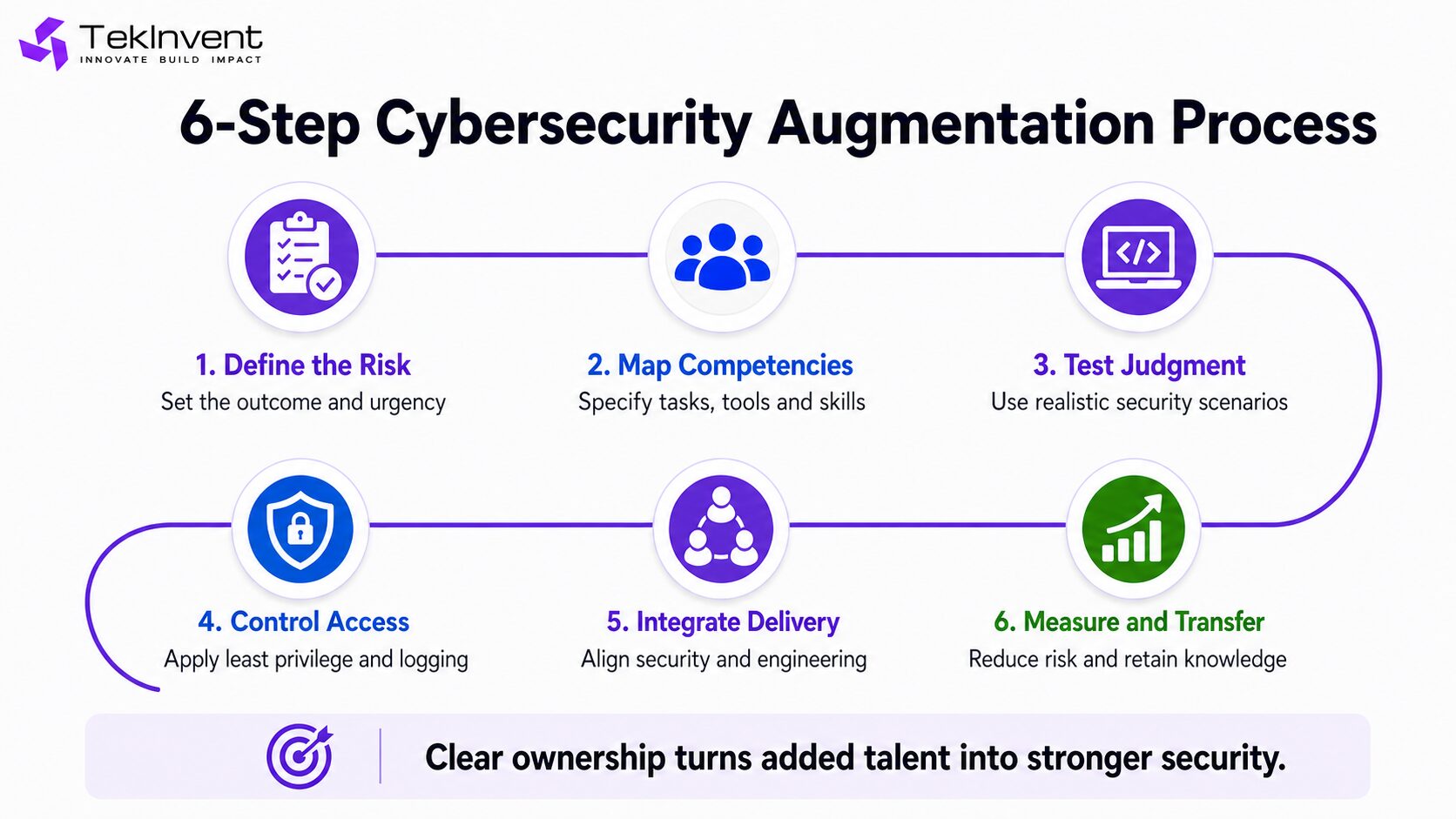
A Six-Step Cybersecurity Augmentation Process
1. Define the Risk and Desired Outcome
Begin with the security result rather than a list of tools. “We need a cybersecurity engineer” is vague. “We need to remediate critical cloud identity findings and create repeatable access reviews before our customer audit” defines the outcome, environment and urgency.
Document the current state, target state, deadline and person authorized to accept residual risk. This makes candidate evaluation more relevant and gives the augmented professional a meaningful definition of done.
2. Translate the Outcome Into Tasks and Competencies
Describe the work the specialist will perform during the first 30, 60 and 90 days. Identify required platforms, regulations, development practices and communication responsibilities.
Separate essential experience from preferences. A certification may support credibility, but it should not replace evidence that a candidate has solved comparable problems in a production environment.
3. Evaluate Practical Security Judgment
Cybersecurity interviews should test reasoning, not memorized terminology. Present a realistic scenario and ask the candidate to explain how they would gather evidence, prioritize risks, implement safeguards and communicate tradeoffs.
A cloud security candidate should be able to discuss identity boundaries, logging, network architecture, secrets and configuration drift. A DevSecOps candidate should explain how to introduce scanning and policy gates without creating a pipeline that developers bypass.
Ask candidates about a decision that did not work as expected. Experienced professionals can normally describe the constraint, adjustment and lesson without pretending every implementation was perfect.
4. Establish Access and Operating Controls
Augmented specialists should receive only the access needed for their work. Use named accounts, multifactor authentication, role-based permissions, logging and defined approval paths. Avoid shared administrator credentials.
Production changes should follow the client’s review and change-management process. Emergency access must be time-limited and monitored.
When an engagement ends, credentials, tokens, repositories and third-party access should be removed through a documented offboarding procedure.
5. Integrate the Specialist With Delivery Teams
Security professionals create more value when they can work with the people designing and operating the system. Include the augmented specialist in relevant architecture discussions, sprint planning and incident reviews instead of treating security as a final approval gate.
Assign an internal owner who can answer questions and resolve conflicts. Make responsibilities explicit: the specialist may recommend a control, an engineering owner may implement it and an accountable executive may accept any remaining risk.
6. Measure Outcomes and Transfer Knowledge
Track evidence of risk reduction rather than hours or raw activity. Useful measures may include critical findings closed, time to remediate, detection coverage, privileged accounts reviewed, pipeline controls adopted or incident-response actions completed.
Require documentation as work progresses. Runbooks, architecture decisions, threat models, control mappings and remediation history should remain with the client. Knowledge transfer should not be postponed until the final week.
How to Evaluate a Cybersecurity Augmentation Provider
A provider should demonstrate how it verifies role-specific ability. Ask who conducts technical screening, what practical assessment is used and how experience in regulated or sensitive environments is confirmed.
Review how the provider handles confidentiality, candidate identity, background checks, subcontracting and security incidents. Do not assume that a generic staffing agreement covers source code, production access or regulated data.
The provider should also be willing to narrow the role. If every request produces a generic “security engineer” profile, the sourcing process is unlikely to distinguish between cloud security, application security, operations and compliance.
Before work begins, use an IT staff augmentation contract checklist to confirm intellectual-property ownership, confidentiality, access obligations, replacement terms and offboarding responsibilities.
Security and Compliance Considerations
An augmentation contract should define what information the professional may access, where work may occur, which tools are approved and how data must be handled. It should also specify incident notification, return or deletion of information and cooperation during investigations.
Technical controls remain essential even with strong contracts. Apply least privilege, environment separation, code review, credential rotation, endpoint requirements and centralized logging in proportion to the sensitivity of the work.
Regulated organizations should involve qualified legal, privacy and compliance professionals when determining their obligations. A staffing provider can supply technical expertise, but it should not be treated as the final authority on whether an organization complies with a particular law or contract.
Companies handling patient information can review the additional considerations surrounding healthcare IT staff augmentation.
Financial technology organizations should also account for their specific customer, regulatory and transaction risks when planning fintech staff augmentation.
How Much Does Cybersecurity Staff Augmentation Cost?
Cost depends on specialization, seniority, location, schedule and the sensitivity of the environment. Incident response, cloud architecture and advanced application security generally command different rates from routine monitoring or documentation work.
Compare providers using total engagement value rather than hourly rate alone. Consider candidate quality, screening time, onboarding effort, management overhead, replacement support and the financial impact of leaving the problem unresolved.
A lower-cost candidate can become expensive if weak judgment creates rework or leaves critical exposure in place. A senior specialist may cost more per hour while resolving the issue faster and leaving the internal team with a stronger operating process.
Need specialized security expertise without waiting through a long recruitment cycle? TekInvent can help define the role, screen suitable professionals and build an augmentation plan aligned with your environment.
Risks to Control in an Augmented Security Engagement
The model introduces risks if access, ownership and accountability are vague. Common problems include excessive permissions, undocumented decisions, inconsistent screening and dependence on one external person.
These concerns can be reduced with role clarity, contractual controls, least-privilege access, peer review and continuous documentation.
This detailed guide to staff augmentation risks explains how to address broader operational, security and continuity concerns before they affect delivery.
Do not allow urgency to eliminate verification. A security professional may receive access to some of the company’s most sensitive systems. Identity, qualifications, references and relevant production experience should be confirmed before access is granted.
Cybersecurity Staff Augmentation vs Managed Security Services
Augmentation and managed security services solve different problems. With augmentation, individuals join the client’s workflow and operate under its direction. With a managed service, a provider typically delivers an ongoing function against a defined service scope and service levels.
Augmentation is often appropriate when the client needs a specific capability while retaining close control. A managed service may fit a standardized function such as continuous monitoring when the client prefers the provider to manage staffing, process and coverage.
Some companies use both. A managed detection provider can monitor alerts while an augmented cloud security engineer works with internal teams to remediate architecture and access issues.

Build Smart with The Right Team.
We bring expertise, technology, and trust you look for in your digital journey.