

In today’s highly competitive software development landscape, speed, quality, and cost efficiency have become the foundation of digital success. As businesses race to innovate, delivering powerful applications faster than ever is no longer optional.
So how can a mobile app development company build next-generation apps quickly without sacrificing user expectations or performance? This is where Rapid Application Development (RAD) comes in.
RAD is an approach that prioritizes fast development cycles through continuous prototyping, testing, and iteration. It enables teams to accelerate product launches, improve time-to-market, and maintain high quality throughout the development process. By streamlining workflows and reducing rework, RAD also helps lower development costs while making custom software creation more flexible and efficient.
That said, achieving strong results with RAD depends heavily on choosing the right development tools. Developers need a clear understanding of platform capabilities, performance benchmarks, and project requirements before making a decision.
To help with that, we’ve curated a list of the top rapid development tools, evaluated based on features, functionality, and user feedback.
Let’s dive in.
What is Rapid Mobile Application Development (RMAD)?

Rapid Mobile Application Development (RMAD) is an approach to building mobile applications that focuses on speed, flexibility, and continuous iteration. Instead of following long, rigid development cycles, RMAD enables teams to design, develop, test, and deploy mobile apps in shorter timeframes using visual development tools, reusable components, and agile workflows.
RMAD platforms often rely on low-code or no-code environments, pre-built templates, and drag-and-drop interfaces that reduce the need for extensive manual coding. This allows developers and businesses to rapidly prototype ideas, validate functionality, and refine features based on real user feedback. This also means that they don’t have to compromise app performance or scalability.
One of the core advantages of RMAD is its ability to adapt quickly to changing business requirements. As user expectations evolve or market conditions shift, teams can make updates and improvements in real time, ensuring the application stays relevant and competitive.
In 2026, RMAD plays a critical role in helping businesses accelerate digital transformation, reduce development costs, and launch feature-rich mobile apps faster. This makes RMAD a strategic choice for startups, enterprises, and fast-growing digital brands alike.
How Does RMAD Work for Businesses?
Rapid Mobile Application Development (RMAD) works as a strategic enabler for businesses by removing traditional barriers to mobile app innovation. Instead of being limited by long timelines, high costs, or rigid development structures, companies gain the ability to move faster while staying aligned with market demands.
For businesses, RMAD supports quicker go-to-market strategies, allowing new products, features, or updates to be launched ahead of competitors. This speed helps brands respond to user feedback, industry trends, and evolving customer expectations without major disruptions.
RMAD also improves collaboration across teams. Business stakeholders, designers, and developers can stay aligned throughout the app’s lifecycle, ensuring that the final product reflects both technical standards and business objectives. This alignment reduces misunderstandings, rework, and unnecessary delays.
From a growth perspective, RMAD offers scalability and adaptability. As businesses expand or pivot, applications can evolve alongside them to support new integrations, features, and user demands without requiring complete redevelopment.
Overall, RMAD helps businesses innovate with confidence by balancing speed, flexibility, and quality, making it an ideal approach for organizations aiming to stay competitive in a digital-first economy.
The Four Core Stages of Rapid Mobile Application Development
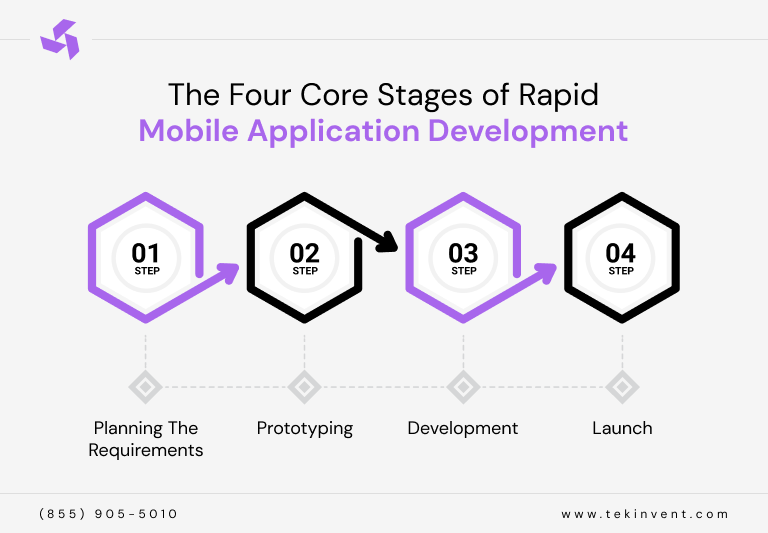
Rapid Application Development follows a streamlined framework designed to keep projects flexible, fast, and user-focused. Below are the four fundamental stages that define the RAD approach.
1. Planning the Requirements
Unlike traditional development models that rely on detailed, fixed specifications from the start, RAD begins with high-level requirements. The goal is to understand overall business objectives rather than document every technical detail upfront. This broader scope allows teams to refine and prioritize specific requirements throughout the development lifecycle as the product evolves.
2. Prototyping
This stage focuses on quickly turning ideas into working models. Developers build multiple prototypes that showcase different features and functionality, allowing stakeholders to review and provide early feedback. These prototypes are often lightweight and feature-focused, designed to validate concepts rather than represent the final product. The emphasis is on speed, experimentation, and alignment before moving forward.
3. Development
During the construction phase, the approved prototype is transformed into a fully functional application. Development teams expand on the initial model, integrate features, improve performance, and address feedback. Continuous testing and reviews play a major role here, helping teams resolve bugs, refine user experience, and adapt to any changes in direction. This stage may vary in length depending on project complexity and feedback cycles.
4. Launch
The final stage involves releasing the application into a live environment. This includes performance testing, final configurations, documentation, and quality checks to ensure a smooth launch. Teams also focus on resolving any remaining issues, applying final updates, and preparing the app for real-world usage. Once deployed, the application is ready for users, with maintenance and optimization continuing as needed.
Pros of Rapid Mobile Application Development
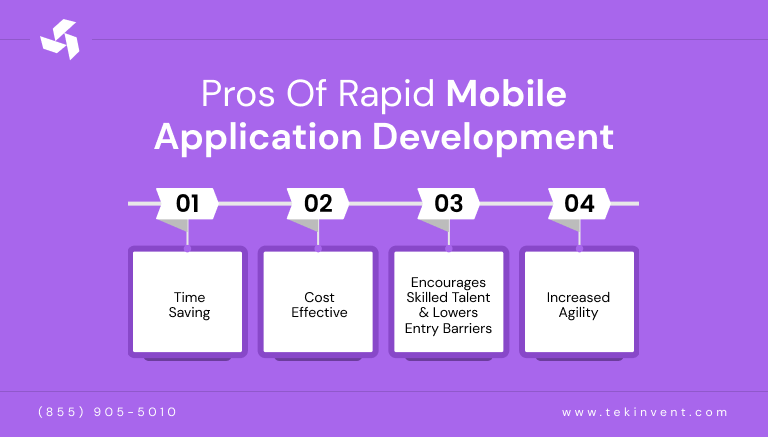
Rapid Mobile Application Development (RMAD) offers several advantages that make it a preferred choice for businesses aiming to innovate faster and smarter. Below are some of the key benefits.
1. Time-Saving
RMAD significantly reduces development timelines by enabling faster iterations and early validation. Applications can be built, tested, and refined in shorter cycles, allowing businesses to launch products and features much sooner compared to traditional development approaches.
2. Cost-Effective
By minimizing extensive coding and reducing rework, RMAD helps lower overall development expenses. Early feedback and continuous refinement prevent costly changes later in the project, making RMAD a budget-friendly option for startups and enterprises alike.
3. Encourages Skilled Talent and Lowers Entry Barriers
RMAD empowers experienced developers to work more efficiently while also making mobile app development more accessible to newer professionals. With visual tools and reusable components, developers can focus on innovation and problem-solving rather than repetitive tasks, fostering skill growth across teams.
4. Increased Agility
One of RMAD’s strongest advantages is its adaptability. Businesses can respond quickly to market shifts, user feedback, and evolving requirements without disrupting the entire application. This agility ensures apps remain relevant, competitive, and aligned with business goals over time.
Cons of Rapid Mobile Application Development
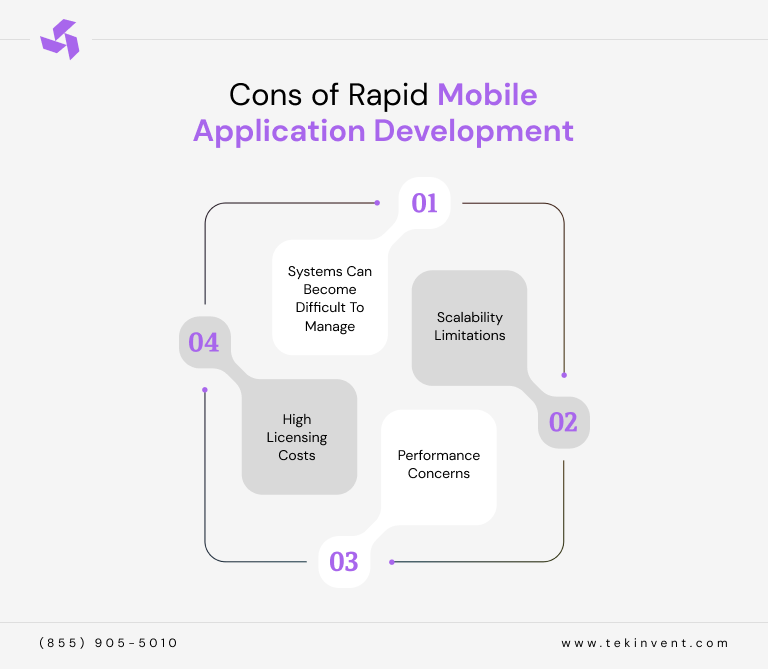
While Rapid Mobile Application Development (RMAD) offers speed and flexibility, it also comes with certain limitations that businesses should consider before adopting this approach.
1. Systems Can Become Difficult to Manage
As applications evolve rapidly, frequent updates and feature additions can lead to complex system structures. Without proper planning and governance, this complexity may result in maintenance challenges and reduced long-term manageability.
2. Scalability Limitations
Some RMAD platforms are better suited for small to mid-sized applications. As user bases grow or requirements become more complex, scaling the application may require additional customization or a transition to more traditional development methods.
3. Performance Concerns
Because RMAD often relies on pre-built components and abstraction layers, performance optimization can be limited. In performance-critical or resource-intensive applications, this may lead to slower response times or reduced efficiency compared to fully custom-built solutions.
4. High Licensing Costs
Many RMAD tools come with subscription-based pricing or enterprise licensing fees. Although, development costs reduce majorly, the drawback is long-term licensing expenses, especially for businesses planning large-scale or long-term projects.
Top Rapid Mobile Application Development Tools for Development in 2026
Enterprise application development tools are specialized platforms designed to support the creation, deployment, and management of large-scale software solutions. They provide the technical framework needed to handle complex business operations, including custom application development, customer service workflows, compliance management, and mission-critical enterprise initiatives.
By offering scalability, security, and centralized control, these tools enable organizations to modernize systems, streamline operations, and respond quickly to evolving business demands.
Here are the top tools for Rapid Mobile Application Development (RMAD) in 2026:
1. Mendix
Mendix is a low-code application development platform designed for building enterprise-grade web and mobile applications. It enables organizations to accelerate development while maintaining strong governance, security, and scalability. Mendix is commonly used for modernizing legacy systems, building internal tools, and supporting complex business workflows across large teams.
2. OutSystems
OutSystems focuses on high-performance application development for enterprises that require speed without sacrificing control. The platform supports full-stack development, allowing teams to create scalable mobile and web apps while integrating seamlessly with existing systems. Its robust architecture makes it suitable for mission-critical applications.
3. Microsoft Power Apps
Microsoft Power Apps allows businesses to build custom applications within the Microsoft ecosystem. It is particularly effective for organizations already using Microsoft 365, Azure, or Dynamics. The platform empowers business users to create data-driven apps while ensuring compliance, security, and centralized management through Microsoft’s infrastructure.
4. Zoho Creator
Zoho Creator is a low-code platform built for rapid application development with a focus on business automation. It enables companies to create custom apps for internal processes, workflows, and data management. With strong integration across the Zoho suite, it is a practical choice for small to mid-sized enterprises.
5. Appian
Appian is an enterprise low-code automation platform that combines application development with process management. It is widely used for building compliance-driven, workflow-heavy applications in regulated industries. Appian emphasizes security, scalability, and operational efficiency across large organizations.
6. FlutterFlow
FlutterFlow is a visual app builder based on Google’s Flutter framework, enabling teams to create cross-platform mobile applications quickly. It offers greater design flexibility and code ownership compared to traditional low-code tools, making it popular for startups and businesses looking to build scalable, user-centric mobile apps.
Why Use Rapid Mobile Application Development?
Rapid Mobile Application Development (RMAD) allows businesses to build, test, and launch mobile applications faster without compromising functionality or user experience. In a competitive digital environment, speed-to-market can directly impact growth and customer retention. RMAD reduces development complexity by using flexible frameworks, reusable components, and agile methodologies.
This approach enables faster iterations, early feedback integration, and continuous improvement. For businesses looking to innovate, validate ideas quickly, or roll out updates efficiently, RMAD offers a practical balance between speed, quality, and cost control. It also supports better collaboration between development teams and stakeholders, ensuring the final product aligns with real business needs and user expectations.
When to Use Rapid Mobile Application Development for Your Business?
RMAD is best suited for businesses that need quick deployment, frequent updates, or rapid experimentation. Startups can use RMAD to validate ideas and reach the market faster, while enterprises can rely on it to modernize legacy systems or build internal workflow applications.
It is especially effective when requirements are expected to evolve over time or when customer feedback plays a critical role in shaping the product. Businesses facing tight deadlines, limited budgets, or competitive pressure often benefit from RMAD’s flexibility. If your organization prioritizes adaptability, faster releases, and reduced development risks, RMAD can be a strong strategic choice.
What Are the Effects of Rapid Mobile Application Development on Businesses?
Rapid Mobile Application Development significantly influences how businesses innovate and operate digitally. It shortens development cycles, allowing organizations to respond quickly to market changes and user demands. RMAD also improves collaboration by bridging the gap between technical teams and business stakeholders. Over time, this leads to better-aligned products, fewer costly revisions, and improved operational efficiency.
Businesses adopting RMAD often experience reduced development costs, faster product launches, and greater flexibility in scaling applications. However, success depends on selecting the right tools and maintaining proper governance to ensure long-term performance, security, and maintainability.
What Industries Benefit Most From Rapid Mobile Application Development?
Industries such as finance, healthcare, retail, logistics, and education benefit significantly from RMAD. These sectors often require frequent updates, process automation, and user-centric applications. RMAD allows organizations in these industries to respond quickly to regulatory changes, customer needs, and market trends while maintaining performance and security standards.
Final Thoughts
Rapid Mobile Application Development has become a strategic advantage for businesses aiming to innovate faster in 2026 and beyond. While it may not suit every use case, RMAD offers a balanced approach to speed, flexibility, and cost-efficiency. When paired with the right tools and expertise, it enables businesses to build scalable, high-quality mobile applications with confidence. So, contact us now and let’s build your app!

Build Smart with The Right Team.
We bring expertise, technology, and trust you look for in your digital journey.