
With the technologies evolving and technical trends moving faster than ever, choosing between iOS and Android is no longer an option; it’s a necessity. In fact, it’s become a necessity because your users are everywhere – whether it’s Android or iOS. Luckily, companies don’t need to pay twice for two different apps since you can hire a cross platform app development company!
Cross-platform app development is a shortcut to building a single app on multiple operating systems at the same time and this can be done quickly on a budget. Thinking about which cross-platform framework is best for your app? Then read our blog further!
What Are Cross-Platform Frameworks?
If you haven’t caught on by now, cross-platform frameworks are basically software used for creating a single app on multiple operating systems. The apps built using cross-platform frameworks can run on Android, iOS, Windows, Blackberry and more.
It’s the most popular method in the mobile app development domain today and the one everyone prefers.
Features of Cross-Platform Frameworks
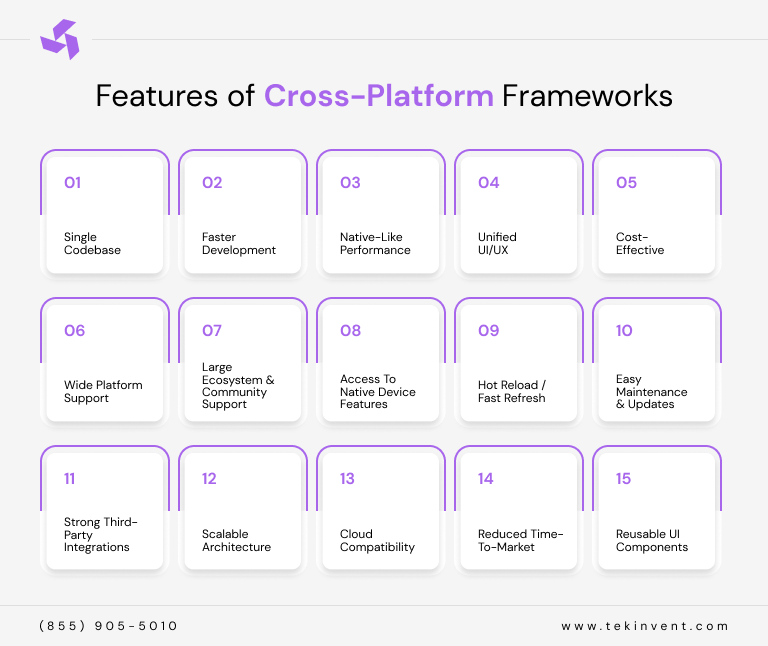
Just because cross-platform frameworks are the easier choice for mobile app development; it doesn’t mean they don’t offer many features. In fact, they come equipped with numerous features that make it robust while being economical.
1. Single Codebase
Even though it’s a cross-platform app, it doesn’t mean the development team will be creating different apps or making any changes platform-wise. In fact, when developers use cross-platform frameworks, all they do is write the app code once and deploy it on every platform.
2. Faster Development
Since the development team is only writing the code once, it cuts down the development time by half. This also ensures that you can release your mobile app in time.
3. Native-Like Performance
If you use cross-platform frameworks that are modern then your mobile app is a lot smoother, almost native-like. What this means is maximum performance, more memory utilization, and a seamless user experience on every platform.
4. Unified UI/UX
The single codebase allows for a unified and mostly same UI/UX design on every version of the app. There might be some tweaks but those aren’t too major or time-consuming.
5. Cost-Effective
Of course, since the development team only has to write a single codebase, it means they technically only charge for one mobile app. Your cross-platform mobile app won’t require separate iOS and Android teams which results in lower development and maintenance costs.
6. Wide Platform Support
Cross-platform mobile apps don’t require separate app deployment on every platform. Whether you’ve built an app for Android, iOS, Windows, macOS, or Linux; there’s only one deployment needed for the cross-platform app.
7. Large Ecosystem & Community Support
Since cross-platform frameworks are popular for mobile app development, that also means these frameworks have a large community. The popularity has enabled engineers to create numerous plug-ins, libraries, and a wide variety of features.
8. Access to Native Device Features
With a cross-platform mobile app, you can access native modules as well. These modules come equipped with camera, GPS, Bluetooth, sensors, and a lot more.
9. Hot Reload / Fast Refresh
Hot reload or fast refresh is a common process that the development team runs in case of any software updates during the app development. Cross-platform frameworks are designed to cater every update without having to rebuild the app.
10. Easy Maintenance & Updates
Since cross-platform frameworks allow you to deploy a single app on multiple platforms, they also allow you to push bug fixes and updates all at once. This means, you can
11. Strong Third-Party Integrations
Due to the flexible nature, it’s extremely easy to integrate third-party plugins, APIs, maps, authentication and more on cross-platform apps. This allows you to make a feature-rich cross-platform mobile app.
12. Scalable Architecture
Once a cross-platform app is built and deployed, every brand has the option to scale the app as needed. Cross-platform apps offer the flexibility of growing with a modular code structure to ensure uninterrupted seamless user experience.
13. Cloud Compatibility
Cross-platform frameworks offer smooth integration with cloud services, APIs, and backend systems. This enables secure data storage, real-time syncing, and scalable performance, ensuring apps run efficiently across different devices and environments without extra development effort.
14. Reduced Time-to-Market
These frameworks significantly speed up development by using a single codebase for multiple platforms. This reduces coding time, testing cycles, and deployment efforts which helps startups and businesses launch MVPs or full products faster and more cost-effectively.
15. Reusable UI Components
Cross-platform frameworks provide ready-made UI components and widgets, eliminating repetitive design work. Developers can reuse elements across platforms, ensuring consistent layouts, smoother development workflows, and reduced time spent on building interfaces from scratch.
The Best Cross-Platform Frameworks
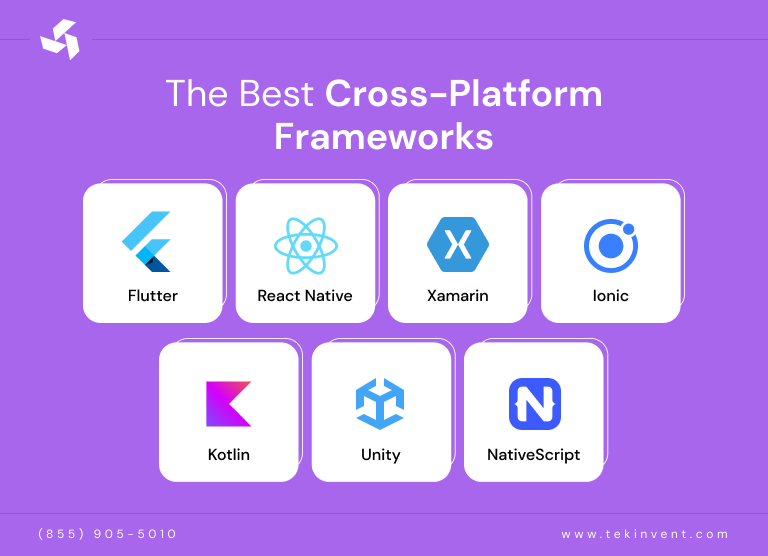
So, what are the BEST cross-platform frameworks in 2025? Here is the list of frameworks that you can pick from with your eyes closed.
1. Flutter
Flutter uses a single Dart codebase to deliver fast, native-like apps across platforms. Its rich widget library, smooth performance, and hot reload feature make it ideal for stunning, scalable cross-platform applications.
2. React Native
React Native enables cross-platform app development using JavaScript and reusable components. Backed by Meta, it offers strong performance, native modules, large community support, and efficient development for both Android and iOS applications.
3. Xamarin (Now .NET MAUI)
Xamarin, now .NET MAUI, allows developers to build cross-platform apps using C#. It offers native performance, strong Microsoft support, and a unified project structure that simplifies development, maintenance, and multi-platform deployment.
4. Ionic
Ionic uses web technologies like HTML, CSS, and JavaScript; to create fast hybrid apps. It’s ideal for content-based apps, offering an extensive UI library, rapid development, and integration capabilities using frameworks like Angular, React, or Vue.
5. Kotlin Multiplatform Mobile (KMM)
KMM enables sharing core business logic between Android and iOS while keeping native UI. It improves code efficiency, reduces bugs, and offers flexibility, making it perfect for performance-focused apps requiring deeper platform integration.
6. Unity (For Games & 3D Apps)
Unity is the leading framework for mobile games, AR, and 3D applications. Its powerful engine, asset marketplace, and cross-platform exporting deliver immersive experiences across devices with high-quality graphics and smooth performance.
7. NativeScript
NativeScript allows building truly native mobile apps with JavaScript, TypeScript, or Angular. It gives direct access to native APIs, ensuring strong performance, customizable UI, and flexibility for teams preferring web technologies in mobile development.
Cross-platform Frameworks You Should Avoid
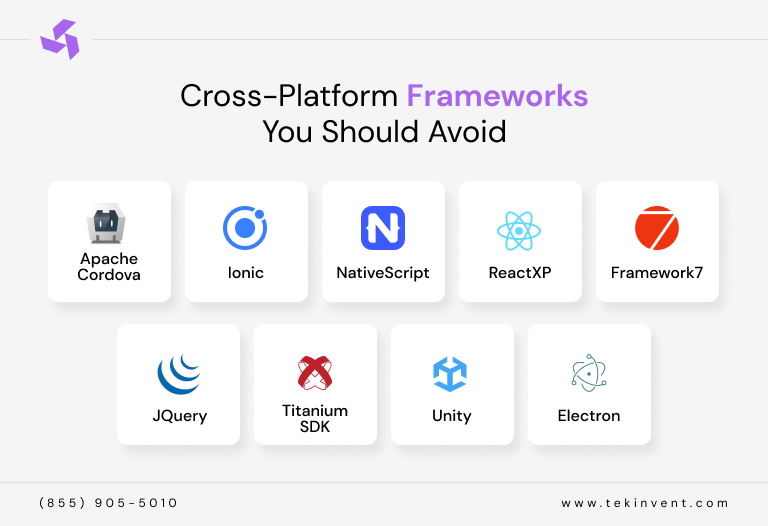
Some cross-platform frameworks are outdated, unsupported, or deliver poor performance. Avoiding these options helps ensure better app speed, smoother user experience, long-term scalability, and reliable development, especially for businesses building modern, future-ready mobile applications.
1. Apache Cordova (PhoneGap)
Cordova is outdated, slow, and heavily dependent on WebView, resulting in poor performance and limited native capabilities. With discontinued support and declining community activity, it’s no longer suitable for modern, scalable mobile applications.
2. Ionic (for Heavy, Scalable Apps)
Ionic performs well for simple apps but struggles with heavy workloads, animations, and real-time features due to WebView limitations. It’s not ideal for fast, complex, or enterprise-level apps requiring true native performance.
3. NativeScript (in Most Cases)
NativeScript offers native access but suffers from slow updates, limited community support, and inconsistent plugins. It’s often risky for large projects that require long-term stability, scalability, and reliable third-party integrations.
4. ReactXP
ReactXP lacks maintenance, updates, and ecosystem support. Originally created by Microsoft, it’s now outdated and unsuitable for production apps, especially when modern alternatives like React Native and Flutter offer far better performance.
5. Framework7
Framework7 is mainly built for web-style interfaces and lacks the performance needed for complex mobile apps. It relies heavily on WebView and isn’t ideal for businesses seeking scalable, high-performing, native-like applications.
6. jQuery Mobile
jQuery Mobile is extremely outdated and unsuitable for modern mobile development. Its slow performance, old UI components, and lack of responsive capabilities make it incompatible with today’s app standards and user expectations.
7. Titanium SDK (Appcelerator)
Titanium is essentially abandoned after official support ceased. With outdated tools, broken plugins, and an inactive community, it’s unreliable for modern cross-platform development and unsuitable for long-term, business-critical applications.
8. Unity (for Business Apps)
Unity is excellent for games but overkill for business apps. It produces heavy builds, drains battery, and complicates development, making it a poor choice for standard productivity, utility, or enterprise applications.
9. Electron (for Mobile Apps)
Electron is designed for desktop apps, not mobile. It creates extremely heavy files, performs poorly on mobile devices, and lacks native optimization which makes it ineffective for iOS or Android development.
How to Pick the Best Frameworks for Cross-Platform App Development?
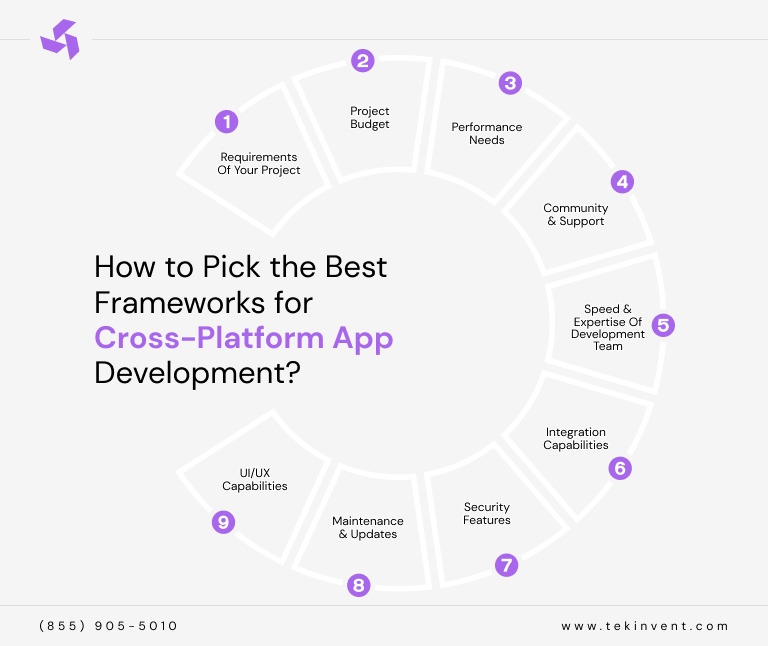
Choosing the right framework requires understanding your project goals, budget, performance needs, long-term scalability, and available expertise. Evaluating these factors ensures you select a framework that delivers efficient development, strong user experience, and reliable results.
1. Requirements of Your Project
Start by defining your app’s core features, target audience, and platform needs. Clear requirements help narrow framework options, ensuring you select a solution that supports your functionality, scalability goals, and long-term development roadmap effectively.
2. Project Budget
Your budget influences which framework fits best. Some offer cost-effective tools, shared codebases, or fewer development hours. Choosing a framework aligned with your budget ensures efficient spending without compromising quality or app performance.
3. Performance Needs
If your app requires real-time updates, animations, or heavy processing, performance becomes a priority. Select frameworks known for speed and native-like capabilities to ensure smooth user experiences across various devices and platforms.
4. Community & Support
A strong community ensures access to tutorials, libraries, bug fixes, and faster problem-solving. Frameworks with active support reduce development challenges and help your team deliver stable, well-supported cross-platform applications over time.
5. Speed & Expertise of Development Team
Consider your team’s technical skills and framework familiarity. Choosing a framework your developers know speeds up delivery, reduces errors, and ensures efficient development without unnecessary delays or a steep learning curve.
6. Integration Capabilities
Check whether the framework supports APIs, plugins, and third-party tools you need. Strong integration capabilities ensure smooth connectivity with backend systems, databases, cloud services, and essential external features required by your app.
7. Security Features
Security is crucial. Pick frameworks offering strong data protection, encryption, secure authentication, and regular updates. This reduces vulnerabilities and ensures your app meets modern security standards across all supported platforms.
8. Maintenance & Updates
A good framework provides long-term support, easy maintenance, and consistent updates. This ensures your app remains compatible with OS upgrades, device changes, and evolving user expectations without significant redevelopment costs.
9. UI/UX Capabilities
Choose frameworks that support flexible UI components, smooth animations, and modern design systems. Strong UI/UX capabilities ensure your app delivers a consistent, engaging, and intuitive experience across all platforms.
Conclusion
Choosing the right cross-platform framework is essential for building fast, scalable, and cost-effective apps. By understanding your project requirements, budget, performance needs, and long-term goals, you can confidently select a framework that delivers exceptional results.
With the right tools and a skilled development team, your business can create powerful, future-ready applications that perform seamlessly across every device and platform.

Build Smart with The Right Team.
We bring expertise, technology, and trust you look for in your digital journey.