
Choosing the right way to bring outside technical expertise into your business is not always straightforward. When your team is overloaded, you may consider hiring additional developers. When a project is unclear or technically complex, you may look for outside specialists to guide the decision. This is where understanding staff augmentation vs consulting becomes important.
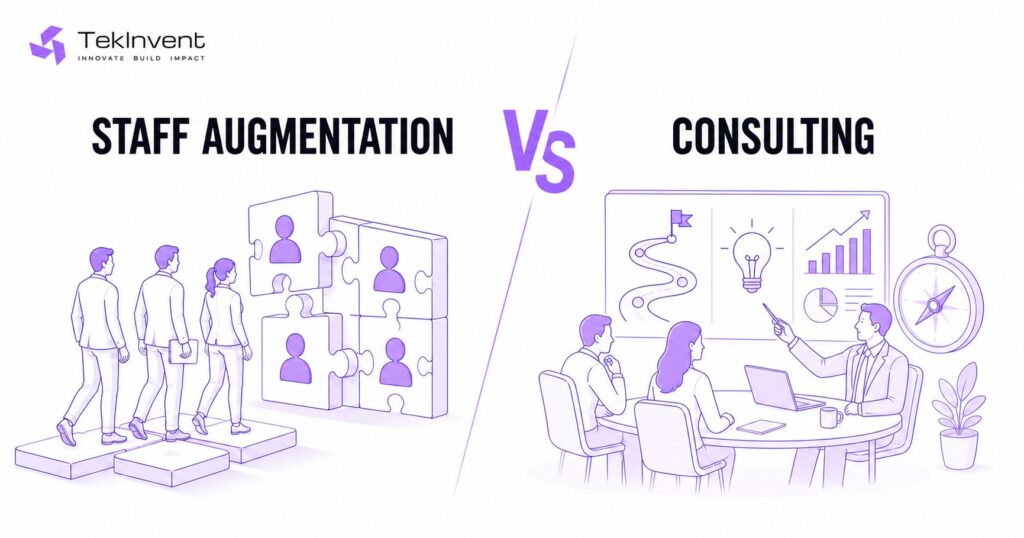
Although both models give businesses access to external expertise, they work in very different ways. Staff augmentation primarily adds skilled professionals to an existing team, while consulting focuses more on expert advice, problem-solving, strategy, and specialized guidance.
Knowing the difference can help business owners and technology leaders avoid unnecessary costs, improve project execution, and choose an engagement model that matches their actual needs.
What Is the Difference Between Staff Augmentation and Consulting?
The simplest way to understand staff augmentation vs consulting is to look at who owns the work and who manages the people doing it.
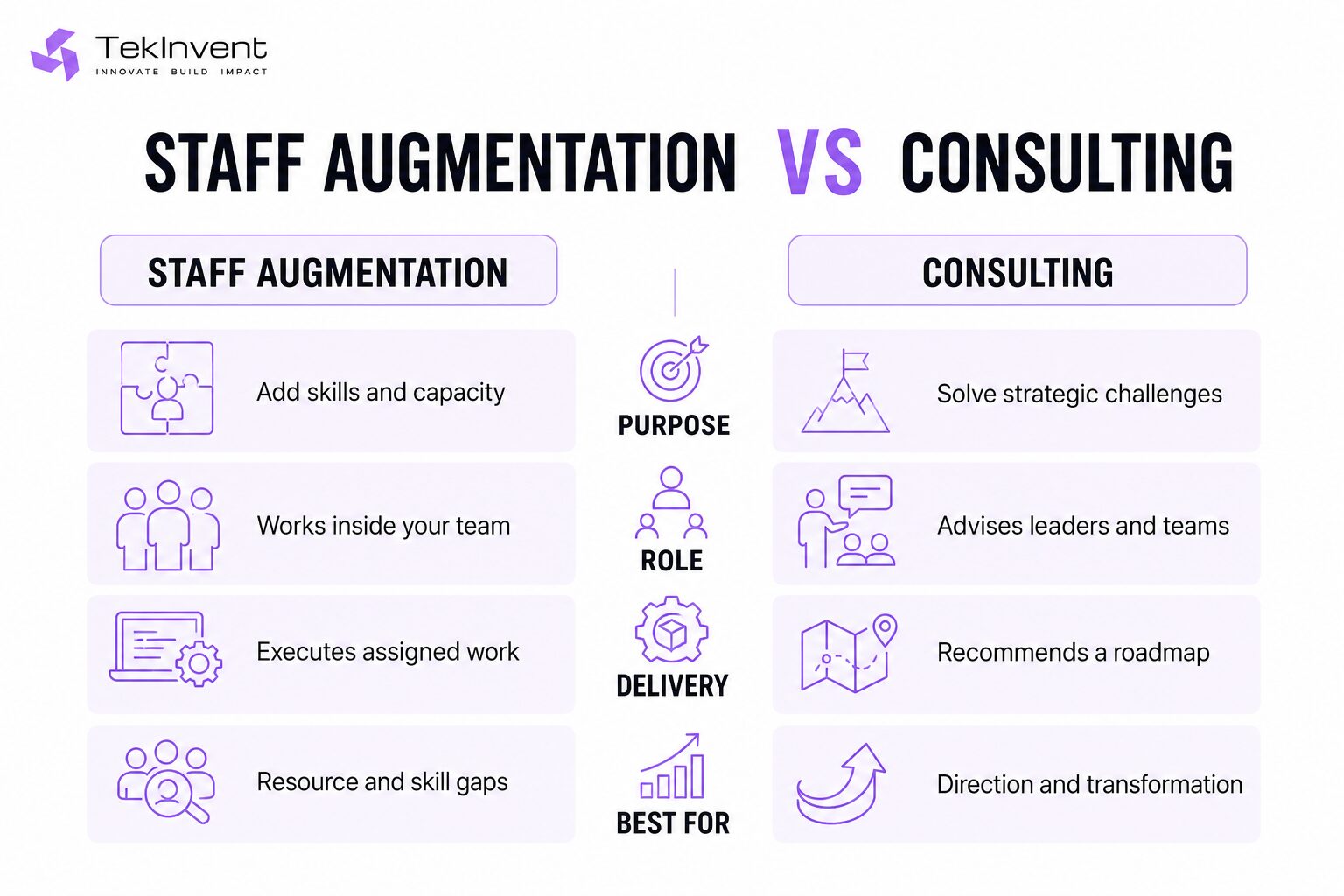
With staff augmentation, a business adds external professionals to its existing team. These professionals may include software developers, QA engineers, UI/UX designers, project managers, or other technical specialists. They work within the client’s existing processes and usually follow the client’s priorities, tools, communication methods, and development workflow.
For example, imagine a software company has an experienced product manager and technical lead but needs three additional React developers to meet a product launch deadline. Instead of permanently hiring three employees, the company can bring in external developers who work alongside its existing team.
Consulting works differently. A consulting firm is generally brought in because the business needs specialized knowledge, analysis, strategy, or help solving a difficult problem. The consultant may evaluate the current situation, identify problems, recommend an approach, and sometimes help implement the solution.
This difference is important when comparing consulting vs staff augmentation.
A useful way to think about it is:
- Staff augmentation: “We know what needs to be done, but we need more skilled people to do it.”
- Consulting: “We need expert help deciding what should be done and how to approach it.”
The two models can also work together. A company might first use consulting to determine the right technology architecture and then use staff augmentation to add developers who can execute the plan.
Why Does Choosing the Right Model Matter?
The right model can affect project speed, internal management, costs, flexibility, and overall accountability.
One major advantage of staff augmentation is flexibility. A business can increase its technical capacity without committing to permanent hiring for every temporary need. This can be particularly useful when workloads change, a project has a strict deadline, or a company needs a specific technical skill for a limited period.
It can also help internal teams maintain control. Since augmented professionals become part of the existing workflow, the company’s managers can continue assigning tasks, reviewing work, and making project decisions.
This is one reason businesses consider IT staff augmentation services when they already have strong internal leadership but need additional technical capacity.
Consulting provides a different type of value. It can be useful when internal teams do not have enough experience with a particular problem. Instead of simply adding more developers, a company can bring in specialists who have dealt with similar challenges and can provide an outside perspective.
For example, consider a business planning to replace an outdated software system. Hiring more developers may increase the number of people available to write code, but it does not necessarily answer bigger questions such as:
- Which architecture should the company use?
- Should the system be rebuilt or gradually modernized?
- What security risks need to be addressed?
- Which integrations are essential?
- How should the migration be planned?
These are consulting-type questions.
A real-world example also shows why additional technical capacity can be valuable. In 2018, Matt Watson of Stackify needed to add 10 developers because local hiring could not meet the company’s needs quickly enough. The team eventually grew to more than 20 developers through this type of staffing approach.
The lesson is simple: if the strategy and direction are already clear, additional skilled professionals can help a business move faster.
For businesses that need broader technical guidance, however, IT consulting vs staff augmentation may lead to a different decision.
How to Choose Between Staff Augmentation and Consulting
Before selecting an engagement model, start by identifying the actual problem. Do not choose a service simply because it is popular or because another company uses it.
1. Identify what your team is missing
Look at your current team and ask whether the problem is a lack of people or a lack of expertise.
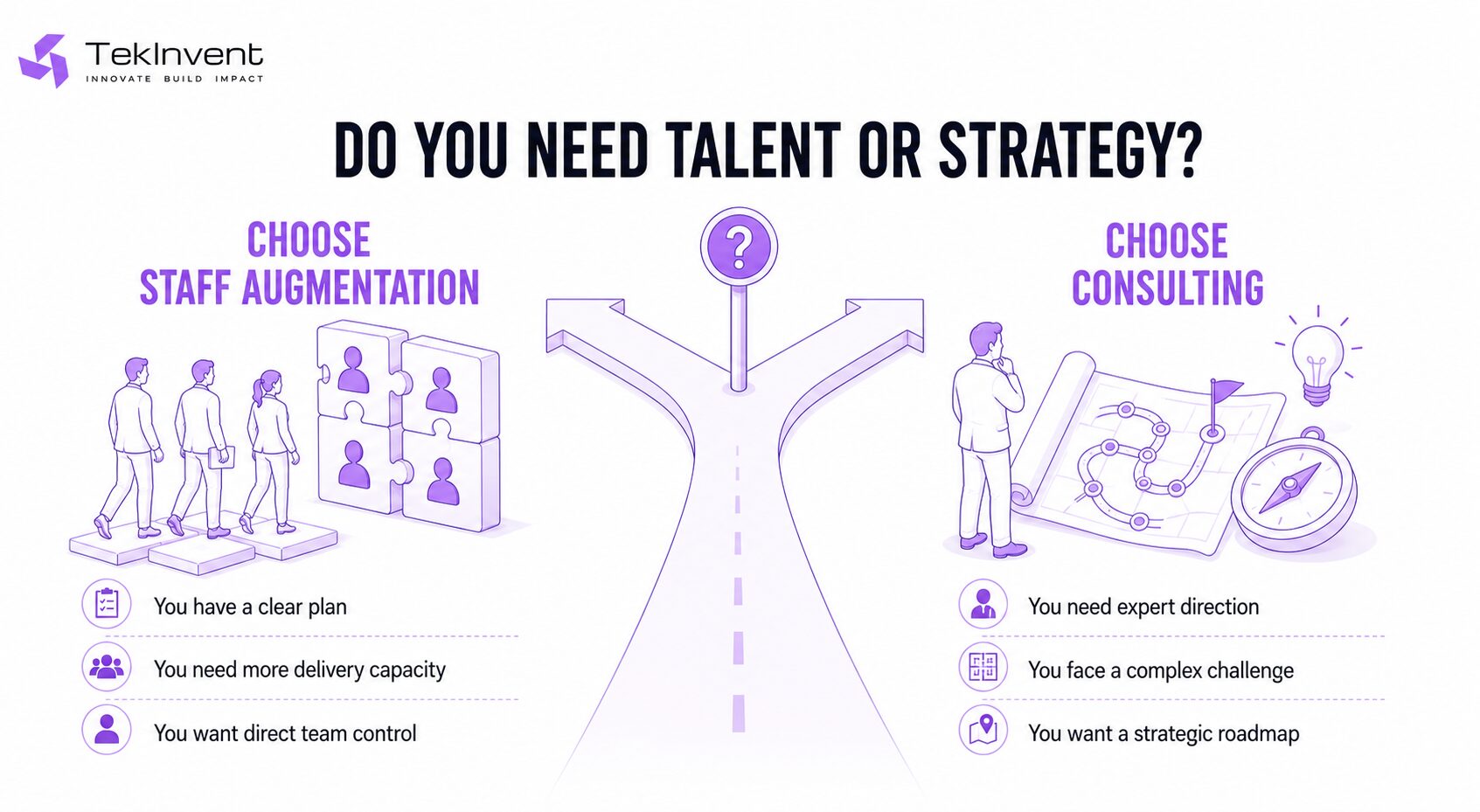
If your developers understand the project but cannot complete the workload on time, staff augmentation may be appropriate.
If your team is unsure about the technology, architecture, security approach, or overall strategy, consulting may provide more value.
2. Define who will manage the work
This is one of the most important differences between the two models.
With staff augmentation, your internal managers generally remain responsible for assigning work and managing day-to-day activities.
With consulting, the external experts may take a stronger role in analyzing the problem and recommending the solution.
Before signing an agreement, clearly define responsibilities. This prevents confusion about who makes technical decisions, who approves work, and who is responsible for delivery.
3. Consider the project scope
Staff augmentation tends to work well when requirements are reasonably clear.
For example, suppose your company already has a product roadmap and needs two backend developers and one QA engineer for six months. The work is defined, but the team needs more capacity.
That is a strong staff augmentation scenario.
Consulting is often more appropriate when the scope is uncertain. If you are trying to determine why an application is slow, whether a legacy system should be replaced, or how to redesign your technology infrastructure, expert analysis may need to happen before implementation.
4. Check your internal management capacity
Adding external developers does not eliminate the need for project management.
Your team still needs someone who can assign tasks, communicate requirements, review progress, and provide feedback.
If your internal team already has strong project and technical leadership, staff augmentation can fit naturally into the workflow.
If your team is already struggling to define priorities, simply adding more people may not solve the underlying problem.
5. Compare flexibility and commitment
Staff augmentation can provide a flexible way to scale technical resources according to project requirements.
Consulting engagements are often organized around a specific business problem, assessment, strategy, or implementation objective.
The best choice depends on how long you need outside support and what you expect the external partner to deliver.
Businesses evaluating these options can also review TekInvent’s software development services to understand how different development engagement models can support specific project requirements.
6. Consider a hybrid approach
You do not always have to choose one model exclusively.
A business may start with consulting to evaluate its technology architecture, define requirements, or create a roadmap. Once the direction is clear, it can add developers and other specialists to execute the plan.
This approach can be useful for larger digital transformation projects where both strategic guidance and additional technical capacity are required.
Common Mistakes When Comparing the Two Models
One common mistake is assuming that staff augmentation and consulting are simply different names for the same service.
They are not.
Staff augmentation is primarily about adding people and capabilities to an existing team. Consulting focuses more heavily on expertise, analysis, recommendations, and solving complex problems.
Another mistake is choosing staff augmentation when the real issue is poor project direction. Adding five developers to a project with unclear requirements may increase activity without improving results.
The opposite can also happen. A company may hire expensive consultants for work that its internal team already understands. If the problem is simply that there are not enough developers to complete clearly defined tasks, consulting may be unnecessary.
Businesses should also avoid judging a provider only by the number of professionals it can supply. Technical ability matters, but communication, relevant experience, development practices, security awareness, and the ability to integrate with an existing team are equally important.
Before starting an engagement, clarify:
- Expected responsibilities
- Required technical skills
- Project duration
- Management structure
- Communication process
- Expected deliverables
- Security and access requirements
- Success measurements
It is also important not to assume that a larger team automatically means faster delivery. Adding people to a project that lacks planning can create additional communication and coordination overhead.
The best engagement model is the one that addresses the actual bottleneck.
For businesses that already have a defined software roadmap and need additional technical professionals, TekInvent’s staff augmentation approach can provide access to developers and technical specialists who can integrate with an existing team.
Conclusion
The decision between staff augmentation vs consulting ultimately comes down to what your business needs from an external technology partner.
If you already understand the project, have internal leadership, and mainly need additional technical capacity, staff augmentation can be a practical choice. It gives you flexibility to expand your team without making every technical hire permanent.
If the challenge involves uncertainty, strategic decisions, architecture, transformation, or specialized problem-solving, consulting may be the better option.
In some cases, the strongest approach is to combine both. Consulting can help establish the right direction, while augmented professionals can provide the people needed to execute that plan.
Before choosing a model, define the problem, understand your team’s capabilities, establish responsibilities, and determine what success should look like. A clear decision at the beginning can save time, reduce unnecessary costs, and help your technology project move forward with greater confidence.

Build Smart with The Right Team.
We bring expertise, technology, and trust you look for in your digital journey.