The cost and complexity of a healthcare app depend on the workflow it supports, the systems it connects to, and the safeguards needed for the data it handles. A Miami provider planning a patient portal, telehealth service, or care coordination tool should clarify these requirements before comparing development estimates. Otherwise, proposals may describe different products while appearing to quote the same project.
Start by deciding who the app serves and what job it should make easier. Then map the patient and staff experience, identify data flows, and separate launch requirements from later ideas. That scope gives the provider a practical way to discuss budget, schedule, and risk with a development partner.
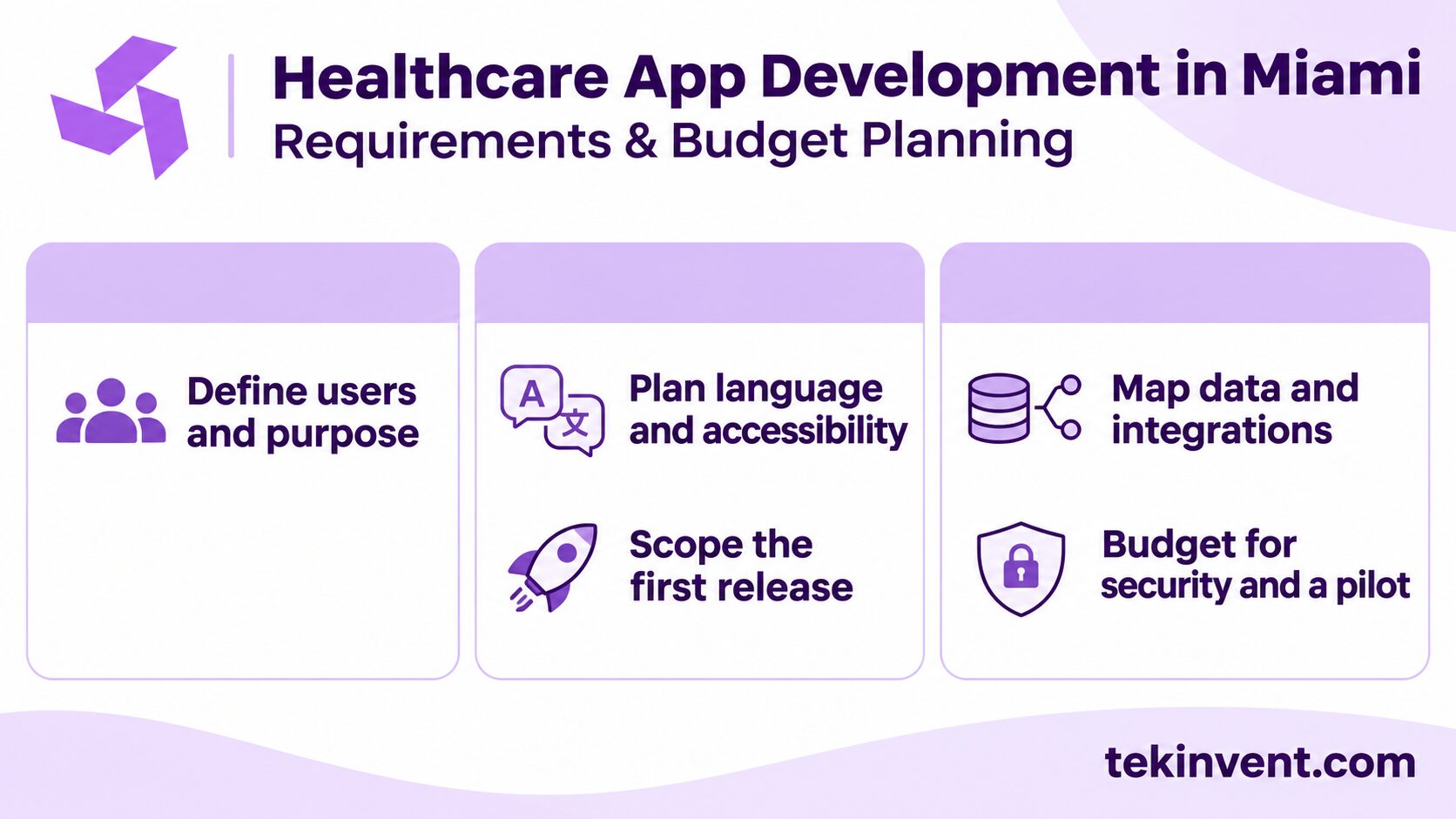
Define the app’s purpose and intended users
“A healthcare app” can mean many things: appointment scheduling, patient intake, secure messaging, remote visits, medication reminders, post-visit instructions, or a tool for clinicians. Each use has different content, integrations, privacy considerations, and support needs. Begin with one clear problem statement that names the user, the task, and the current obstacle.
For example, a practice might want patients to complete intake before an appointment. The project should examine how the practice currently collects information, who checks it, how corrections are made, and where the information needs to appear. If the goal is fewer incomplete forms, the team should measure completion and staff rework rather than simply count app downloads.
Speak with patients and staff who represent the intended audience. Ask them to explain the current process and the points where it breaks down. For patients, look at registration, device access, language, accessibility, and account recovery. For staff, examine how app-submitted information enters the day’s work and who handles exceptions.
Keep the product’s intended use precise. If the app provides general education, that scope differs from software that interprets symptoms or influences clinical decisions. Clinical, legal, and regulatory review may be needed for certain functions. Get qualified advice before treating a feature as a routine software requirement.
Account for language and accessibility needs
Miami organizations may serve patients with different language preferences and levels of comfort with technology. Confirm the languages the target users need instead of assuming that one translation will suit everyone. If the app will support English and Spanish, include translation, clinical review, and ongoing content updates in the project scope.
Plan for language selection across the full journey: account creation, consent, forms, messages, help content, and error states. A translated landing page is not sufficient if appointment instructions or recovery steps remain in another language. Make it clear which language a patient has selected and preserve that choice when possible.
Accessibility also affects completion. Use readable text, clear labels, keyboard and screen-reader support where applicable, and error messages that explain how to recover. Test with people who use assistive technology or need a simpler interface. These checks can expose issues that internal reviewers may overlook.
Do not assume an app can replace staff interpretation or other established communication support. Define when the digital flow is appropriate and how a patient can request help. The product should fit the provider’s service process, not force every person into a self-service path.
Choose a first release that can be operated
Prioritize a small number of connected capabilities that solve the main problem. A patient intake release may need sign-in, identity checks, consent, form completion, staff review, and correction handling. It may not need automated recommendations, a broad analytics dashboard, or several unrelated patient features on day one.
Create a workflow map that includes both the patient-facing app and internal staff steps. Note what happens if someone submits information twice, loses access, changes an appointment, or enters something staff cannot verify. A feature is not finished just because its happy path works in a demo.
Some work can remain manual during a pilot, provided the team can perform it safely and consistently. Write down who handles each manual step and what information they need. If the process depends on a person checking a queue every hour, include that responsibility in the operating plan and test whether the service can maintain it.
Use a prototype to test task flow before building production screens. Give patients and staff realistic scenarios and observe where they pause, misunderstand a label, or seek help. Fix the points that block the intended outcome. This is often less expensive than discovering after launch that an important step made sense only to the project team.
Map integrations and information ownership
List each system the app must connect to: electronic health record, scheduling software, billing platform, identity service, video provider, or messaging system. For every connection, define the fields exchanged, direction of travel, timing, and system that remains authoritative. “Integrate with the EHR” is not detailed enough for an estimate.
Confirm whether the organization can obtain the required technical access and test environment. Identify vendor contacts, approval steps, documentation, and any fees or service agreements that may apply. An integration may be technically possible but still require coordination or workflow changes outside the app team’s control.
Decide how the product handles mismatches and interruptions. If the app receives an updated phone number but the record system has a different one, should the new value be saved, flagged, or reviewed? If a video appointment cannot connect, what does the patient see and what should staff do? These decisions affect both user experience and operational workload.
Test integrations with realistic cases, including missing values, duplicates, delays, and recovery after an outage. Make sure the provider can see when information was not delivered. Plan who investigates an error and how staff can continue essential work while it is resolved.
Budget Your Healthcare App With Clear Requirements
TekInvent can help map your workflows, integrations, and release priorities before a build begins.
Build privacy and security into the budget
Before estimating, identify what information the app collects and where it goes. A data flow map should cover the mobile app or website, APIs, storage, analytics, notifications, support tools, backups, and third-party services. Remove data that is not needed for the stated task and limit access to the people who need it.
HIPAA does not apply to every health-related app in the same way. Its requirements depend on whether an organization is a covered entity or business associate and how protected health information is handled. Other privacy and consumer protection rules may apply to products outside HIPAA. Ask qualified legal and privacy professionals to determine the obligations for the specific organization and service relationships.
Where HIPAA applies, risk analysis and risk management are part of the organization’s security responsibilities. Work through administrative, technical, and physical safeguards with the people accountable for compliance. The development team can help implement technical controls, but a vendor’s description of its platform does not by itself establish that the provider’s overall use is compliant.
Discuss access permissions, authentication, encryption, audit records, monitoring, backups, incident response, and staff procedures. If cloud or communication vendors will handle protected information on behalf of the organization, review the needed agreements and safeguards before real data is shared. Keep development and test environments separate from production, and use synthetic or de-identified test data where possible.
Understand what drives the project estimate
There is no reliable flat price for a healthcare app without a defined scope. An estimate changes with the number of user roles, supported platforms, integrations, clinical workflow, language coverage, security review, and amount of custom content. The provider’s existing systems and availability of test access can also affect delivery effort.
Ask for a proposal that separates work into understandable parts:
- Discovery and workflow design
- User experience and content planning
- Patient, clinician, or administrator interfaces
- Backend services and third-party integrations
- Privacy and security implementation
- Functional, accessibility, integration, and security testing
- Deployment, training, monitoring, and ongoing support
This breakdown makes omissions easier to spot. Confirm what the project assumes about the EHR vendor, patient identity, translation, data migration, testing participants, and approval time. Ask how changes to those assumptions affect the scope. If the estimate combines everything into one line, it is difficult to compare it with another proposal.
Budget for the period after launch. Recurring costs may include hosting, messaging or video services, monitoring, software maintenance, security updates, vendor support, and content review. The provider also needs internal time for user support, account administration, access review, and workflow adjustments. These operating costs should be considered alongside the initial development budget.
If major unknowns remain, fund a discovery phase with concrete outputs. Useful deliverables include workflow maps, prioritized requirements, integration assumptions, a risk register, prototype feedback, and a phased estimate. Discovery should help the organization make decisions; it should not be a vague preliminary phase with no agreed deliverables.
Plan a pilot and measure practical outcomes
Before broad release, test the app with a defined group and set a review date. Decide what the team needs to learn: Can patients finish intake without staff assistance? Do appointment requests reach the right queue? Can staff act on the information without re-entering it? Are translated instructions understandable?
Track both patient behavior and operational effects. App opens alone do not show that a workflow improved. Measure task completion, incomplete submissions, repeat contacts, staff rework, and support requests where those measures fit the goal. Review feedback for differences among user groups so one easy-to-serve group does not hide problems for others.
Prepare training and support for each role. Patients need a way to recover access and get help. Staff need clear steps for reviewing submissions and escalating issues. Assign an owner for questions, content updates, and technical incidents. A pilot without an operational owner can produce little actionable learning.
After the pilot, decide whether to improve, expand, or pause the app. Compare results with the original problem statement and document what the organization learned. If users did not complete the task, determine whether the cause was a confusing interface, poor fit with the workflow, lack of trust, or a technical issue before adding features.
A requirements checklist for Miami healthcare teams
Before approving a full build, make sure the project team can explain:
- The user group and problem the app addresses.
- The intended use and any clinical review it requires.
- The first-release workflow, including errors and exceptions.
- Language and accessibility needs for the intended patients.
- Systems involved, data exchanged, and information ownership.
- Privacy, security, legal, and vendor responsibilities.
- Testing, training, support, and ongoing maintenance plans.
- The measures that will guide the next product decision.
Unanswered items should become explicit discovery work or project assumptions. That keeps uncertainty visible and prevents it from quietly turning into additional development later.
When the scope is ready for implementation planning, a software development company in Miami can help translate the requirements into a delivery approach. For healthcare-specific product needs, TekInvent’s healthcare app development services can also be part of the evaluation.
Make the first budget decision a scope decision
A useful healthcare app estimate begins with decisions about users, workflow, information, and operations. Miami providers can make proposals easier to compare by giving every development partner the same requirements and asking each to identify assumptions and ongoing responsibilities.
The first release should solve a defined problem and fit the organization’s ability to support it. With clear measures and a careful pilot, the provider can learn what patients and staff need before expanding the product.

Build Smart with The Right Team.
We bring expertise, technology, and trust you look for in your digital journey.