An app can be polished and still fail to answer the questions that matter to a startup: Does a specific group of people need this? Will they use it more than once? Can the business reach them at a reasonable cost? Before committing a large share of a startup’s budget to development, founders should use smaller tests to reduce uncertainty.
For Austin founders preparing for customer growth or investor conversations, the strongest early product work is often less about adding features and more about collecting credible evidence. A focused prototype, a narrow minimum viable product (MVP), and a plan to measure user behavior can show what has been learned, what remains uncertain, and what the next build should accomplish.
What investor readiness means for an early app
Investor readiness is not a special version of an app. It is the ability to explain the product’s purpose, the evidence behind its key assumptions, and the decisions the team made with that evidence. A working demo may help someone understand the idea, but it does not prove that customers will adopt it or that the business can serve them sustainably.
The evidence founders can collect depends on the product stage. Before launch, it may include observed user tests, letters of intent, or pilot commitments. After launch, it may include activation, repeat use, task completion, support needs, and conversion data. These signals do not guarantee funding. They make the discussion more concrete and help a team avoid presenting guesses as results.
An investor or potential partner may ask how the app solves a real problem, how the team reached its early users, what those users did, and what the business learned. Prepare to distinguish between what users said, what they actually did, and what the team expects to happen next. That distinction makes a small test more useful than an impressive but unverified claim.
Validate the problem before choosing features
Start by describing one user and one recurring problem. “Small businesses need better software” is too broad to guide a product. “A clinic coordinator spends the end of each day reconciling appointment changes across two systems” gives a team something it can investigate.
Talk with people who fit the intended user group. Ask them to walk through the last time they faced the problem, what they did, how often it happens, and what the current workaround costs in time or effort. Avoid pitching the proposed app during the first part of the conversation. If participants only respond to your concept, their enthusiasm can be mistaken for evidence of demand.
Look for repeated patterns, but record disagreements too. A scheduling problem may be painful for one role and minor for another. A workaround may be inconvenient but good enough for the buyer. Those details can change the product’s audience, pricing model, or sales plan before development begins.
Useful discovery notes capture the participant’s role, the situation, the current process, and the consequence of the problem. Keep direct quotes separate from the team’s interpretation. A short, honest record makes it easier to revisit assumptions when new information arrives.
Choose the cheapest test that answers the next question
The right validation method depends on what the team does not know yet. If the uncertainty is whether people understand the idea, a simple screen prototype may be enough. If the uncertainty is whether they will complete a workflow, test a clickable prototype with representative users. If the question concerns repeat use or operational fit, a limited pilot may be necessary.
| Uncertainty | Practical test | What to observe |
|---|---|---|
| Do users recognize the problem? | Interviews about recent experiences | Similar examples and current workarounds |
| Can users understand the flow? | Clickable prototype session | Where users hesitate or need help |
| Will people commit time or money? | Pilot offer or paid presale where appropriate | Follow-through after the conversation |
| Can the workflow operate in context? | Small, time-boxed pilot | Exceptions, handoffs, and support load |
Set a decision rule before running the test. For example, a team might decide to revise the onboarding flow if users cannot complete the core task without coaching. The exact threshold should fit the risk being tested. A test without a decision attached often produces notes but no direction.
Do not ask a prototype to prove more than it can. A simulated checkout does not confirm payment reliability. A sample dashboard does not show that a business has access to usable data. State the limits of each test plainly when sharing results.
Scope an MVP around one complete job
An MVP is useful when it lets a defined user complete a meaningful task and gives the team a way to learn from that use. It does not need every feature on the roadmap. It does need enough reliability and context that users can try the core job without the team quietly filling in missing steps.
Map the journey from the user’s starting point to the outcome. Include account setup, permissions, notifications, payment or handoff steps, and what happens when the expected path fails. Then mark which steps must be in the first release and which can remain manual during a controlled pilot.
For example, a service marketplace might initially support one provider category and one service area. The team could handle provider approval manually while the app supports searching, booking, and confirming a request. That scope tests whether customers complete a booking and whether providers can fulfill it. Adding several categories before learning those things increases build effort without improving the test.
Manual work is appropriate only when it is visible to the team and safe for users. Document who performs it, how quickly, and what information they need. If the manual process hides delays or errors that would exist at scale, do not use the pilot as proof that a fully automated service is ready.
Build measurement into the first release
Decide what the product needs to learn before adding analytics. A long list of tracked events can create noise and privacy risk. Choose a small set tied to the product question: whether a user reaches the first useful outcome, where they leave a task, and whether they return to complete it again.
Define events in language the whole team understands. “Activation” might mean a user has created a project and invited a teammate; it should not mean simply opening the app unless opening it represents value. Keep a written event plan with names, meanings, and the decision each event supports.
Instrument the product before inviting pilot users. Otherwise the team may be unable to reconstruct where users struggled. Check that events fire once, exclude test accounts from reporting, and avoid collecting sensitive information without a clear need and appropriate safeguards. For products involving health, finance, children, or other sensitive data, privacy and security planning must shape the measurement plan from the start.
Pair quantitative signals with direct observation. A drop-off can show where people stop, but a short usability session can reveal why. Neither method alone tells the whole story. If users abandon a task because they do not trust the requested information, a new button will not solve the underlying concern.
Keep ownership and technical decisions organized
Product evidence is easier to evaluate when the business can explain how the app was made and who owns its components. Keep source code, cloud accounts, design files, domain registrations, and analytics accounts under company-controlled access. Make sure agreements clearly address work ownership and confidentiality with employees and contractors.
Track third-party services and software dependencies. Record why each important service was chosen, what data it receives, and what would be required to replace it. This is practical operating documentation as well as preparation for technical review. A small startup does not need an elaborate architecture deck, but it should be able to explain key trade-offs and known limitations.
Plan for basic reliability before recruiting a large test group. Set up backups, error monitoring, access controls, and a way to respond when a release breaks a core task. If the app handles personal or regulated information, bring qualified security and legal reviewers into planning early. A development team can implement controls, but it cannot decide every legal obligation on the business’s behalf.
Present results without overstating them
Summarize the product’s current stage in a compact evidence brief. Include the target user, the problem being tested, the test method, who participated, what happened, and what the team changed as a result. Separate measured outcomes from assumptions and future targets.
If a pilot had a small number of participants, say so. Explain how they were recruited and whether they resemble the intended customer. Do not present sign-ups as active usage, a prototype test as a production launch, or a few positive comments as proof of product-market fit.
The next-step plan matters as much as the current demo. Identify the highest-risk unanswered question, the smallest useful test, and what result would change the roadmap. This shows that the team can learn and allocate development effort deliberately.
A practical sequence for an Austin startup
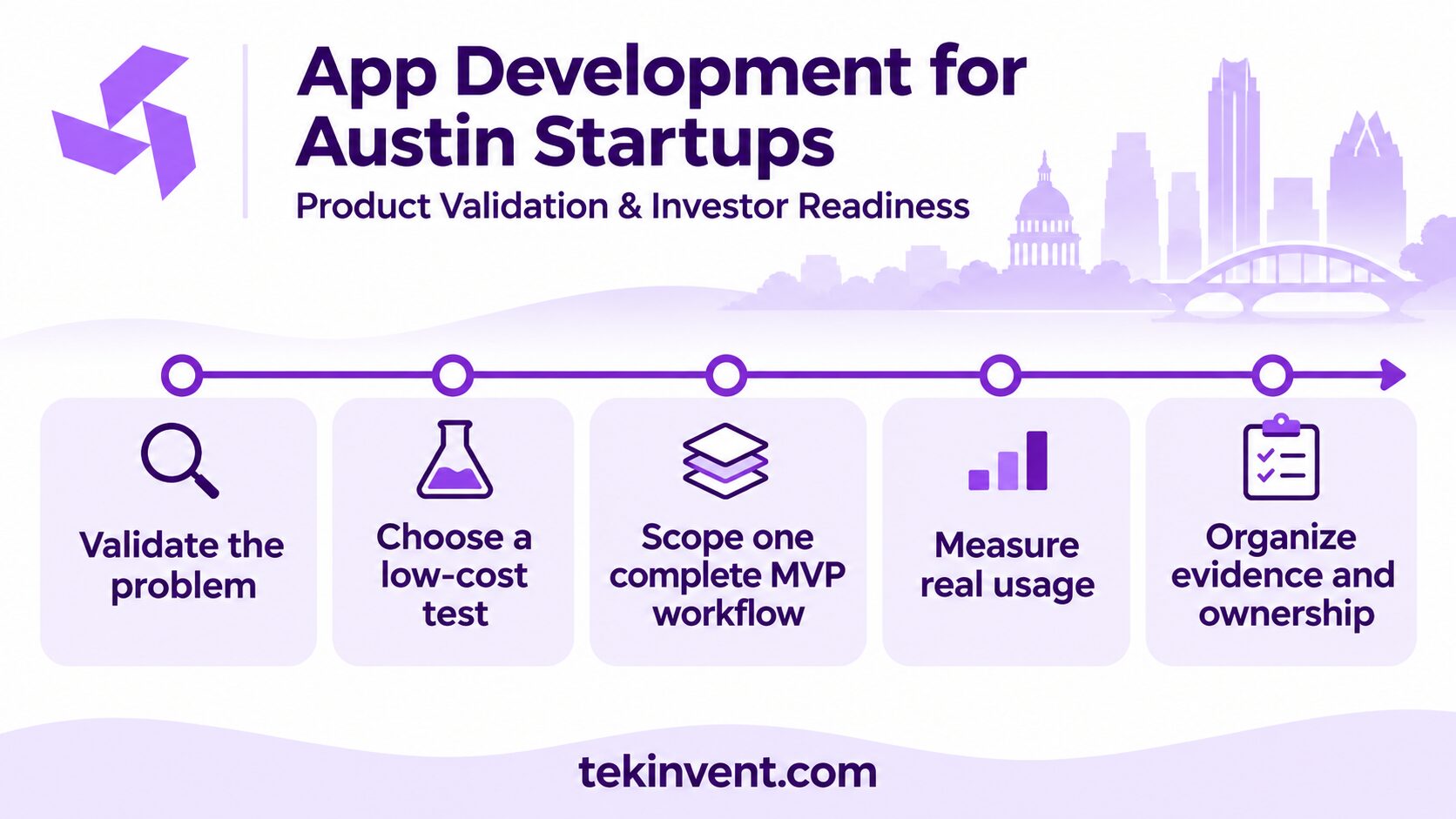
Move through the work in short decision cycles:
- Describe the user, problem, and current workaround in specific terms.
- Interview people who recently experienced that problem.
- Select one high-risk assumption and a test that can challenge it.
- Prototype or build only the workflow needed for that test.
- Define useful events and privacy boundaries before inviting users.
- Review what users did, what they said, and what the team should change.
This sequence can lead to more development when evidence supports it, or to a narrower audience, revised workflow, or a decision to stop. Each outcome can save effort by making the next commitment better informed.
When it is time to turn a validated workflow into a production app, a mobile app development company in Austin can help estimate the work around the agreed scope, integrations, platforms, and operating requirements. Bring discovery findings and test results into that planning conversation so the estimate reflects the product the team needs to learn from.
Validate the Product Before Expanding the Build
TekInvent can help shape your startup app scope around the user problem and the evidence you need.
Before the next product milestone
Review the evidence brief with the people responsible for product, engineering, operations, and fundraising. Confirm that everyone uses the same definition for the core user and the next milestone. If a key assumption remains untested, make that visible in the plan instead of hiding it inside a feature list.
A good early app gives users a useful way to complete a real task and gives its team a disciplined way to learn. For Austin startups, that combination supports better product decisions and more grounded conversations about what to build next.

Build Smart with The Right Team.
We bring expertise, technology, and trust you look for in your digital journey.