

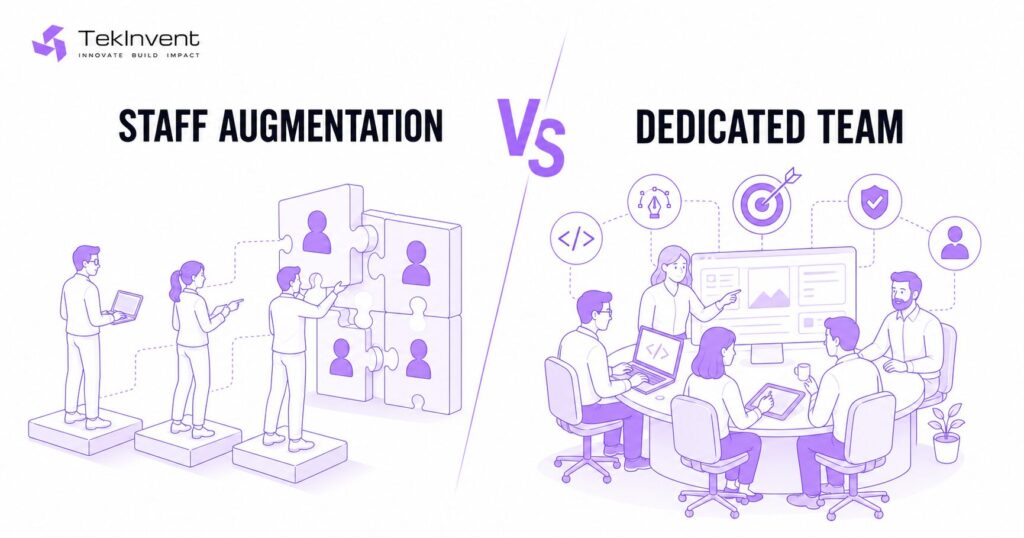
Growing a software team does not always mean hiring more full-time employees. Businesses can bring in outside technical talent when they need additional capacity, specialized skills, or an entire development team. Two common ways to do this are staff augmentation and dedicated teams.
The staff augmentation vs dedicated team decision matters because the two models may look similar from the outside, but they create very different responsibilities for the business. One gives you additional professionals to manage within your existing structure. The other gives you a more complete team built around ongoing development.
The right choice depends on your existing technical leadership, project duration, required skills, and how much responsibility you want to keep internally.
What Is Staff Augmentation vs Dedicated Team?
To understand staff augmentation vs dedicated team, start with one practical question: who is responsible for managing the developers?
Under a staff augmentation model, external professionals join your existing development team. Your company generally remains responsible for assigning tasks, setting priorities, managing sprints, reviewing work, and making technical decisions.
Suppose your company already has six developers, a product manager, and an engineering lead. You have a product release approaching but are missing two backend developers. Instead of recruiting permanent employees, you could temporarily add those developers to the existing team.
They work within your development process rather than operating as a separate team.
Our detailed guide to the IT staff augmentation model explains this structure in greater depth.
A dedicated team model usually provides a complete or largely self-contained development unit assigned to a product or workstream. Depending on the project, it may include:
- Frontend developers
- Backend developers
- QA engineers
- UI/UX designers
- DevOps specialists
- Technical or project leadership
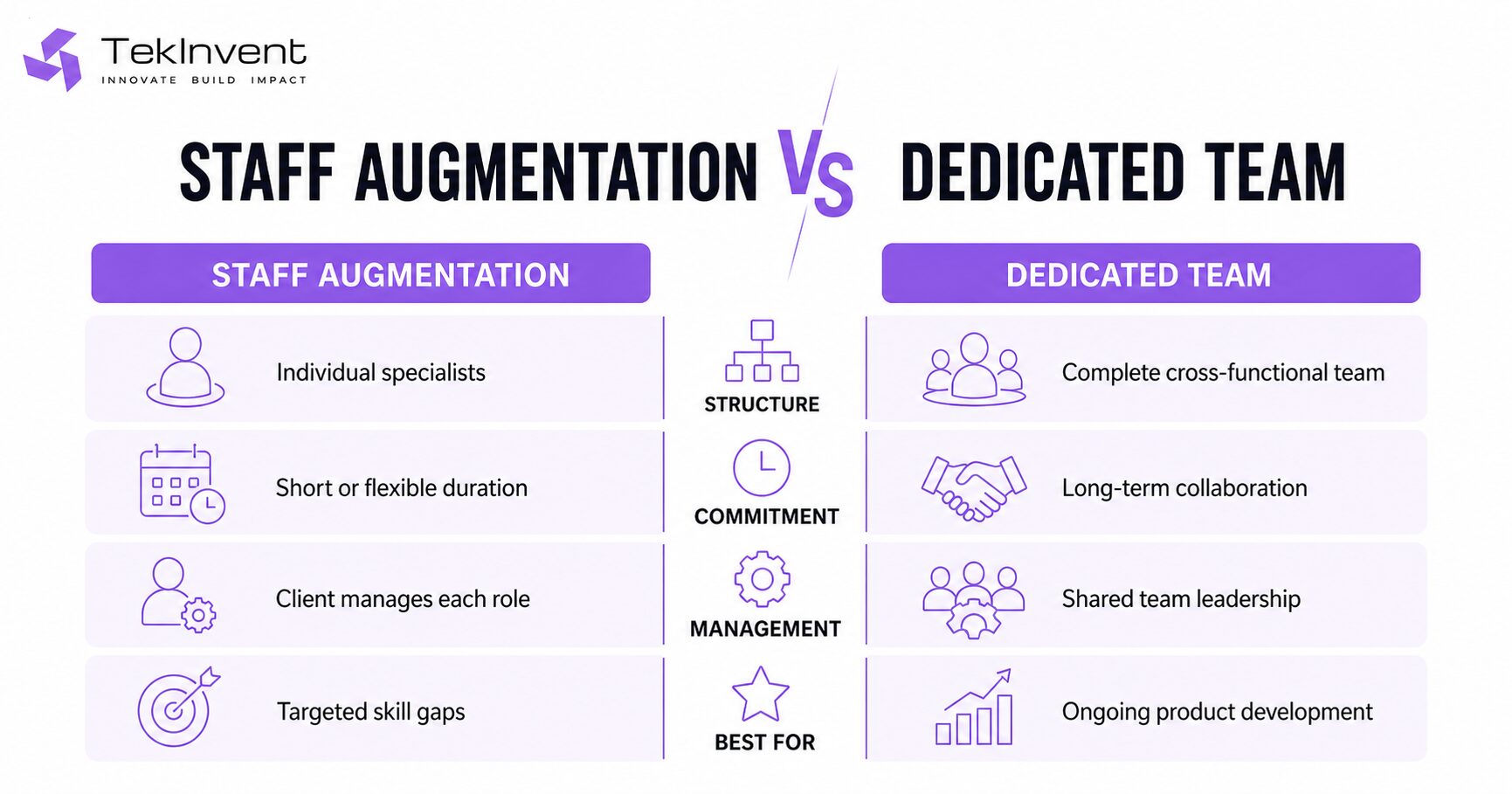
The difference between a dedicated team vs staff augmentation therefore goes beyond team size. Staff augmentation extends a team you already manage, while a dedicated team can take broader responsibility for execution and coordination.
| Factor | Staff Augmentation | Dedicated Team |
|---|---|---|
| Main purpose | Fill skills or capacity gaps | Build a stable development unit |
| Management | Primarily client-managed | Often shared or provider-managed |
| Integration | Joins an existing team | Operates as a coordinated team |
| Best fit | Specific skills and extra capacity | Larger or long-term initiatives |
| Internal leadership | Usually important | Less day-to-day management may be required |
| Scaling | Add individual specialists | Expand or adjust the overall team |
Why Does the Right Engagement Model Matter?
Choosing between staff augmentation vs dedicated team affects more than hiring. It influences management workload, project continuity, flexibility, communication, and potentially the total cost of delivery.
Staff Augmentation Gives You Direct Control
Staff augmentation works particularly well when your existing development operation is already functioning effectively.
Your engineering manager can continue controlling architecture, priorities, code quality, and development processes while additional professionals increase capacity.
Businesses also use IT staff augmentation services when they need expertise that is difficult to justify as a permanent position.
For example, imagine a SaaS company that already has a stable engineering department but needs an experienced DevOps engineer during a cloud migration. Adding one specialist may make far more sense than creating another development team.
This flexibility is one of the important staff augmentation benefits, particularly when demand changes during different stages of development.
Dedicated Teams Can Provide Greater Delivery Ownership
A dedicated team becomes useful when the problem isn’t simply a shortage of developers.
Imagine a growing business has a product road map but its internal engineering leaders are already managing several projects. Adding five individual developers may technically increase capacity, but those people still require on boarding, task assignment, reviews, communication, and supervision.
A dedicated team can reduce that coordination burden by functioning as a unit rather than a collection of individual specialists.
The dedicated development team vs staff augmentation decision therefore often comes down to the kind of resource you need.
Do you need additional people?
Or do you need a team capable of taking responsibility for a work stream?
That distinction matters much more than simply comparing hourly rates.
How to Choose Between Staff Augmentation vs Dedicated Team
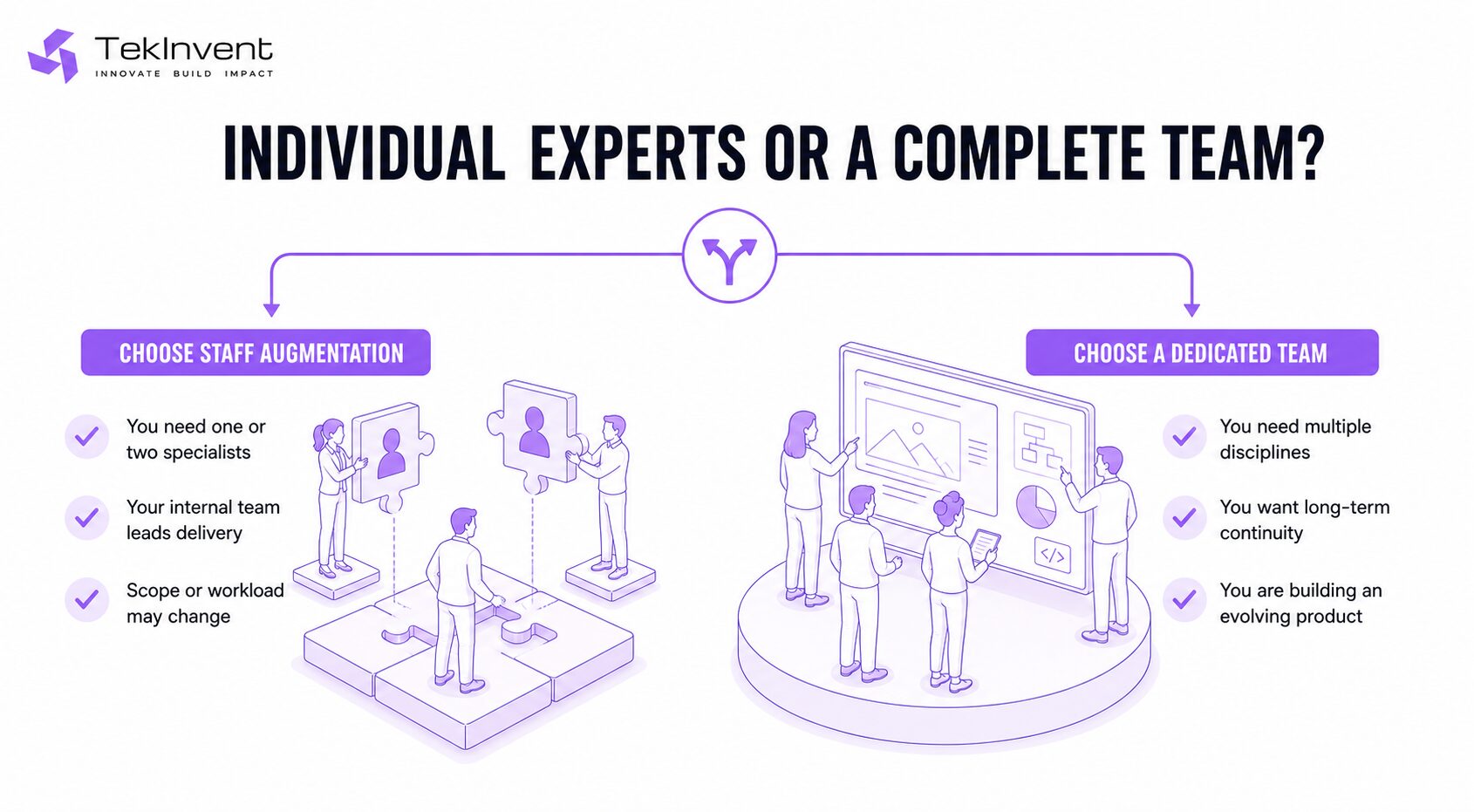
A business should evaluate its actual development environment before selecting either model. Here are five practical steps.
1. Assess Your Current Engineering Leadership
Start with your existing team.
Do you already have a CTO, engineering manager, technical lead, or experienced project manager who can manage additional developers?
If the answer is yes, the staff augmentation model can work well because the management structure already exists.
If your internal leaders have little time for additional coordination, a dedicated team deserves closer consideration.
2. Identify Exactly What Is Missing
Write down your resource gap before contacting a development partner.
For example:
- Two React developers for six months
- One senior Python engineer
- One QA automation specialist
- Temporary DevOps expertise
These are relatively clear augmentation requirements.
Now compare that with:
“We need a team to develop and maintain a new SaaS product over the next 18 months.”
That requirement points more naturally toward a dedicated team because you need coordinated development capacity rather than one missing skill.
3. Consider How Long You Need the Team
Duration is another important factor in staff augmentation vs dedicated team planning.
Staff augmentation can make sense for temporary capacity shortages, specialist requirements, release periods, or existing long-term teams that simply need more engineers.
Dedicated teams tend to become more valuable when developers need to accumulate product knowledge over an extended period. A stable team can become familiar with architecture, customers, technical debt, business rules, and the reasons behind earlier product decisions.
That context becomes increasingly valuable as a product grows.
4. Calculate the Total Cost, Not Just the Rate
One common mistake is comparing engagement models using developer rates alone.
Management has a cost too.
Consider the internal time required for:
- Recruitment and onboarding
- Sprint planning
- Technical supervision
- Code reviews
- Performance management
- Meetings
- Documentation
- Knowledge transfer
The cost of IT staff augmentation should therefore be evaluated alongside internal management requirements.
A lower hourly rate does not automatically produce a lower overall development cost.
5. Decide How Much Control You Actually Need
Control is sometimes treated as an all-or-nothing issue, but it isn’t.
With staff augmentation, your company usually maintains close control over daily development because external specialists operate inside your existing processes.
With a dedicated team, your business can still control the roadmap, priorities, product requirements, and major technical expectations while allowing the team to handle more day-to-day execution.
If your priority is managing individual developers directly, augmentation is usually the stronger fit.
If your priority is managing outcomes rather than every development task, the dedicated team model may be more practical.
Common Mistakes When Comparing Dedicated Team vs Staff Augmentation
The first misconception is assuming that staff augmentation vs dedicated team is simply another way of saying outsourcing.
There is overlap, but the engagement structures are different. Traditional project outsourcing can involve handing an agreed scope to another company for delivery, while augmented developers generally work inside the client’s existing organization.
For a deeper distinction, see our comparison of staff augmentation vs outsourcing.
Choosing Staff Augmentation Without Management Capacity
Adding developers does not automatically increase productivity.
If nobody has enough time to explain requirements, review code, remove blockers, or coordinate work, additional engineers can increase communication overhead rather than solve it.
Before augmenting, determine whether your technical leads genuinely have enough capacity to manage more people.
Assuming a Dedicated Team Requires No Oversight
A dedicated team should not mean “give the project away and wait.”
Your business still needs to establish product priorities, success criteria, communication routines, security requirements, and decision-making responsibilities.
The team may manage execution, but business ownership remains important.
Ignoring Documentation and Knowledge Transfer
This is a risk under either model.
Code ownership, repositories, system documentation, architecture decisions, credentials, deployment procedures, and project history should remain accessible to the client.
Clear knowledge-transfer requirements should be agreed upon from the beginning rather than discussed only when the engagement ends.
Choosing Based Only on Team Size
A project involving one developer isn’t automatically augmentation, and a project involving several developers isn’t automatically a dedicated team.
Management structure and delivery responsibility provide a better basis for comparison.
Conclusion: Which Model Should You Choose?
There is no universal winner in the staff augmentation vs dedicated team debate.
Staff augmentation is generally a better fit when you already have strong engineering leadership and need additional capacity or specific technical expertise. It lets external professionals become part of an existing development operation while your company retains close control.
A dedicated team is often more suitable when you need a stable group to support a larger product or long-term roadmap and want more responsibility for day-to-day execution handled by that team.
Before deciding, evaluate your internal management capacity, project duration, technical gaps, budget, and desired level of ownership.
If you’re still unsure, start by identifying whether your real problem is a shortage of people or a shortage of delivery capacity. That answer usually makes the choice much clearer.

Build Smart with The Right Team.
We bring expertise, technology, and trust you look for in your digital journey.