

Technology projects rarely follow a predictable schedule. A product launch may require extra developers, a cloud migration may create a temporary skills gap, or an unexpected resignation may leave an important position vacant. Permanent recruitment can support long-term needs, but it may not solve an urgent or temporary capacity problem.
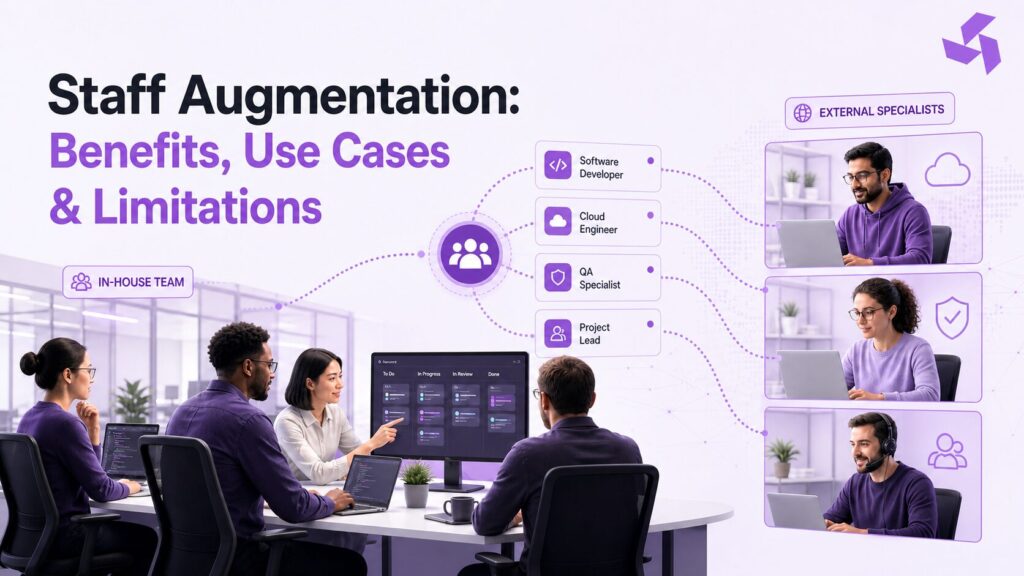
Staff augmentation gives businesses another option. It allows external professionals to join an existing team for a defined period or requirement. The company retains control of priorities and delivery while gaining extra capacity or specialized knowledge.
Understanding staff augmentation benefits is important before choosing this approach. The model offers flexibility and control, but successful implementation still requires clear responsibilities, structured onboarding, secure access, and active management.
What Is Staff Augmentation?
The IT staff augmentation model allows a company to add external specialists to its internal team while retaining control over priorities, workflows, and daily delivery.
These specialists usually work with the client’s employees, systems, processes, and project-management tools. Depending on the requirements, the engagement may last several weeks, a few months, or longer.
The client generally remains responsible for:
- Setting priorities and assigning work
- Managing the project backlog
- Reviewing quality and performance
- Making technical and business decisions
- Coordinating team communication
- Approving completed work
For example, a software company preparing a product release may already have developers and product managers but lack enough quality assurance engineers. It could add external QA specialists for the testing period instead of creating permanent positions.
Businesses can use IT staff augmentation services to fill individual roles or add several specialists. These professionals may include software developers, cloud engineers, cybersecurity specialists, data engineers, designers, business analysts, or quality assurance engineers.
Staff Augmentation vs Hiring
Permanent hiring is generally more suitable for ongoing roles that support the company’s long-term capabilities. Employees become part of the organization and receive the associated salary, benefits, training, and career development.
Staff augmentation supports a more flexible requirement. The engagement may end when the project finishes, demand falls, a permanent employee is hired, or the required knowledge has been transferred.
This does not make one option universally better. The right choice depends on whether the business needs long-term capability or temporary support.
Staff Augmentation vs Outsourcing
Staff augmentation vs outsourcing models assign responsibility differently. With staff augmentation, external specialists work under the client’s direction. In an outsourced project, the provider commonly manages a broader deliverable using its own team and delivery process.
The right choice depends on the work. A company with strong project leadership that needs more developers may prefer augmentation. A company that wants a provider to plan and deliver an entire project may consider outsourcing.
Major Staff Augmentation Benefits
The model can address several workforce and delivery problems. However, the actual advantages depend on careful planning and management.
Flexible Team Capacity
Project demand can change from one quarter to the next. A company may need more engineers before a major release and fewer after the product becomes stable.
Staff augmentation flexibility allows the business to adjust capacity without creating a permanent position for every temporary increase in work. It can help teams manage seasonal demand, system migrations, technical upgrades, and tight delivery periods.
Flexibility should not create constant disruption. Managers still need clear engagement terms, notice periods, role expectations, and transition plans.
Access to Specialized Skills
Some projects need knowledge that an internal team does not use every day. Examples include cloud architecture, penetration testing, machine learning, data engineering, or experience with a specific development framework.
Hiring a permanent employee for every specialist requirement may not be practical. Staff augmentation allows the company to access the required knowledge during the relevant project stage.
The business should still assess each candidate carefully. A list of technologies on a résumé does not prove that a person can apply those skills to a real business problem.
Faster Team Expansion
A lengthy recruitment process can affect a project with an approaching deadline. An established provider may already have access to professionals who match the required technical background.
One of the practical staff augmentation benefits is the ability to expand an existing team without completing an entire permanent hiring cycle. The actual starting time will still depend on candidate availability, interviews, contracts, security reviews, and system access.
Companies should therefore avoid assuming that every external specialist can start immediately.
Continued Operational Control
The client decides what augmented team members work on and how the work is completed. External professionals can join the same sprint planning, stand-ups, reviews, and documentation processes as internal employees.
This control can be valuable when the project involves an existing architecture, sensitive business rules, or frequent changes in priorities.
Direct control also creates responsibility. The internal team must provide decisions, technical direction, access, and useful feedback. Adding more people will not automatically resolve weak project leadership.
A Flexible Cost Structure
Staff augmentation can convert a long-term staffing commitment into a cost connected to a project or defined period. A business may avoid some permanent recruitment and employment expenses, particularly for temporary requirements.
However, cost savings are not guaranteed. The total IT staff augmentation cost may include provider fees, internal management time, onboarding, software access, security controls, and knowledge transfer. Businesses should compare the complete engagement cost instead of focusing only on hourly rates.
A realistic cost review should consider:
- Provider and contract fees
- Internal management time
- Equipment and software licenses
- Security and compliance requirements
- Training and onboarding
- Quality assurance and possible rework
- Documentation and handover activities
Cost benefits are strongest when the company defines the role clearly and uses external capacity for a genuine specialist or temporary requirement.
Common Staff Augmentation Use Cases
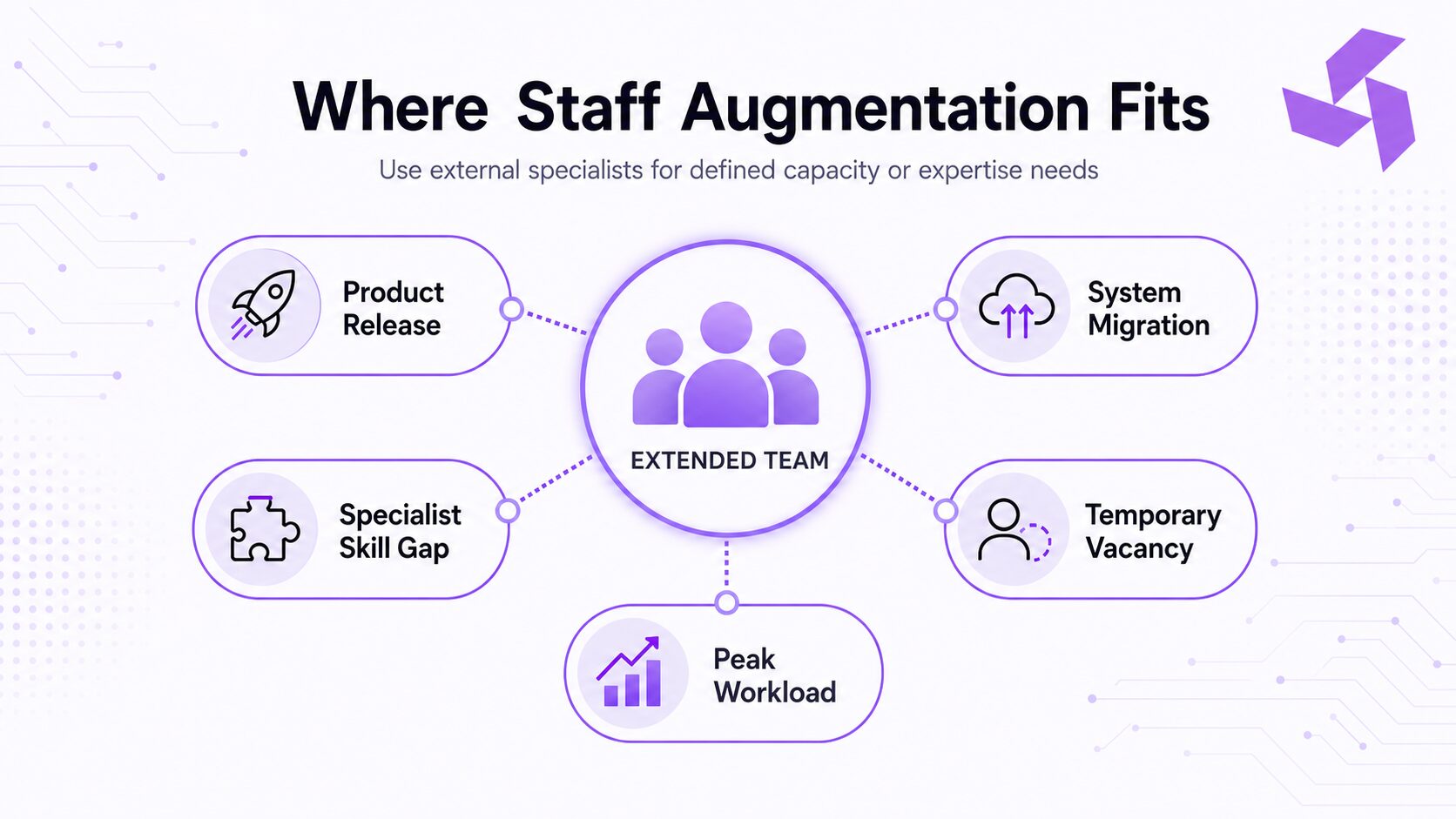
When does staff augmentation make sense? The clearest situations involve a known skills or capacity gap that the internal team can manage.
Supporting a Product Release
A development team may need extra backend developers, mobile specialists, or QA engineers to complete a scheduled release. External professionals can support the busy period and leave after stabilization and knowledge transfer.
Completing a System Migration
Cloud migrations, database upgrades, and platform changes may require skills that a company needs only during the transition. Specialists can help complete technical tasks, reduce avoidable errors, and document the new environment.
Filling a Temporary Vacancy
A resignation, parental leave, or extended absence can interrupt important work. An augmented professional may provide continuity while the company recruits a permanent employee or waits for an existing team member to return.
Addressing a Specific Skills Gap
An internal team may understand the product but lack experience in security testing, infrastructure automation, data engineering, or another specialist area. Adding the right professional can close that gap without transferring control of the whole project.
Managing a Temporary Workload Increase
Retail, logistics, financial services, healthcare, and other industries can experience periods of unusually high technical demand. Flexible staffing can provide extra capacity during these periods, provided the business plans onboarding before the workload reaches its peak.
How to Implement Staff Augmentation Successfully
A provider can supply candidates, but the client must create the conditions in which those professionals can contribute effectively.
First, define the role precisely. Document the required skills, expected responsibilities, working hours, reporting line, project duration, and success criteria. Separate essential requirements from preferences.
Second, assess practical ability. Use structured interviews, relevant technical exercises, portfolio reviews, and communication questions. The evaluation should reflect the actual role instead of relying on generic tests.
Third, prepare secure onboarding. Give each person only the system permissions needed for the role. Use individual accounts, multi-factor authentication, approved devices, and a documented process for changing or removing access.
Fourth, integrate external professionals into the team. Include them in relevant meetings, communication channels, project documentation, and review processes. Treating them as disconnected temporary workers can create missing context and slow decisions.
Finally, begin knowledge transfer early. Important decisions, setup instructions, code changes, and operating procedures should be documented throughout the engagement. Waiting until the final week increases the risk of losing valuable information.
Limitations and Mistakes to Avoid
Staff augmentation does not remove the need for management. External specialists still require priorities, feedback, access, and timely decisions. If nobody owns these responsibilities, delivery can slow down even when the individuals have strong technical skills.
A vague role is another common problem. Searching for “a senior developer” without defining the technology, responsibilities, and expected outcomes makes candidate selection difficult.
Weak onboarding can also reduce value. People cannot contribute effectively if access takes weeks, documentation is missing, or the internal team does not explain how decisions are made.
Businesses should avoid excessive dependence on one external person or provider. Critical knowledge should remain documented and accessible to the internal team.
Cost assumptions also require care. A low hourly rate can become expensive if communication problems, weak quality, or repeated rework consume internal time.
Staff augmentation may not suit every requirement. Permanent hiring can make more sense when a role is central to long-term business capability. Outsourcing or managed delivery may be more appropriate when the company wants an external provider to accept responsibility for a complete project.
Making the Right Staffing Decision
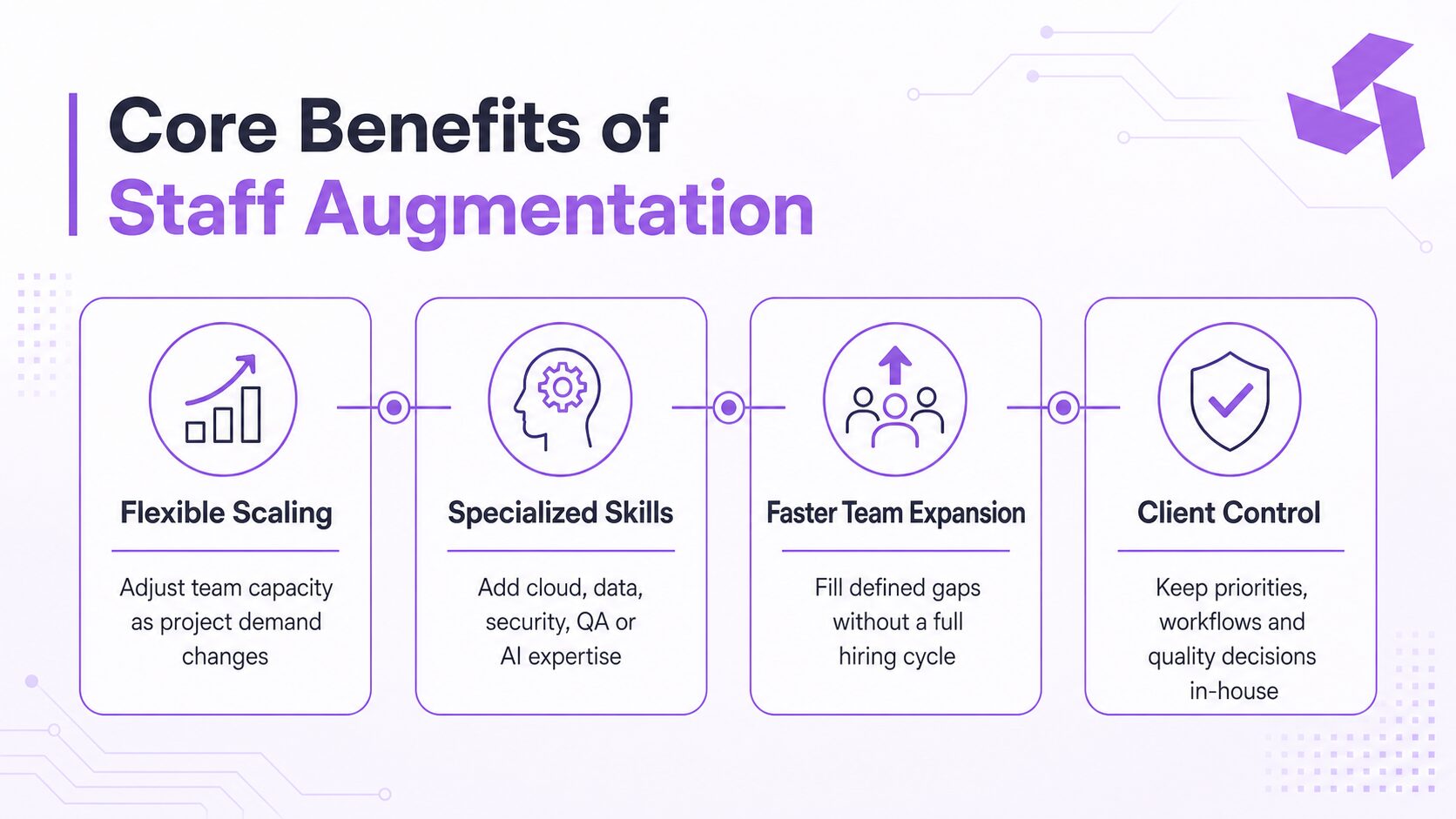
The main staff augmentation benefits include flexible scaling, access to specialized knowledge, faster team expansion, and continued control over delivery. These advantages can help a business respond to deadlines, vacancies, technical gaps, and temporary changes in demand.
Results depend on more than finding available professionals. The company must define roles carefully, assess candidates properly, provide secure access, integrate people into the team, and maintain useful documentation.
Before selecting a staffing model, identify the exact business problem. Does the company need temporary capacity, a specialist skill, a permanent capability, or complete external delivery? A clear answer will make it easier to choose between staff augmentation, permanent hiring, and outsourcing.

Build Smart with The Right Team.
We bring expertise, technology, and trust you look for in your digital journey.