

The financial industry is rapidly evolving as users shift toward faster, safer, and more convenient digital solutions. From mobile banking and e-wallets to investment and budgeting apps, fintech products are now essential to everyday life.
Businesses looking to build secure and scalable financial platforms must understand the right features, costs, and development considerations. With the growing demand for Fintech app development, this guide explores the key elements that ensure your app meets modern user expectations and industry standards.
What Are Fintech Apps?
Fintech apps are digital platforms that simplify financial activities such as payments, banking, investing, and budgeting. They offer fast, secure, and convenient financial services, making money management easier for users and businesses.
Why is the Adoption of Fintech Apps Rising?
Fintech app adoption is rising due to convenience, faster transactions, enhanced security, and accessibility. Users prefer digital solutions that offer real-time payments, easy account management, and personalized financial tools without visiting physical branches.
The Importance of Digital Finance
Digital finance enables faster, safer, and more efficient financial operations for users and businesses. It improves accessibility, reduces costs, increases transparency, and supports financial inclusion, making modern financial services available to everyone, anytime.
The Main Types of Fintech Apps
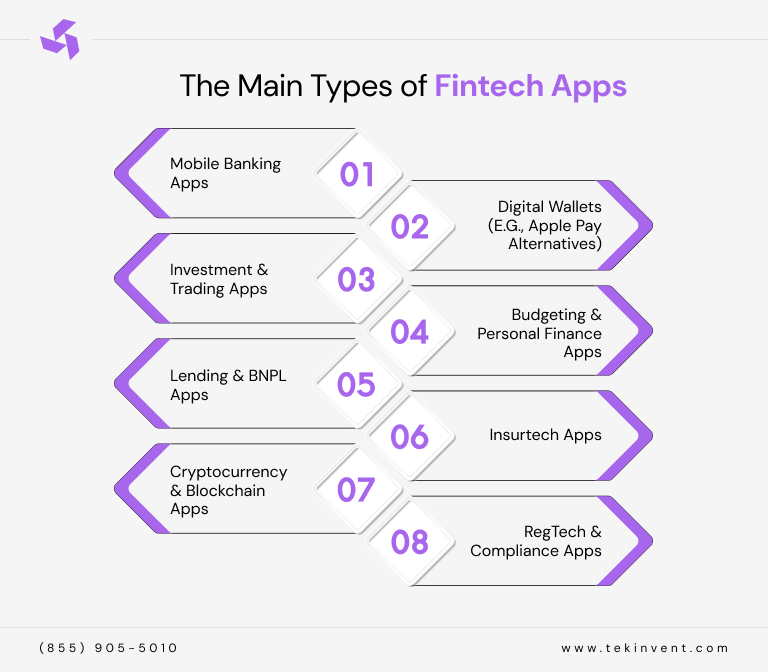
Fintech apps include mobile banking, digital wallets, payment gateways, investment platforms, lending apps, insurance apps, budgeting tools, and cryptocurrency apps. Each type supports different financial needs with tailored features for convenience and security.
1. Mobile Banking Apps
Mobile banking apps let users manage accounts, transfer funds, pay bills, and track transactions instantly. They offer secure, convenient banking without visiting physical branches, improving accessibility and customer experience.
2. Digital Wallets (e.g., Apple Pay alternatives)
Digital wallets store payment information securely, enabling fast contactless payments online or in-store. They simplify checkout processes, enhance security, and support multiple cards, making them essential for modern digital transactions.
3. Investment & Trading Apps
Investment and trading apps allow users to buy stocks, crypto, and mutual funds in real time. They provide analytics, portfolio tracking, and low fees, empowering users to invest easily.
4. Budgeting & Personal Finance Apps
Budgeting apps help users manage spending, track expenses, set savings goals, and analyze financial habits. They offer personalized insights, alerts, and automation to improve money management and financial health.
5. Lending & BNPL Apps
Lending and BNPL apps offer instant loans, credit scoring, and installment payment options. They simplify borrowing with fast approvals, minimal documentation, and flexible repayment, making credit more accessible to users.
6. Insurtech Apps
Insurtech apps streamline insurance processes by offering digital policy management, claim submission, quote generation, and real-time support. They enhance transparency, reduce paperwork, and provide personalized insurance solutions using advanced analytics.
7. Cryptocurrency & Blockchain Apps
Crypto apps allow users to buy, store, and trade digital assets securely. They feature blockchain-based authentication, real-time tracking, and decentralized transactions, offering transparency and enhanced financial control.
8. RegTech & Compliance Apps
RegTech apps help businesses meet financial regulations through automated compliance checks, fraud detection, identity verification, and reporting. They reduce risk, improve accuracy, and lower compliance costs with advanced AI-driven monitoring.
Why Fintech App Development Requires Specialized Expertise
Fintech projects demand expert handling due to strict security needs, regulatory requirements, complex integrations, and high transaction volumes. Specialized teams ensure reliability, compliance, and smooth financial operations without compromising performance or security.
1. High Security Requirements
Fintech apps must protect sensitive financial data using encryption, biometrics, fraud detection, and secure architectures. High security standards prevent breaches, ensuring user trust and safeguarding transactions against evolving cyber threats.
2. Regulatory Compliance (KYC, AML, PCI-DSS)
Fintech apps must comply with regulations like KYC, AML, and PCI-DSS. Meeting these legal standards ensures secure identity verification, prevents fraud, and protects payment data while avoiding penalties and operational risks.
3. Large Transaction Volumes
Fintech platforms handle thousands of transactions simultaneously, requiring scalable systems that remain fast and stable. Proper optimization ensures real-time processing, minimal delays, and reliability during peak financial activity.
4. Complex Integrations (banks, payment gateways, APIs)
Fintech apps rely on integrations with banks, payment gateways, credit bureaus, and third-party APIs. These integrations require technical expertise to ensure secure data exchange, smooth communication, and consistent financial operations.
Key Features of a Successful Fintech App
A successful fintech app combines security, usability, and functionality. Key features like authentication, real-time transactions, AI insights, and robust admin controls ensure seamless, reliable, and user-friendly financial experiences.
1. Secure User Authentication
User authentication via biometrics, passwords, or multi-factor methods protects accounts, ensures secure access, and prevents unauthorized transactions, building trust and safeguarding sensitive financial data.
2. Real-Time Payments & Transfers
Real-time payments and transfers allow instant fund movement between accounts, enhancing convenience and efficiency while providing notifications for completed transactions and ensuring transparency.
3. Robust KYC & AML Verification
Integrating KYC and AML verification ensures users’ identities are authenticated, prevents fraud, and ensures compliance with financial regulations, maintaining a secure and trustworthy platform.
4. Secure Data Encryption
End-to-end encryption protects sensitive financial data, including transactions and personal details, from breaches or cyberattacks, ensuring secure storage and communication within the app.
5. Wallet Integration & Money Management
Digital wallet integration allows users to store, transfer, and manage funds effortlessly. Combined with money management tools, it simplifies payments, budgeting, and account tracking in one platform.
6. Transaction History & Insights
Detailed transaction histories and analytical insights enable users to track spending, monitor investments, and make informed financial decisions, improving transparency and engagement.
7. Push Notifications
Push notifications keep users informed about payments, promotions, security alerts, and personalized financial insights, increasing engagement and providing timely, actionable updates.
8. Budgeting Tools & AI Insights
AI-driven budgeting tools analyze spending patterns, provide smart suggestions, and help users optimize finances, save money, and reach financial goals more efficiently.
9. Customer Support (Chatbot + Live)
Integrated chatbots and live support offer instant assistance for queries, disputes, or troubleshooting, ensuring a smooth user experience and enhanced satisfaction.
10. Admin Panel for Full Control
A robust admin panel allows app owners to manage users, monitor transactions, control content, and oversee operations securely, ensuring smooth platform administration and compliance.
Advanced Features Modern Fintech Apps Include
Modern fintech apps go beyond basic banking, integrating AI, crypto, automated savings, cross-border payments, and advanced card management. These features enhance security, convenience, and personalization for today’s tech-savvy users.
1. AI-Powered Fraud Detection
AI analyzes transactions in real time to detect unusual patterns and prevent fraud, ensuring financial security, minimizing losses, and protecting both users and the platform from cyber threats.
2. Crypto Wallet Integration
Integration with cryptocurrency wallets allows users to buy, store, and transfer digital assets securely, supporting blockchain transactions and expanding app functionality for modern finance enthusiasts.
3. Automated Saving Tools
Automated savings tools round up purchases or set aside funds periodically, helping users save effortlessly and reach financial goals without manual tracking or effort.
4. Investment Portfolios / Robo-Advisors
Robo-advisors provide algorithm-driven investment recommendations, portfolio management, and risk analysis, enabling users to invest intelligently with minimal effort and professional-level guidance.
5. QR Code Payments
QR code payments enable fast, contactless transactions in-store or online, reducing friction, improving convenience, and supporting secure digital payment options for users.
6. Cross-Border Payments
Cross-border payment functionality allows users to send and receive money internationally, handling multiple currencies efficiently while minimizing transaction costs and delays.
7. Card Management (virtual/physical cards)
Virtual and physical card management allows users to create, activate, block, or monitor cards directly from the app, ensuring secure, flexible, and convenient payment control.
Technology Stack for Fintech App Development
A robust technology stack ensures scalability, security, and performance. Choosing the right front-end, back-end, database, security tools, and payment integrations is critical for reliable, modern fintech applications.
1. Front-End Technologies (Flutter, React Native, Swift, Kotlin)
Front-end frameworks like Flutter, React Native, Swift, and Kotlin create responsive, intuitive, and visually appealing interfaces, enabling smooth user experiences across mobile platforms.
2. Backend Technologies (Node.js, .NET, Python)
Backend technologies such as Node.js, .NET, and Python handle data processing, business logic, APIs, and server-side operations to ensure app scalability and reliability.
3. Database Options (PostgreSQL, MongoDB, DynamoDB)
Databases like PostgreSQL, MongoDB, and DynamoDB store and manage sensitive financial data securely, supporting high transaction volumes and real-time access for users.
4. Security Tools & Encryption Frameworks
Security tools and encryption frameworks protect user data, ensure regulatory compliance, prevent breaches, and maintain trust across all fintech transactions.
5. Payment Gateway Integrations (Stripe, PayPal, Plaid, etc.)
Integrating gateways like Stripe, PayPal, and Plaid enables seamless, secure payments, transfers, and financial operations within the app, improving convenience for users.
Fintech App Development Process
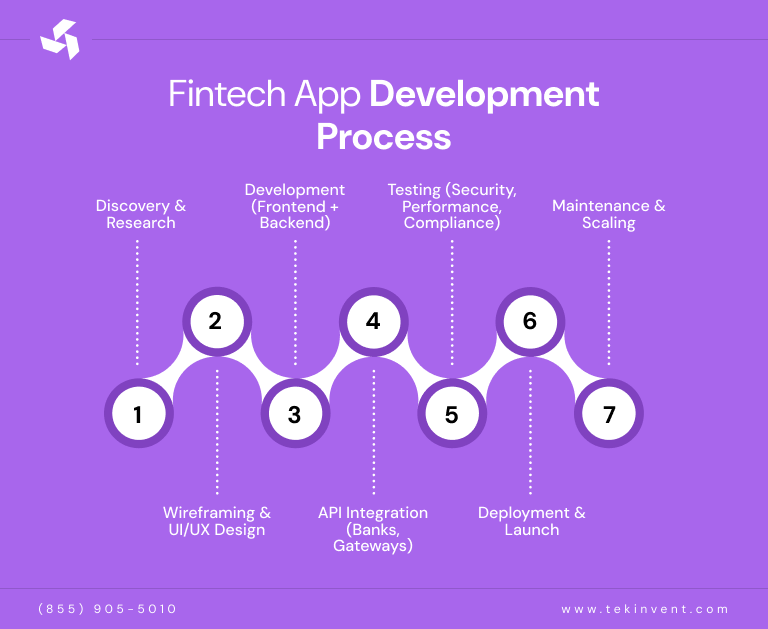
A structured development process ensures successful fintech apps. From research to maintenance, each step ensures security, usability, and regulatory compliance for smooth operations and high user satisfaction.
1. Discovery & Research
Identify target users, business goals, competition, and regulatory requirements to plan a strategic, secure fintech app roadmap.
2. Wireframing & UI/UX Design
Design intuitive, user-friendly interfaces with clear flows, ensuring seamless interactions and visually appealing layouts for engaging app experiences.
3. Development (Frontend + Backend)
Build scalable front-end interfaces and robust back-end systems, ensuring smooth functionality, real-time processing, and high performance.
4. API Integration (banks, gateways)
Integrate APIs for banking, payments, and third-party services, enabling real-time transactions, secure data exchange, and expanded functionality.
5. Testing (Security, performance, compliance)
Conduct thorough testing for security, performance, and regulatory compliance, identifying vulnerabilities and ensuring app reliability.
6. Deployment & Launch
Deploy the app on platforms like iOS and Android, ensuring smooth launch, stable performance, and initial monitoring.
7. Maintenance & Scaling
Provide continuous updates, bug fixes, and scaling solutions to support growing users, transactions, and feature expansions.
How Much Does Fintech App Development Cost?
Fintech app development costs vary by complexity, platform, and features. Understanding cost ranges helps businesses plan budgets effectively and ensure high-quality, secure solutions.
1. Banking app
Banking apps cost more due to account management, transfers, and security compliance, typically ranging from US$50,000 to US$150,000, depending on features.
2. Wallet app
Wallet apps are moderately priced, around $30,000–$80,000, including fund transfers, card integration, and payment processing.
3. Trading app
Trading apps cost $70,000–$200,000 due to real-time data, analytics, portfolio management, and regulatory compliance requirements.
4. Crypto app
Crypto apps range from US$80,000 to US$250,000, factoring in blockchain integration, wallet security, and real-time crypto trading functionality.
Factors That Affect Fintech App Development Cost
Multiple factors determine cost, including app complexity, number of features, security requirements, technology stack, platform, design, and development team location.
1. App Complexity
More features and real-time functionality increase development time and cost.
2. Number of Features
Apps with advanced integrations, AI, or analytics require more resources, raising costs.
3. Platform (iOS, Android, Cross-Platform)
Developing for multiple platforms or cross-platform affects the budget and timeline.
4. Security Requirements
High-security features like encryption, fraud detection, and authentication add to development cost.
5. Technology Stack
Choice of backend, frontend, database, and third-party integrations influences complexity and expenses.
6. Design Complexity
Custom UI/UX, animations, and advanced interfaces increase time and cost.
7. Development Team Location
Hourly rates vary by region; outsourcing to cost-effective countries reduces expenses without compromising quality.
How to Choose the Right Fintech App Development Company?
Selecting the right company ensures security, regulatory compliance, and high-quality development while avoiding delays, poor design, or data risks.
1. Check Their Portfolio
Review past projects to assess experience, design quality, and fintech expertise.
2. Look for Regulatory Knowledge
Ensure the team understands KYC, AML, PCI-DSS, and other financial regulations.
3. Ask About Their Security Practices
Confirm secure coding, encryption standards, and fraud prevention measures.
4. Evaluate Their Tech Expertise
Check experience with fintech frameworks, databases, APIs, and scalable architectures.
5. Clear Communication & Project Transparency
Choose a company offering regular updates, milestones, and open communication to avoid misunderstandings.
Final Thoughts
Fintech app development requires careful planning, robust security, and feature-rich designs to meet modern financial needs. By understanding features, costs, and best practices, businesses can launch scalable, reliable, and user-friendly apps that build trust and drive adoption.

Build Smart with The Right Team.
We bring expertise, technology, and trust you look for in your digital journey.