

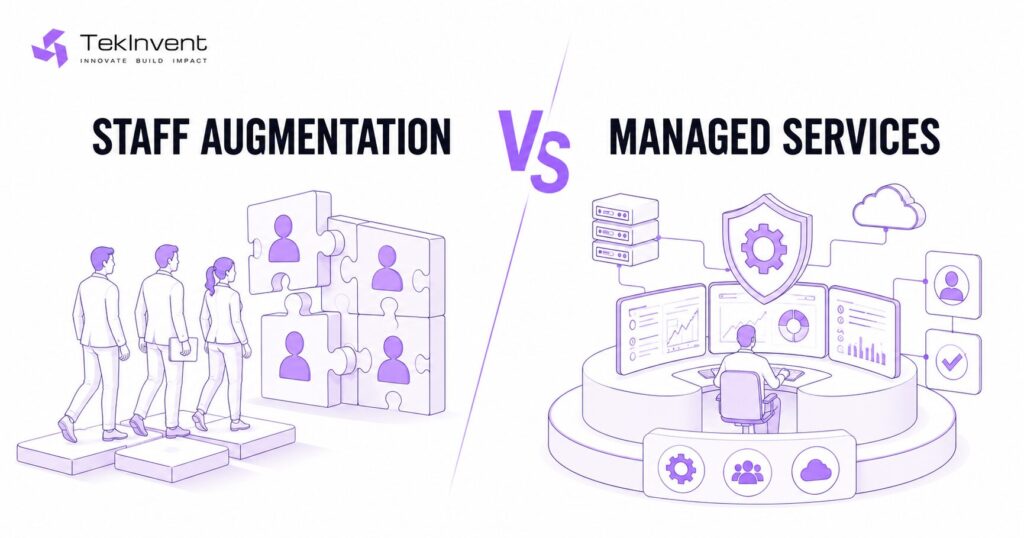
Technology needs can change quickly. A business may need additional developers for a new product, cybersecurity expertise during a security project, or ongoing IT support without building a large internal department. In these situations, companies often consider Staff Augmentation vs Managed Services as two possible ways to access external expertise. An IT staff augmentation services can be especially useful when a company needs skilled professionals to strengthen its existing team without making permanent hires.
Although both models involve working with an outside technology provider, they are designed for different needs. Staff augmentation adds skilled professionals to an existing team, while managed services generally involve outsourcing responsibility for a specific IT function or service.
Understanding this difference is important for business owners, technology leaders, and project managers. Choosing the wrong model can create unnecessary management work, unexpected costs, or unclear responsibilities. The right approach depends on the level of control you want, the type of expertise required, the length of the engagement, and who should be responsible for delivering the work.
What Is the Difference Between Staff Augmentation and Managed Services?
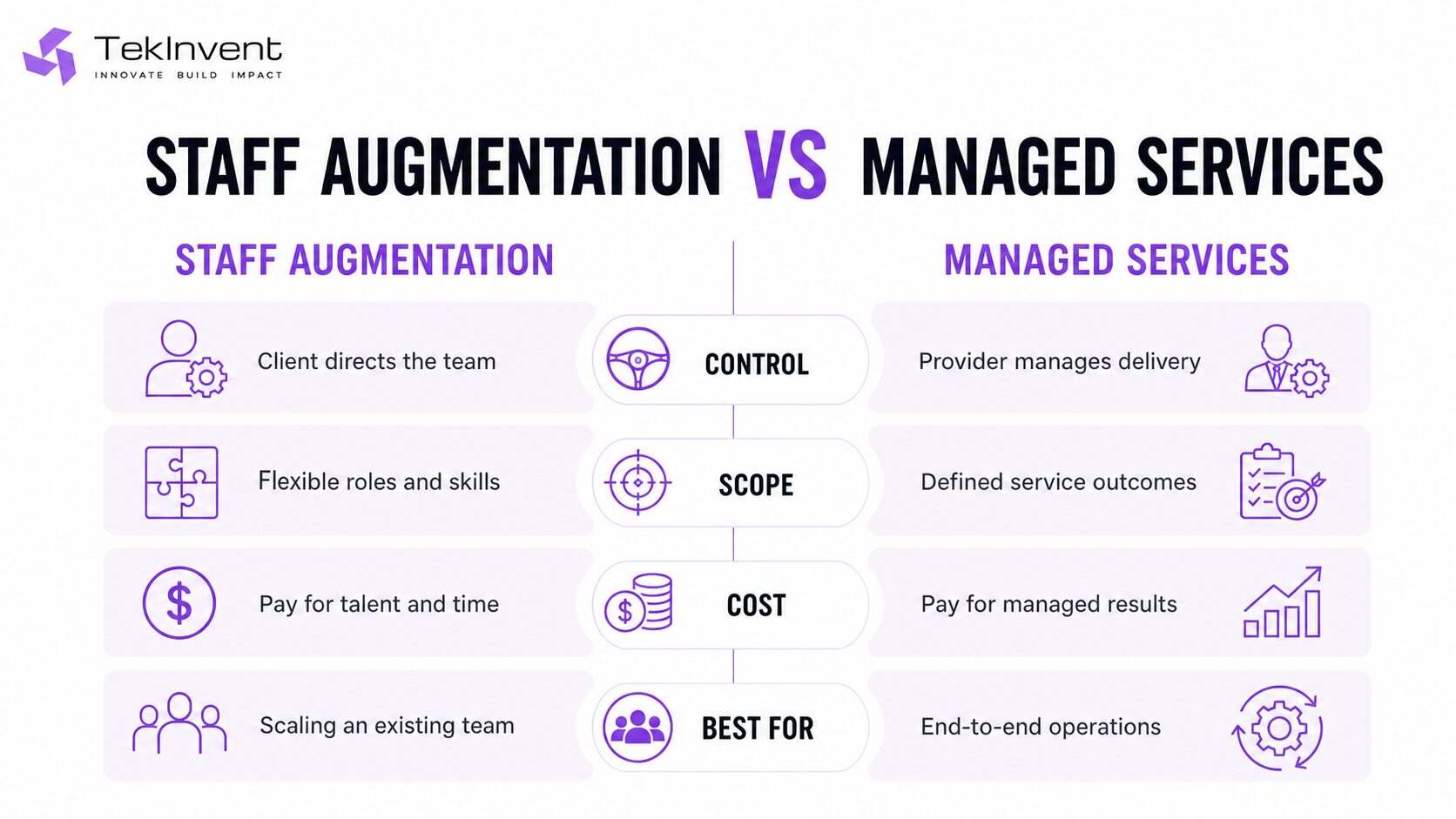
The clearest way to understand Staff Augmentation vs Managed Services is to look at who manages the people and who is responsible for the final work.
With staff augmentation, a business brings external professionals into its existing team. These professionals might include software developers, UX designers, QA engineers, DevOps specialists, data engineers, or cybersecurity professionals. They work alongside the company’s internal employees and generally follow the organization’s existing processes and priorities. Businesses can learn more about how this approach works in the IT staff augmentation model.
For example, imagine a software company preparing to launch a new mobile application. Its internal development team has enough frontend developers but lacks an experienced backend engineer. Instead of hiring a permanent employee, the company could use staff augmentation to bring in a backend specialist for the duration of the project.
The internal team would still decide what needs to be built, assign tasks, review progress, and manage the overall project. The external professional simply becomes an extension of that team.
Managed services work differently. Instead of adding individual professionals to the organization, the business gives an external provider responsibility for a defined service or IT function. The provider manages its own team and processes while delivering the agreed service according to contractual requirements and, in many cases, service-level agreements.
For example, a company might outsource its network monitoring and technical support to a managed services provider. The provider handles monitoring, responds to incidents, manages its employees, and reports on performance.
This is the central difference when comparing managed services vs staff augmentation. Staff augmentation primarily gives a business additional people and skills. Managed services gives the business an external team responsible for delivering a defined service.
Why Does the Difference Matter?
The choice between these models can affect how a business manages projects, controls costs, handles technical responsibilities, and scales its workforce.
One of the biggest advantages of staff augmentation is control. The business maintains direct control over the work being performed. Internal managers can assign tasks, change priorities, participate in meetings, and make technical decisions alongside the augmented professionals. The benefits and use cases of staff augmentation can make this approach useful when companies need additional expertise without changing their overall project structure.
This makes the model useful for projects where requirements change regularly. A company developing an e-commerce platform, for instance, may initially need two additional developers. As development progresses, it may discover that it also needs a DevOps engineer or QA specialist. Staff augmentation allows the company to add those skills without committing to permanent hiring.
Managed services provide a different advantage: reduced operational responsibility.
Instead of managing every technical task internally, the business can transfer responsibility for a particular function to a specialist provider. This can be valuable for organizations that do not have enough internal resources to operate an IT function efficiently.
For example, a growing company may not have the resources to maintain a dedicated cybersecurity operations team. Rather than hiring security analysts, purchasing monitoring tools, and managing continuous coverage internally, it could contract a managed security service provider to handle the function.
The distinction between IT staff augmentation vs managed services becomes particularly important in situations like this. With augmentation, the business usually manages the external professionals. With managed services, the provider manages its team and takes responsibility for delivering the agreed service.
Cost structure can also be different. Staff augmentation is often easier to scale according to the number of professionals and the length of a project. Businesses evaluating the financial side can review the factors involved in IT staff augmentation costs. Managed services may involve recurring fees based on the scope and level of service.
Neither model is automatically less expensive. The real comparison should consider the total cost of management, recruitment, tools, infrastructure, supervision, support coverage, and operational responsibility.
How to Choose the Right Model
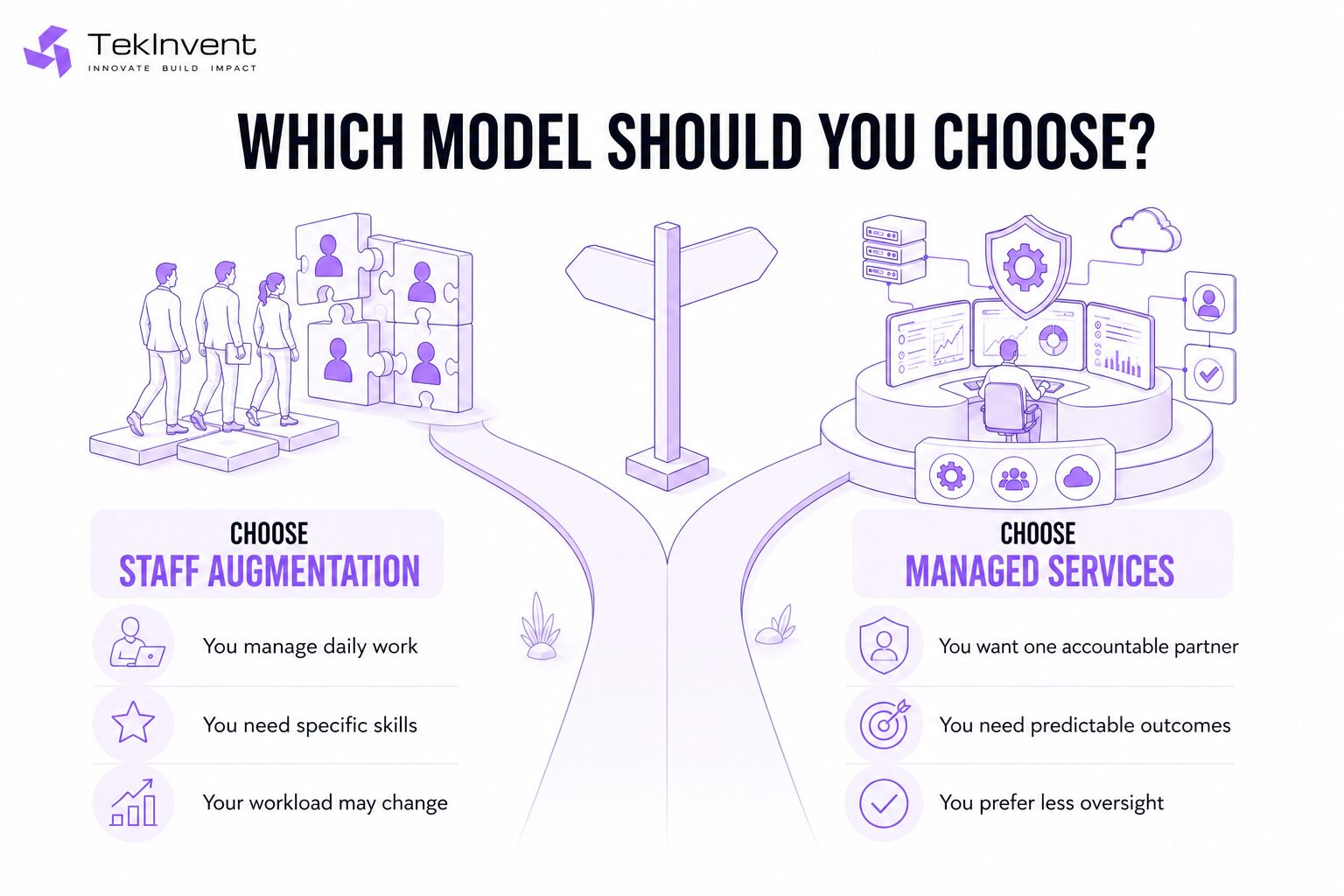
The best way to approach Staff Augmentation vs Managed Services is to start with the business problem rather than the service model.
First, determine whether you need people or an outcome.
If your company already knows what needs to be done and simply lacks the right people to do it, staff augmentation can be a practical solution. For example, a company with an established software team may bring in three additional developers to meet an important release deadline.
On the other hand, if your business needs an entire function to be managed, a managed services model may make more sense. IT help desk support, infrastructure monitoring, cloud operations, and cybersecurity monitoring are examples where ongoing service delivery may be more important than adding individual employees.
The second consideration is control.
Staff augmentation generally provides greater day-to-day control. Your project manager or technical lead can decide which tasks should be completed and how the team should work.
Managed services involve more delegation. You define the required service and expected performance, while the provider determines how its team delivers that service.
The third factor is duration.
Temporary projects are often well suited to staff augmentation. A company completing a six-month cloud migration may need additional cloud engineers during the migration but may not require those specialists afterward.
Ongoing responsibilities can be better suited to managed services. If a company needs continuous monitoring, maintenance, support, or security operations, outsourcing the function can reduce the pressure on its internal team.
You should also consider whether your business has enough management capacity.
Staff augmentation works best when someone internally can coordinate the additional professionals. External developers still need direction, priorities, technical decisions, and feedback. If you are unsure whether your organization has reached the point where additional technical professionals are needed, reviewing the common signs you need IT staff augmentation can help with the decision.
If your internal team is already overloaded, adding more people may not solve the problem. In that situation, a managed service can sometimes be more effective because the provider takes responsibility for managing the service.
Finally, establish measurable expectations before signing an agreement.
For staff augmentation, companies can evaluate performance through project milestones, delivery quality, code quality, productivity, and contribution to the development team.
For managed services, measurements may focus on service availability, response times, incident resolution, SLA compliance, system performance, and customer satisfaction.
Clear expectations make the relationship easier to manage regardless of which model you choose.
Common Mistakes to Avoid
One common mistake is choosing between Staff Augmentation vs Managed Services based only on the advertised price.
An hourly staff augmentation rate and a managed services fee do not necessarily represent the same thing. Managed services may include team management, monitoring, tools, processes, reporting, and operational responsibility. Staff augmentation may provide the professional but leave management responsibilities with the customer.
The better question is not simply “Which one costs less?” It is “Which model provides the responsibilities and resources we actually need?”
Another misconception is that managed services mean losing all control. That is not necessarily the case. A well-designed managed service agreement can define performance requirements, reporting standards, security responsibilities, escalation procedures, and service levels.
The business gives the provider operational responsibility, but it can still maintain strategic oversight.
The opposite mistake can happen with staff augmentation. Some companies assume that adding experienced professionals will automatically solve a project problem. It will not if the project lacks clear leadership.
An augmented developer may be highly skilled, but someone inside the organization still needs to establish priorities, approve decisions, communicate requirements, and coordinate the work.
Businesses should also avoid creating vague managed service agreements. Terms such as “IT support” or “cloud management” are too broad on their own. The contract should clearly explain what is covered, what is excluded, how incidents are handled, and how performance will be measured.
Another important misconception is that companies must choose one model for every IT requirement.
In practice, organizations can use both. A business might use managed services for its infrastructure and security operations while using staff augmentation to increase its software development capacity. This approach can work well when different technology functions require different levels of control and responsibility.
Conclusion
The decision between Staff Augmentation vs Managed Services depends largely on what your business needs from an external technology partner.
Staff augmentation is generally more appropriate when you need specific professionals to strengthen an existing team while maintaining direct control over the project. Managed services are better suited to situations where you want an external provider to take responsibility for an ongoing IT function or defined service.
When comparing managed services vs staff augmentation, consider more than the initial price. Look at management responsibilities, project duration, required expertise, control, accountability, security, scalability, and expected outcomes.
If your business needs additional technical talent for a specific project, staff augmentation may provide the flexibility you need. If you need a complete IT function managed continuously, a managed services model may be the more practical choice.
The right decision is ultimately the one that matches your operational needs and gives your business the right balance between control, expertise, flexibility, and responsibility.

Build Smart with The Right Team.
We bring expertise, technology, and trust you look for in your digital journey.