
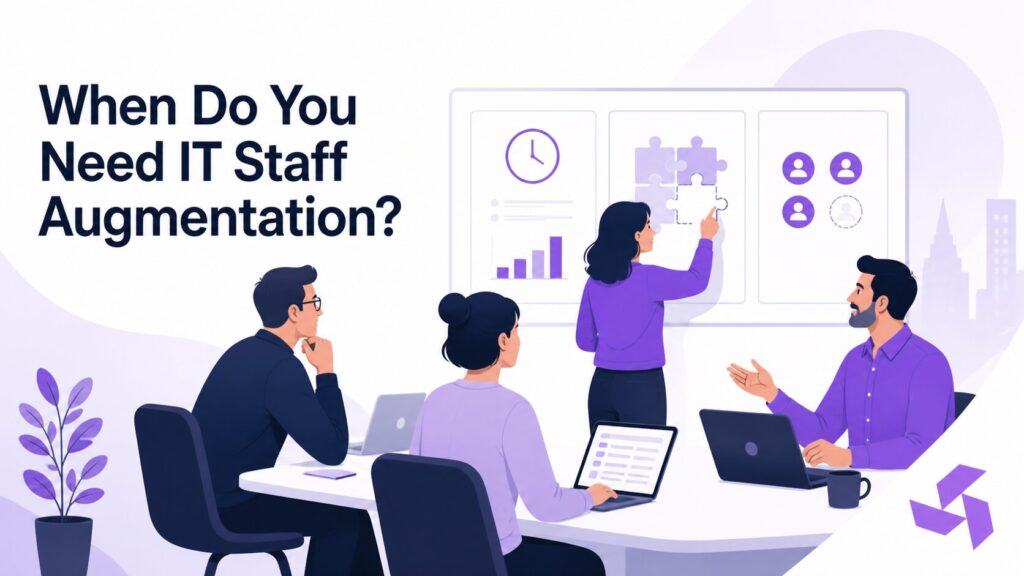
A growing backlog does not always mean a company needs more permanent employees. Some teams face a delivery surge, temporary vacancy, or technical requirement that will disappear after one project. A full-time hire may not match that need.
Knowing when to use IT staff augmentation starts with diagnosing the problem correctly. The model can add external specialists to an existing team while the business keeps control of priorities and delivery. It works best when the need is specific, an internal manager can direct the work, and the engagement has a clear purpose. The signs below can help a business decide whether augmentation, permanent hiring, or outsourcing is the more suitable response.
What IT Staff Augmentation Is Designed to Solve
Staff augmentation is a flexible staffing arrangement. A provider supplies one or more professionals who join the client’s team for an agreed role, period, or workload. The client normally assigns tasks, manages the backlog, reviews quality, and makes product or technical decisions.
That structure separates augmentation from project outsourcing, where a provider normally manages a broader result. Permanent hiring instead builds long-term internal capability.
The IT staff augmentation model is therefore most useful when a company has delivery ownership but lacks temporary capacity or a particular skill. It may support a product release, cloud migration, security review, testing phase, employee absence, or backlog reduction effort.
The model does not repair unclear priorities or weak leadership. External specialists still need direction, access, documentation, and timely feedback.
When to Use IT Staff Augmentation: Practical Signs
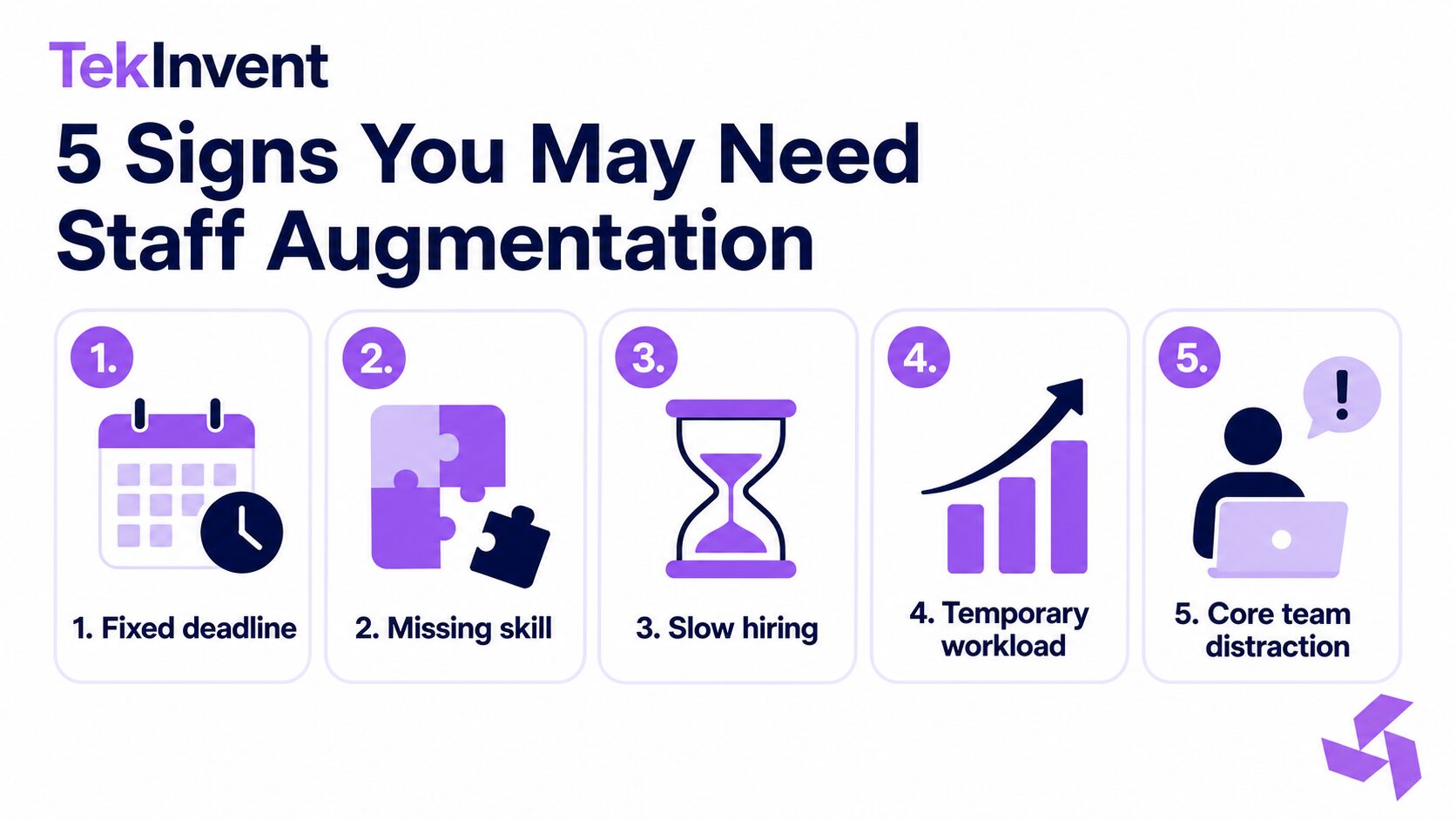
No single signal proves that augmentation is the right choice. A combination of the following conditions creates a stronger case.
A Deadline Is Approaching but the Scope Is Clear
Your team may understand what must be delivered but lack enough capacity to finish it within the required period. Examples include a scheduled release, a compliance update, a testing cycle, or a migration with a fixed cutover date.
Augmentation can help when work has defined responsibilities and an internal lead can review it. Extra capacity will not fix an unstable scope or slow approvals.
A Required Skill Is Missing Internally
A project may need cloud architecture, cybersecurity, data engineering, DevOps, test automation, or experience with a particular framework. The need may be important but limited to one phase.
A specialist can complete defined work and transfer knowledge before leaving. Permanent recruitment may be better if the skill will remain essential.
Permanent Recruitment Is Taking Too Long
A vacant technical role can block delivery while recruiters search for a long-term employee. An augmented professional can provide temporary coverage so important work continues.
Set review dates so temporary coverage does not continue without a clear business case.
Workload Has Increased for a Limited Period
Seasonal demand, a product launch, accumulated technical debt, or a large customer commitment can create a temporary workload spike. If demand is likely to fall after the work is complete, permanent headcount may be difficult to justify.
Managers should compare the expected duration with onboarding effort. A very short assignment may offer little value if useful work requires weeks of context.
Your Core Team Is Losing Focus
Special projects can pull permanent employees away from product ownership, customer priorities, or critical operations. Augmented professionals may take on defined implementation, testing, migration, or documentation work while internal staff protect the capabilities that matter most.
The existing article on staff augmentation benefits explains the wider advantages and limitations. For this decision, identify the delayed work, internal owner, and outcome that would justify the engagement.
When Staff Augmentation Makes Sense
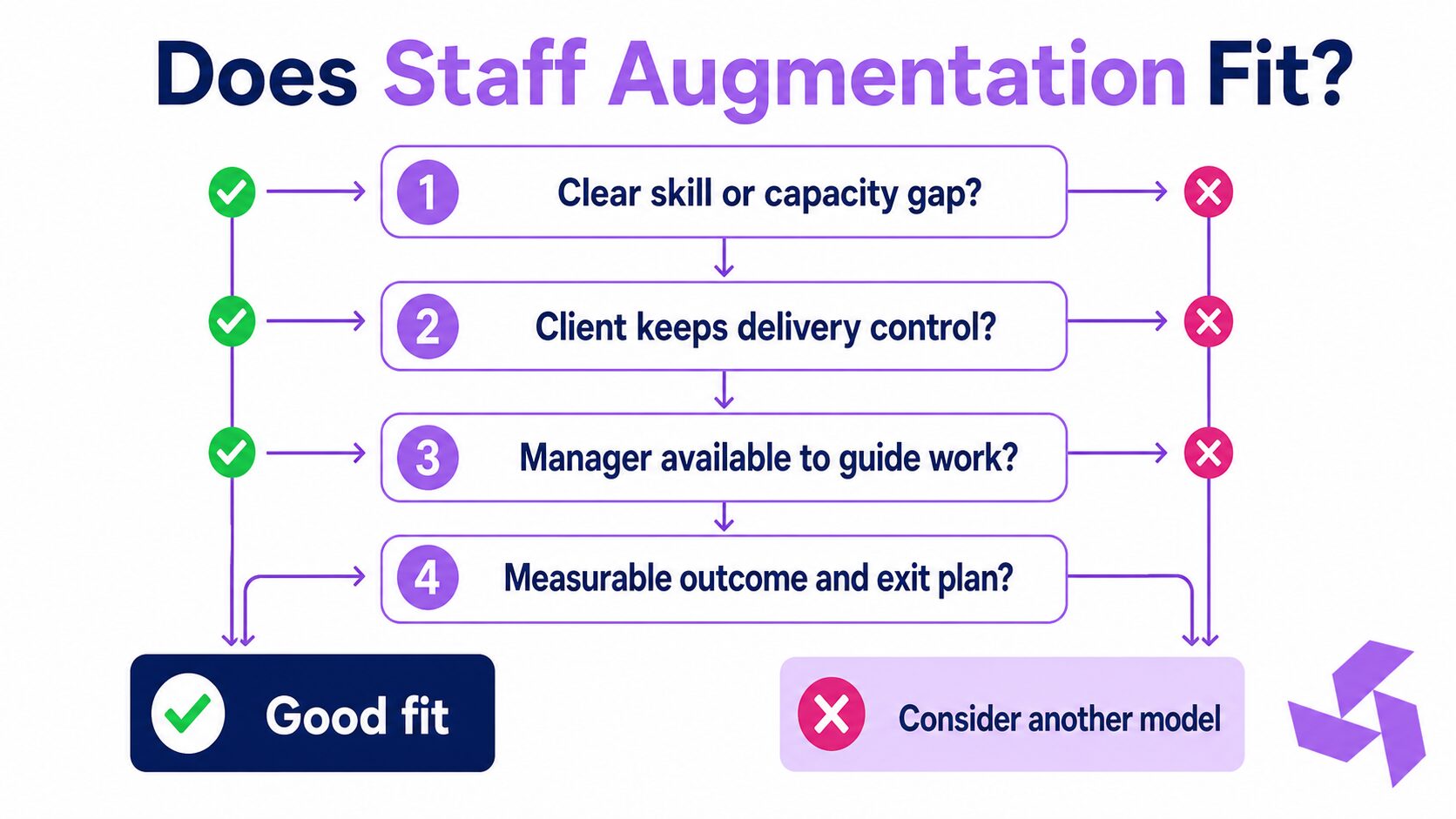
The strongest staff augmentation use cases share four characteristics:
The capability or capacity gap is clearly defined.
The client wants to retain daily control of the work.
An internal manager has time to provide direction and feedback.
The engagement has measurable outcomes and a transition plan.
For example, a development team may understand its product but lack enough QA capacity for a release. External QA engineers can address that gap without taking ownership of the release.
A cloud migration may similarly need a specialist for architecture, automation, and knowledge transfer only until the new environment stabilizes.
Businesses considering IT staff augmentation services should write the desired outcome before requesting candidates. A useful statement names the required skill, expected work, duration, reporting line, working-hour overlap, and acceptance criteria. This makes provider and candidate evaluation more reliable.
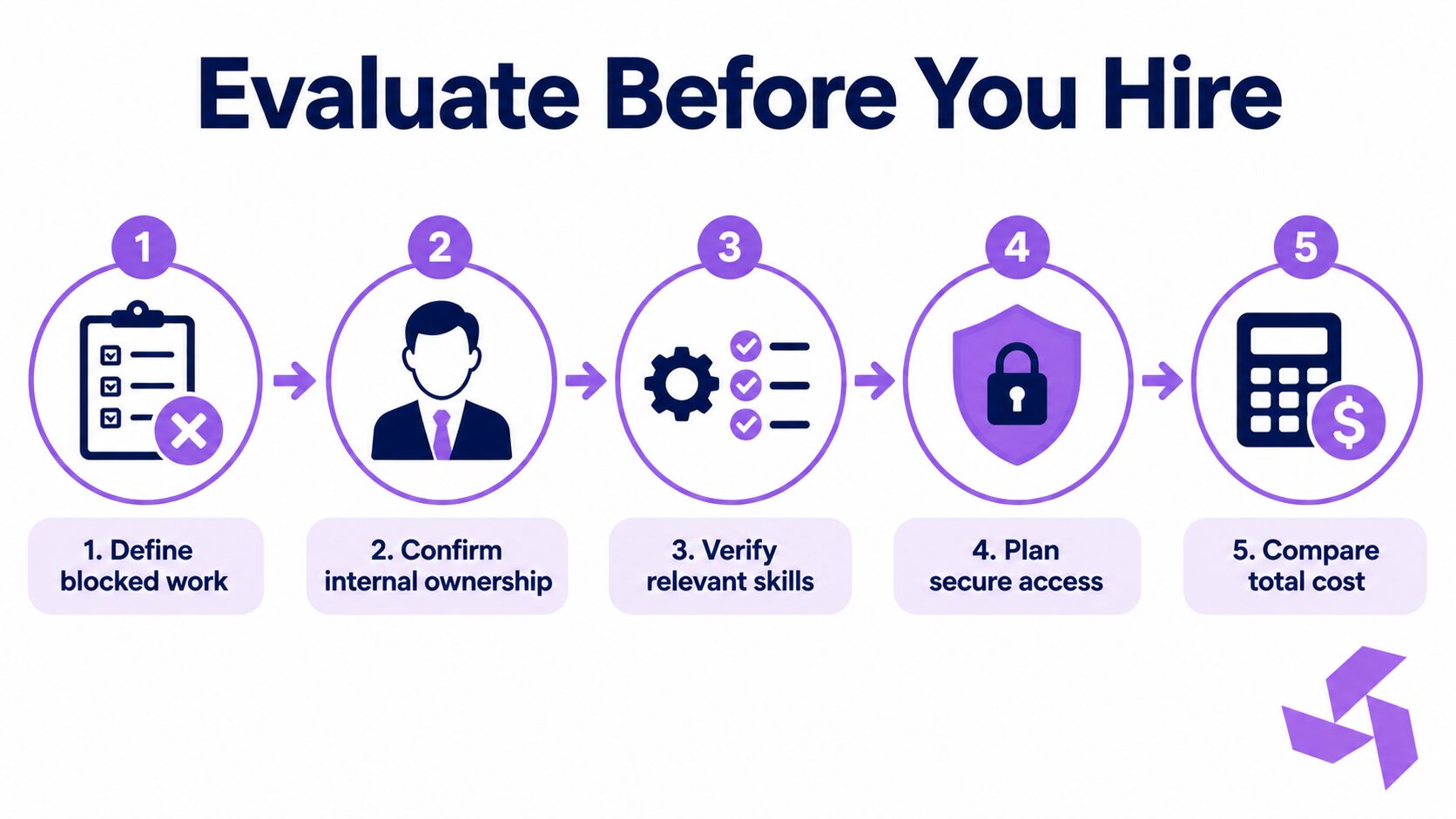
How to Evaluate the Decision Before Hiring
Start with the workload, not a job title. List the tasks that are blocked, the skills required, and the consequences of delay. Then estimate whether the need is temporary, recurring, or permanent.
Next, test internal readiness. Who will assign work? Who will approve technical decisions? Are architecture notes, coding standards, security policies, and access procedures available? A company should resolve these questions before the start date.
Evaluate candidates with relevant work samples, structured interviews, practical scenarios, and communication questions. Generic tests may not reflect the real environment.
Plan secure onboarding. Give each person only the permissions needed for assigned work, use individual accounts and multi-factor authentication, review access, and remove it promptly at the end.
Finally, compare the complete cost. Include provider charges, onboarding, equipment, software licenses, internal management time, security work, possible rework, and handover. The lowest hourly rate does not always produce the lowest delivery cost.
When Another Model May Be Better
A managed project can be more suitable when a provider should plan the work, coordinate the team, and accept responsibility for a complete deliverable.
Permanent hiring may be stronger for a strategic capability the business expects to need for years.
Repeated contract extensions also deserve review. Compare a continuous role with permanent hiring, and reconsider augmentation when onboarding exceeds the assignment or security rules make external access impractical.
Common Decision Mistakes
The first mistake is treating every missed deadline as a staffing shortage. Unclear requirements, slow approvals, and weak prioritization can delay work even with a larger team. Find the constraint before adding capacity.
Do not choose from resumes alone. Verify role-specific ability, communication, availability, and relevant experience.
Assign an internal owner who can answer questions, review output, and resolve blockers.
Require documentation, review, handover, and access removal from the beginning. A planned exit protects continuity.
Conclusion
Knowing when to use IT staff augmentation requires more than recognizing that a team feels busy. The model is most effective when a company has a specific skill or capacity gap, wants to retain delivery control, and can manage the added professionals effectively.
Look for clear signals: a defined deadline, missing specialist knowledge, temporary vacancy, limited workload surge, or core team pulled away from important responsibilities. Then compare the duration, total cost, management requirements, and security needs with permanent hiring or outsourcing. A well-defined problem and measurable outcome make staff augmentation a deliberate workforce decision rather than a temporary fix that continues without review.

Build Smart with The Right Team.
We bring expertise, technology, and trust you look for in your digital journey.