
We are standing in the 21st century, and there is no wrong in saying that, intruders and malware attackers are working really quick to get into the databases and hijack the data from it. Some hackers do it for fun, whereas, some do it for accessing the data, and selling it to other marketing firms for revenue purposes.
Data privacy is the paramount to mobile app development and the companies dealing with app designing and development are now investing heavily into data security because of the different case studies of data thrift.
Whether you are into the IT industry, or planning to start your own design firm, mobile apps are now focusing more on the data security concerns, and users literally want assurance while investing into mobile app development because they know data should be kept secured from unauthorized access.
In this blog, we are now going to discuss the core steps involved to ensure data privacy in mobile app development.
So, this blog is going to be really technical and data-driven for you.
Interesting Statistics About Data Privacy In Mobile App Development
According to usercentric, Data privacy is a paramount concern in 2026, with 86% of consumers worrying about personal data privacy and 48% stopping purchases due to concerns.
- High Awareness: 85% of adults globally want to do more to protect their online privacy, Usercentrics.
- Active Measures: 61% of consumers reviewed or updated their privacy settings in the last 12 months, CookieYes.
- Behavior Shifts: 71% of consumers would stop buying from a company that mishandles their sensitive data, Keywords Everywhere.
- Cookie Consent: 69% of consumers do not automatically accept all cookies, CookieYes
- Breach Cost: The average cost of a data breach per compromised record is approximate to $160, Marketing LTB.
- Breach Source: 57% of data breaches in 2025 were caused by third-party system vulnerabilities, Partisia.
- Detection Time: The median time to detect a data breach is 76 days, Marketing LTB.
- Investment: 95% of companies say investing in data privacy is worth the cost, Keywords Everywhere.
Understand Data Privacy Laws and Regulations
Compliance stands first when it comes to securing the data privacy laws and again it’s the foundational aspect for protecting the data from the end users. Different regions come with different laws and data protection laws like:
- General Data Protection Regulation also known as GDPR in the European Union.
- California Consumer Privacy Act (CCPA) in California, United States.
- Children’s Online Privacy Protection Act (COPPA) for apps targeting children.
The integrity of the data privacy stands as a strong domain in the paramount concern that grips the developer and users. Whereas, if we talk about web and app development, the concerns to keep the data safe from unauthorised access is really important. It plays a great role in maintaining data privacy and plays a crucial role in shaping the secure and dependable digital ecosystem.
Core Concepts behind Data Privacy –
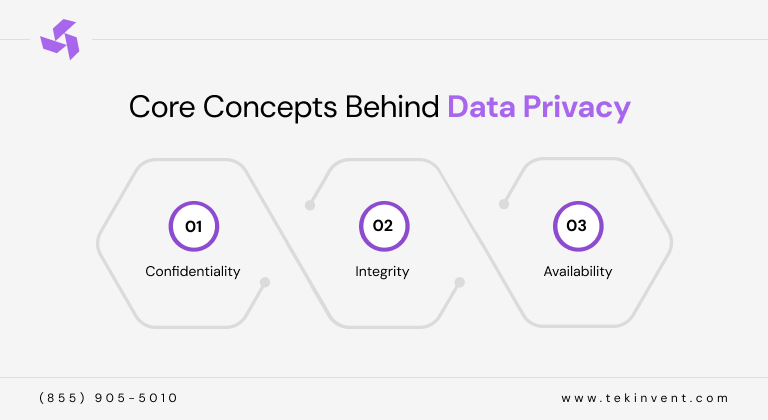
Data privacy is the heart of mobile app development and it relies on different concepts that helps protect personal data from unauthorized access. It includes:
- Confidentiality – to ensure that personal data should be accessible for those who have the access to it.
- Integrity – it’s important to maintain data accuracy and completeness of the data, preventing unauthorized alterations.
- Availability – in order to guarantee that data should be accessible for authorised users only; perhaps, when needed only.
The core concepts behind maintenance of data privacy includes, policies and practices that are built to ensure that personal data is kept secured from unauthorised access without any hassle.
Now let’s hear about the personal data vs sensitive data…
Personal Data vs Sensitive Data
Before we jump into the discussion of protecting the personal data of the customers from intruders. Here is a quick overview of the difference between personal and sensitive data.
| Personal Data | Sensitive Data |
|
|
|
|
The Importance of Data Privacy in Mobile App Development
The importance of data privacy in mobile app development can never be overstated. We have seen different case studies where companies explained the importance of data privacy and how one negligence took them to the loss of millions. Ensuring robust data privacy practices is really important for fostering trust and transparency amongst the end users. Here is a quick overview of the core attributes and dynamics:
We are standing in the era where data breach is pretty much common and it’s making headlines almost every other day. However, users are now increasingly aware of the data risks that are associated with data leaks, and how it can be mishandled for fulfilling a purpose.
Here is a quick overview of maintaining the trust and brands reputation for a cause:
-
Building Trust amongst the Users:
A mobile app development firm should focus on maintaining transparent data practices to ensure clear privacy policies and easy to understand consent forms so it’s easier for the users to read and understand. Whenever a user feels confident that their data is in safe hands and will not be made available for anyone else, they can trust blindly into the app development firm.
-
Protecting the Brands’ Reputation:
Whenever a data leak issue is reported by any customer, it leaves a negative impact on the company. Therefore the need for maintaining privacy is always very important. Perhaps, implementing the robust data privacy measures, businesses should focus on safeguarding the brand’s reputation, and avoid fallout from data breaches.
-
Collect Necessary Data Only:
The key step to data privacy maintenance is to collect necessary data only from the users while they are registering for the services. For instance, if the user is signing up for a GPS-based mobile app to view the location and reach a better one, the app should ask for physical location data only, not any sensitive data like bank details that comprise privacy concerns.
Data breach in sensitive data is very expensive, and we assume that you all know the consequences pretty well.
-
Implement Strong Authentication and Authorization Mechanisms:
The app developers should know how to implement the authentication practices where only authorised users can access the data, and control the viewership of the entire database. In this way, any third-party or person can never get into the mobile app’s private database.
There are different ways to authenticate the users like, sending a code to the user’s phone while they try to access the app from any other platform and those who fail are now allowed to access the mobile app.
However, the app should work with “not storing the password” mechanism in order to keep the users fully confident while accessing the app. Biometric or face recognition authentication practices serve to be best in terms of maintaining data privacy.
-
Cloud Security:
Storing and processing the data in the cloud requires high-end security because malware attacks can happen anytime in cloud-based servers.
It’s important to follow practices that help in safeguarding the cloud-based servers from data breaches and unauthorised access.Encryption and secure access controls are essential to protect sensitive information stored in cloud environments.
-
IoT-based Devices Security:
You know, connected devices in the IoT ecosystem collect and transmit the data to the servers continuously and it raises the concerns for data privacy and security really quickly. It’s important to ensure privacy in IoT based devices to protect the data and devices functionalities from unauthorized access.
-
Secure APIs Integration:
APIs play a great role in accommodating the users with extended features like, online payment gateways, location tracker, and a lot more additional stuff. However, the APIs are vulnerable if they are not properly secured from unauthorized access.
Only authorised apps can access the APIs by using a secured token like OAuth tokens otherwise any other app should not access it. By implementing such practices, you are preventing the app from unauthorized access and users can easily trust the mobile app without any second thoughts.
-
Regular Updates and Security Patches Implementation:
Do you know what’s the core purpose of maintenance and updates for a mobile app? Basically, the new security patches allow in maintaining the vulnerabilities and keeping the data in the mobile app safe from unauthorised access. The regular updates to the mobile app helps in addressing the vulnerabilities and protecting the user data from new data threats.
Ensure that you are maintaining the mobile app and its databases on a regular basis, and run a security check to see if anything is disturbing so it can be fixed accordingly. The best way out is to conduct regular code reviews and penetration testing to identify the security weakness. Consider a bug bounty program to engage the ethical hackers who can easily identify the issues before it becomes a problem for the app development firm.
-
Regular Security Audits:
To ensure that your mobile app is working perfectly fine, it’s important to run regular security audits that help in reviewing the app’s security measures. It will help in identifying the vulnerabilities and ensure that your designed mobile app is consistent with the latest security patches.
You should conduct regular or weekly security audits to see the database if free from any unauthorised access. You should hire a professional cybersecurity team to conduct detailed security audits from time to time for identification of the issues that the internal team fails to look at.
-
Educating Internal Team on Data Privacy and Security:
Users play a great role in maintaining data privacy. When it comes to internal teams and users then both the parties should focus on maintaining the security of the mobile app. You should offer users information on creation of strong passwords, two-factor authentication and avoiding public WiFi connection for ensuring that sensitive data is kept secure. You may encourage users to update the apps regularly to gain the benefit from the latest security patches.
Ethical Data Collection Practices –
If we talk about ethical data collection then, it involves the responsible gathering of the sensitive data that doesn’t disturb the individual privacy rights, and preferences. The key consideration includes:
-
Purpose Specification:
The purpose for data collection should be mentioned clearly for maintaining transparency in the users while they submit the data for any mobile app registration or any other process.
-
Minimal Data Collection:
The collection of data should be minimal to avoid any mishap and leaks issue. If you are allowing the user to register for a mobile game, then, only details like, username, password, email address should be taken. In this way you are maintaining integrity and keeping the users trust built within you.
-
Collecting Data from User Consent:
No personal and sensitive data should be collected without the consent of the users. Most of the apps take the personal data without taking a go ahead from the users for marketing purposes or sending them discount offers that actually makes them lose that one customer.
How to build Strong Data Storage Solutions?
This is a very common query that we have received from different companies and today we are going to help you out with us. Once you have collected the private or sensitive data from the customers, it’s your responsibility to keep it safe in the database. You should know the essential steps to prevent unauthorized access and data breaches.
The best practices include:
- Using strong encryption techniques and algorithms to encode the sensitive data both in transit and while in databases to keep a check on unauthorized access.
- Implementation of strong access control and authentication mechanisms to restrict unauthorized members to access the databases or private information within the organisations.
- Regularly reviewing and updating security patches for reducing the risks associated with data breaches, and data leaks.
Wrapping Up – Data Privacy is the Pillar of Customer’s Trust
It’s essential to maintain data privacy for building trust in your target audience and make them download or use your developed app in future. You should fulfill all the compliance standards and practices that we have outlined within the blog for better understanding. Once you have improved your app’s overall functionalities and strengthened the databases from unauthorized access; you are all good to go with the public interaction.
The key tip is to run regular security checks and audits to ensure that the mobile app is working perfectly fine, and you have kept your mobile phone data safe from unauthorised access.

Build Smart with The Right Team.
We bring expertise, technology, and trust you look for in your digital journey.