
Artificial intelligence has moved beyond research laboratories and experimental technology. Businesses now use it to analyze information, automate repetitive work, personalize customer experiences, detect unusual activity, and support faster decisions.
However, adding a chatbot or connecting an application to a language model does not automatically create a valuable AI product. A dependable solution requires a clear business objective, suitable data, secure software architecture, realistic testing, and continuous performance monitoring.
So, what is AI development, and how is it different from building conventional software?
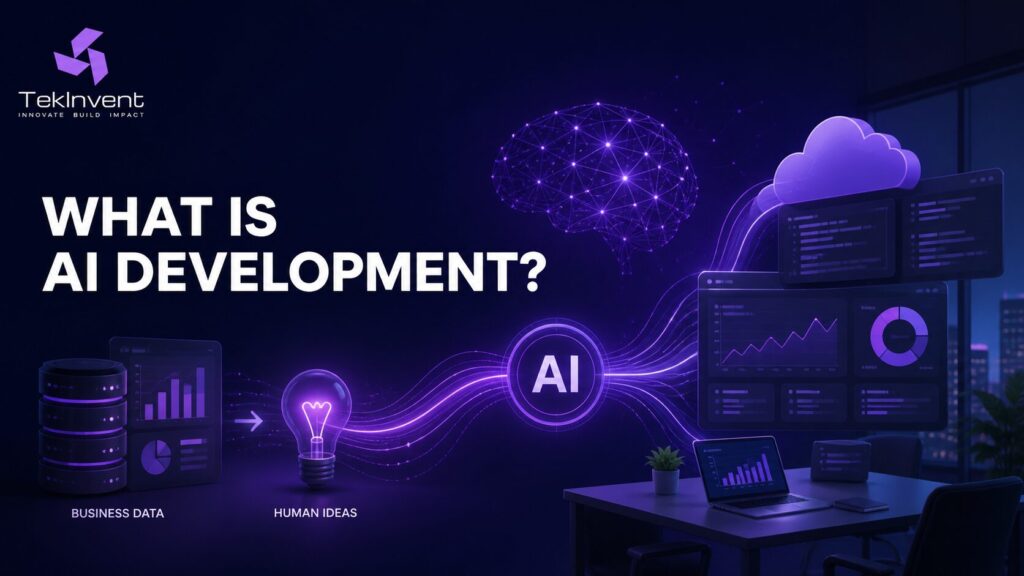
AI development is the process of designing, building, testing, deploying, and improving software capable of performing tasks commonly associated with human intelligence. These tasks can include understanding language, recognizing images, identifying patterns, generating content, making predictions, recommending actions, and completing controlled workflows.
The purpose of AI development is not to replace every existing system with artificial intelligence. Its real purpose is to identify areas where intelligent automation can produce a measurable improvement that ordinary software cannot deliver efficiently.
How Does AI Development Work?
Traditional software usually operates through rules written directly by developers. For example, an application may send a payment reminder when an invoice becomes overdue. The condition and corresponding action are clearly defined in advance.
AI software can work with less predictable information. It may examine a customer message, determine its intent, locate relevant information, summarize the problem, and recommend an appropriate response.
Instead of relying on one rule for every possible sentence, the system uses a model that has learned patterns from data. The model then applies those patterns when it receives new information.
This ability makes AI suitable for situations involving natural language, images, predictions, personalization, or large amounts of unstructured information. Nevertheless, its output can vary. The quality of the result depends on the model, available context, training data, system instructions, and safeguards surrounding it.
AI Development vs Traditional Software Development
Traditional software is generally deterministic. Under the same conditions, a function should produce the same result whenever it receives a particular input.
AI systems are often probabilistic. They may produce slightly different responses to the same request. This difference changes how developers must design, test, and maintain the product.
A conventional feature can often be tested by confirming that it returns an exact value. An AI feature may need to be evaluated for factual accuracy, relevance, completeness, safety, consistency, response time, and operating cost.
AI projects also require greater attention to data quality. A technically advanced model cannot compensate for outdated documents, incorrect labels, missing information, or poorly managed permissions.
AI should therefore be treated as one component of a complete product. Authentication, databases, integrations, interfaces, analytics, and security controls are equally important. TekInvent’s software development company services can support this wider product architecture when businesses need to integrate intelligent capabilities into reliable applications.
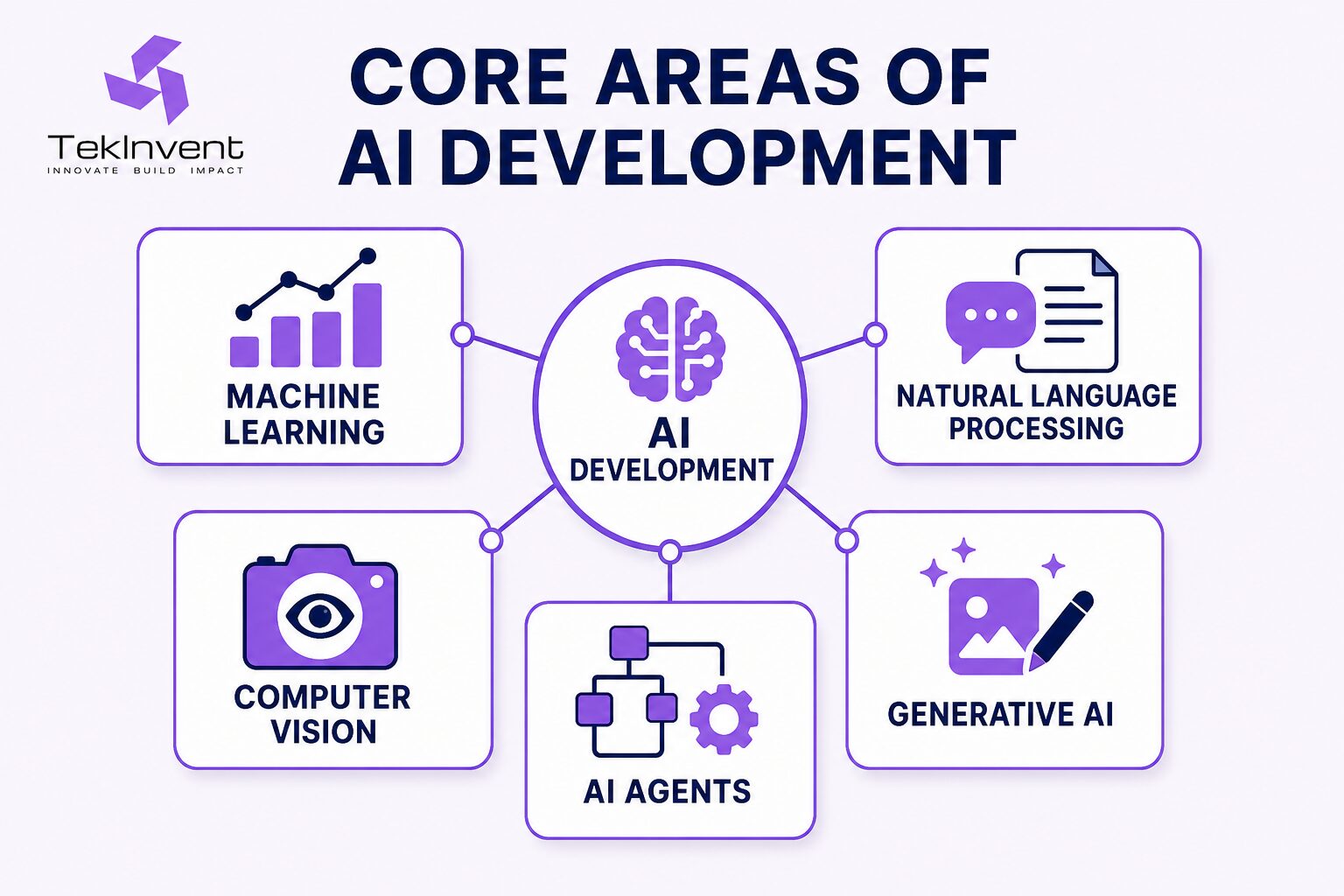
Major Areas of AI Development
Artificial intelligence covers several technologies, and each one solves a different type of problem. Choosing the correct approach is one of the most important early decisions in an AI project.
Machine Learning Development
Machine learning uses historical data to discover patterns and make predictions or classifications. A business may use it to forecast sales, predict customer churn, identify suspicious transactions, plan inventory, or estimate equipment failure.
Machine learning works best when the organization has relevant historical data and a measurable outcome that the model can learn to predict. If the available records are incomplete or do not represent current conditions, the model’s predictions may be unreliable.
Natural Language Processing
Natural language processing enables software to understand and work with written or spoken language.
Companies use it to analyze customer sentiment, classify documents, route emails, extract information from contracts, transcribe calls, and improve search. Modern language models have expanded these capabilities by allowing applications to summarize, translate, reorganize, and generate text.
A well-designed language application still needs clear boundaries. Important information should come from approved sources, while sensitive or high-impact responses may require employee review.
Computer Vision
Computer vision allows software to interpret images and video. It can support product-quality inspection, document scanning, object recognition, identity verification, inventory monitoring, medical-image analysis, and visual search.
These systems must be tested under conditions that reflect the real environment. Changes in lighting, camera angle, image quality, background, or device type can affect performance.
Generative AI Development
Generative AI creates new content from instructions and available context. It can produce text, images, audio, video, and software code.
Businesses increasingly use generative AI for knowledge assistants, content preparation, document summaries, customer-service support, report generation, and employee productivity.
Its ability to produce fluent content should not be confused with guaranteed accuracy. Generative systems can present incorrect information confidently. Production applications therefore need evidence, validation, guardrails, and human oversight where mistakes could create financial, legal, or safety consequences.
AI Agent Development
An AI agent can interpret an objective, select approved tools, take an action, examine the result, and continue through a multi-step workflow.
For example, a support agent might review a customer request, retrieve account details, locate an applicable policy, prepare a response, and ask an employee to approve it.
Agents are useful when the required steps change according to context. When a process always follows the same predictable sequence, conventional automation is usually safer, faster, and more affordable.
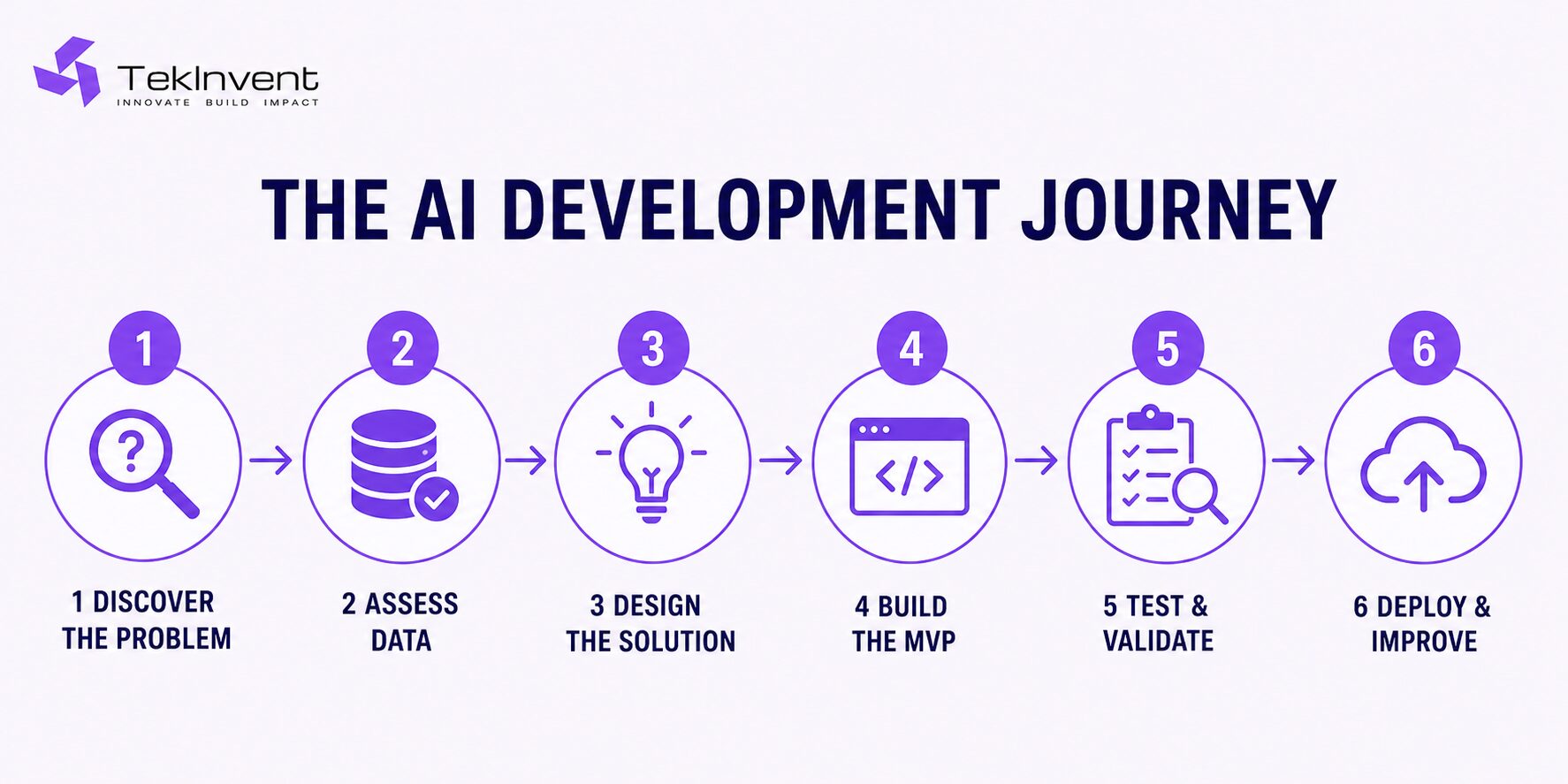
The AI Development Process
A successful project begins with business discovery. The team identifies the workflow that needs improvement, the people affected by it, and the result the organization expects.
“Use AI in customer service” is too broad. “Reduce the time support agents spend searching policy documents” is more useful because it describes a specific operational problem.
The next stage is feasibility assessment. Developers examine whether AI is genuinely appropriate and compare it with rule-based automation or conventional software. They consider data availability, required accuracy, technical dependencies, risks, response time, and estimated operating cost.
Once the project proves feasible, the team prepares the data. This can involve cleaning records, removing duplicates, correcting errors, organizing documents, assigning labels, and defining access permissions. Businesses must also confirm that they are legally and ethically permitted to use the information.
Developers then design the architecture and select suitable models. The decision should consider output quality, speed, privacy, reliability, regional availability, and cost. The largest model is not automatically the best choice for every application.
A focused prototype can test the core technical assumption. An AI minimum viable product goes further by delivering one complete and useful workflow to a defined group of users. Authentication, feedback controls, analytics, and error handling should be included at this stage rather than added after the product has already launched.
Testing an AI Application
AI evaluation must use realistic examples rather than a small collection of perfect demonstrations. Test data should include common requests, unusual wording, incomplete information, edge cases, unsafe instructions, and situations where the correct response is to admit uncertainty.
Quality should be measured according to the task. A document assistant may require accurate citations, while a prediction system may need separate accuracy measurements for different customer groups.
NIST’s AI Risk Management Framework encourages organizations to manage AI risks throughout the lifecycle of a system. This means evaluating reliability, safety, security, privacy, transparency, and accountability alongside technical performance.
The complete application also needs conventional software testing. Permissions, integrations, mobile usability, accessibility, recovery procedures, and performance under heavy traffic can determine whether the product succeeds after launch.
How Businesses Benefit From AI Development
The value of AI comes from improving an existing business outcome. It may reduce the time employees spend searching documents, help teams recognize patterns hidden within large datasets, or make customer interactions more relevant.
Predictive models can support better planning, while language systems can help employees understand and process unstructured information. Recommendation systems can personalize products or content based on customer behavior.
AI can also increase service availability. A properly controlled assistant may provide initial support outside normal operating hours and escalate complex situations to the appropriate employee.
These advantages depend on implementation quality. Automating a poorly designed process may only allow the business to make the same mistakes more quickly.
Challenges Businesses Should Expect
AI projects often struggle because their scope is too broad. When a system is expected to answer every question or automate an entire department, it becomes difficult to test, secure, and improve.
Data presents another major challenge. Information may be outdated, inconsistent, incomplete, or divided across multiple platforms. If developers do not resolve these problems, the AI system may produce unreliable results.
Organizations must also prepare for ongoing costs. Model usage, cloud infrastructure, monitoring, security, data updates, and maintenance continue after development. A low-cost prototype does not necessarily represent the expense of operating a production system.
Privacy and accountability require particular attention. Businesses need to know what information enters the system, where it is processed, how long it is retained, and who is responsible when an incorrect output affects a user.
An experienced AI development company can help align product strategy, data preparation, software engineering, security, and post-launch operations within one controlled development plan.
Is AI Development Right for Your Business?
AI is worth considering when a workflow involves large amounts of language, images, predictions, personalization, or complex patterns that fixed rules cannot manage effectively.
Before investing, a business should define the problem, identify the intended users, establish a measurable target, and determine what will happen if the system makes a mistake. It should also confirm that suitable data exists and that human review can be added wherever important judgment is required.
If a simpler automation can solve the problem, that option may provide better reliability at a lower cost. Responsible AI development includes knowing when artificial intelligence is unnecessary.
Engineering Intelligence for the Next Business Era
AI development is becoming part of the digital foundation on which modern businesses compete, operate, and serve their customers. Yet lasting value will not come from adopting artificial intelligence simply because the technology is popular.
The next business era will be shaped by organizations that connect intelligent models with trusted data, secure engineering, thoughtful experiences, and measurable goals. These companies will not treat AI as an isolated experiment. They will develop it as a dependable capability that improves alongside their people, products, and customers.
The strongest place to begin is one focused problem with a valuable outcome. Once that solution performs reliably, the business can expand its AI ecosystem with greater confidence, clearer evidence, and a foundation designed for sustainable innovation.

Build Smart with The Right Team.
We bring expertise, technology, and trust you look for in your digital journey.