
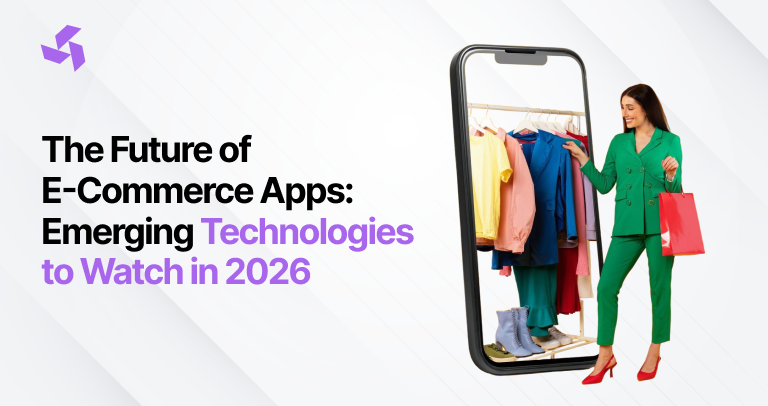
Ecommerce is now entering a new era of tech-driven growth where we see modernised technologies changing the whole way of operations. From AI-driven personalisation to robotics in delivery, AR for giving customers a real time feel – these mobile apps are leading the way in app design and development.
TekInvent,a leading ecommerce app development company is here to help the entrepreneurs planning to build their own ecommerce mobile app. For a better understanding, you may collaborate with the team of experts and let them explain the proceedings and further steps.
In this article, we will walk you through the top emerging technology trends that could be utilised in Ecommerce apps for a memorable user experience.
So, are you excited to explore it with us? Let’s get started then.
Ecommerce Market and Mobile App Development
Here are the statistics related to ecommerce market and its core offerings:
- Revenue in the eCommerce Market is projected to reach US$3.87tn in 2026.
- Revenue is expected to show an annual growth rate (CAGR 2026-2030) of 6.62%, resulting in a projected market volume of US$5.00tn by 2030.
- With a projected market volume of US$1.22tn in 2026, most revenue is generated in the United States.
- In the eCommerce Market, the number of users is expected to amount to 4.1bn users by 2030.
- User penetration will be 54.4% in 2026 and is expected to hit 58.1% by 2030.
- The average revenue per user (ARPU) is expected to amount to US$1.10k
Emerging Technologies To Watch Out For In 2026 For Ecommerce App Development
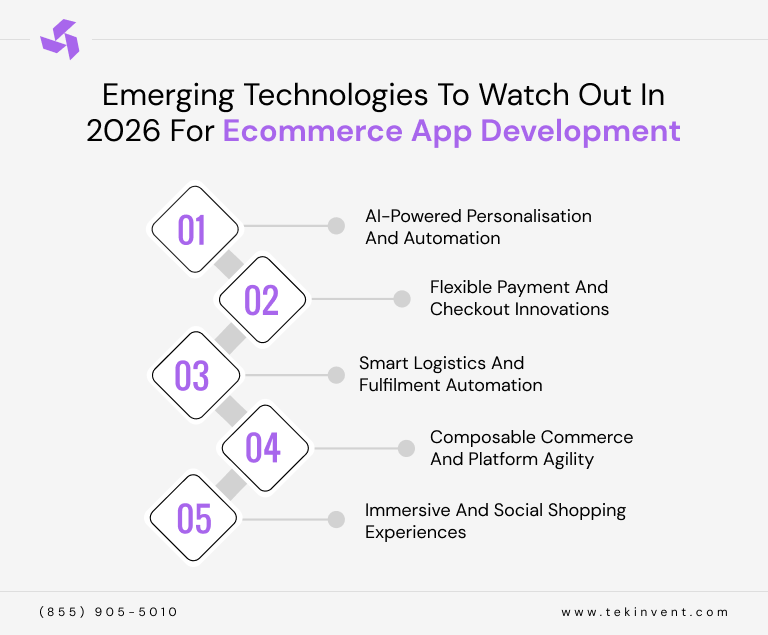
Here are some of the most trending trends that you should keep an eye on while building any Ecommerce mobile app:
-
AI-Powered Personalisation and Automation
Artificial Intelligence, AI have become one of the most trending topics in today’s world. It’s empowering all the domains by enabling the businesses with customized experience for their users. From virtual shopping assistants to AI-based bots that answer the queries instantly, everything is done smoothly.
A recent survey conducted from US and European ecommerce companies indicates that, an average of 403,000 billion were spent on AI customer experience tools with over 98% reporting a positive ROI curve.
AI is solving all the pain points of the customers by analysing the complex data, and automating most of the tasks for an extended experience. For example, it analyze the shopping pattern for a user (A), and then, based on the past experience, it starts suggesting similar products to save the time for searching and directly adding products to the cart.
Brands like Loreal use advanced AI models to aid in creative marketing work for better customer experience. We are now seeing AI has a mainstream adoption with no signs of coming back as it offers more stable and creative solutions for the end users.
-
Flexible Payment and Checkout Innovations
The mode for payment has been evolving for the ecommerce market for a very long time. From doing the payment through cash while receiving the parcels to getting it done online through cards – life is easier now.
According to research, digital wallets are now gaining better traction with over 20% of the consumers using the wallets to make the payments. The new “Buy Now, Pay Later” mechanism is also working amazingly, and the global BNPL market is projected to reach $576 billion this year as consumers embrace spreading payments over time.
To avoid payment delays and give users a better experience, businesses are now integrating merchants like Apple Pay and Google Pay to make them do payments online without any hassle.
Whereas, concerns made with the security checks are kept in mind while developing such kinds of mobile apps. With instant biometric authentication, and financing approvals for consumers and business buyers, customers are enjoying using the apps for a longer run.
-
Smart Logistics and Fulfilment Automation
Same day delivery is one of the smartest ways to attract consumers to purchase more from the Ecommerce stores, and it’s been happening for a very long time.
Retailers are now investing into micro-fulfillment centers that are located closer to the customers and deploying the advanced robotics in warehouses to accelerate the packing process and get the parcels shipped on the similar day of ordering.
Users are now using over 750,000 robots to move and sort the goods, enabling higher throughput and lower costing. Automated systems and AI-driven forecasting tools analyse demand patterns to ensure products are in the right place at the right time.
Perhaps, both retailers and B2B distributors are using these technologies for improving the efficiency rate and scalability for fulfilling the modern consumers’ expectation of getting what they require and what can be done smoothly.
-
Composable Commerce and Platform Agility
Many organisations who are now in the process of upgrading their ecommerce platforms with AI-driven practices spoke with us and told us the aftermath.
By the end of 2026, businesses are going to embrace more fulfillments, and this approach will help the companies innovate faster, and get tailored shopping experiences without being locked into single vendor’s platform.
Enterprises are now being locked into legacy systems, and enterprise retailers are now prioritizing flexibility with AI driven strategies to add features within the stores for an extended shopping experience.
83% of B2B firms planned to increase their digital spending year on year – aiming to deliver the kind of customer-centric online experiences that consumers expect.
-
Immersive and Social Shopping Experiences
Ecommerce stores are now giving immersive and interactive experiences to the customers, removing the thin line between online and in-store purchasing experience.
Augmented reality (AR) and virtual reality (VR) are now enabling the users to test the products in real time and then make the purchase. In this way, the return ratio is decreasing and customers are now enjoying a virtual modelling of the dresses or sunglasses through their mobile phones.
By the end of the year, more than 100 million people in the United States are expected to use AR based glasses through the Ecommerce stores, and retailers are now reporting that AR-try on feature increases the buyer confidence and reduces the return rates as well.
Social media platforms are now transforming the key commerce channels and there are over 110 million US consumers that have made purchases through social networks with a one-click checkout and live shopping stream through apps like Facebook and Instagram.
Perhaps, the social commerce experience is blending entertainment with instant purchasing for the consumers. They are creating a new stream of revenue for them that engages the customers often led by real-time interaction and influencer actions.
Powerful in consumer retail and even B2B firms are now experimenting with AR based products for instant demos and leveraging all platforms like LinkedIn for increasing social sharing.
Key Takeaway
The ecommerce landscape is becoming more agile and modernised with the passage of time. With the use of technologies, it’s bringing a change and business leaders are enjoying the after effects of it. More clicks, increased sales.
From the integration of AI based sensors to automated payment methods, immersive digital experiences are topped with technologies that will position the businesses in the best possible way.
The best way out is to collaborate with TekInvent, and share the roadmap leading to the design and development of Ecommerce store with all the modernised technologies. If you think we have missed anything within the blog then, feel free to share your thoughts in the comments section. Happy Reading.

Build Smart with The Right Team.
We bring expertise, technology, and trust you look for in your digital journey.