
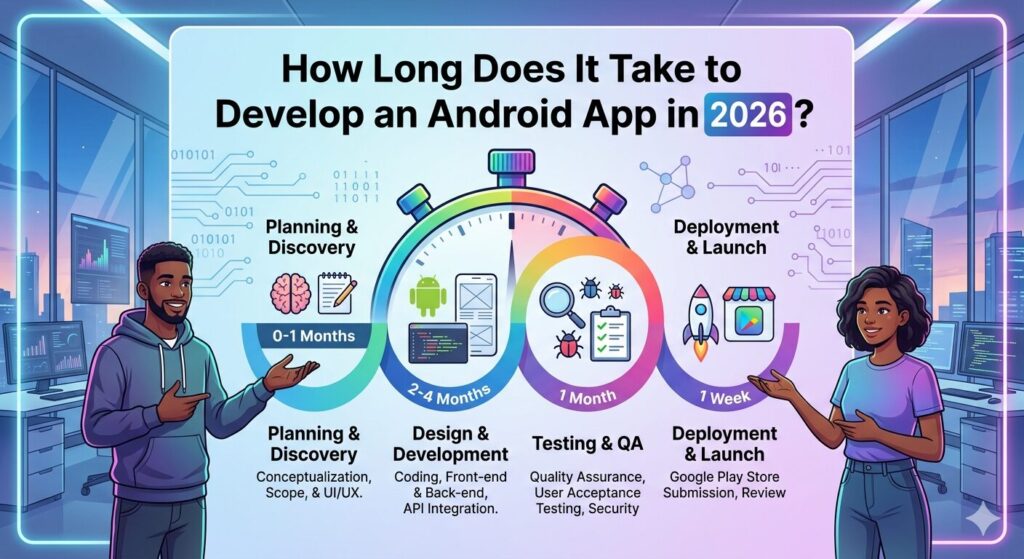
Developing any kind of app, whether it’s an android or iphone takes time. It can notbe done in a week or so. Even with a simple mobile app, the estimated time is around 3-4 working weeks.
Perhaps, if we look back to history then, the first smartphone was released by IBM Simon and it was one of the biggest mobile apps of that time. It took around two years for the completion and definitely, things take time.
From ideation to the completion, the timeline for the development of the mobile app depends on the type of mobile app and the features that are embedded within it.
We are halfway to 2026, and the mobile app market is currently booming with billions of mobile apps being downloaded each year. More businesses are now investing into mobile app development to connect with the customers and faster the demand curve. High quality mobile app development also takes time and the app developers need to be really proficient with the detailing.
So, with a blog we are going to discuss the timeline for developing an android mobile app. If you are searching for the query how long does it take to develop an android app then this depends on the scope and features of the android app.
We will break down what factors affect the development timeline for android app development. Are you excited to explore it? We’ll break down the factors involved for a better understanding.
Interesting Statistics about Android App Development
Android dominates the global mobile OS market with roughly 70–75% share, driving massive demand for app development, with over 2 million apps on Google Play. In 2025, the mobile app market is projected to reach $673 billion, featuring 139+ billion annual downloads on Android. Key trends include AI integration, rising fintech/health apps, and high user engagement (avg. 4.6 hours/day), though 70% of users churn within 30 days.
- Android Market Share: Android controls 70-75% of the global mobile operating system market.
- Google Play Store: As of early 2026, there are over 2.06 million apps on the Google Play Store.
- Growth: Nearly 1,200+ new apps are added to the Google Play Store daily.
- Downloads: Google Play is expected to reach 143 billion downloads by 2026.
Key Factors Affecting Android App Development Timelines
Several factors impact the overall costing and timeline associated with the development of android apps. Understanding those is really important as it directly impacts the planning phase.
-
App Complexity:
The overall complexity of the Android app is one of the biggest factors that impacts the app development timeline. A basic mobile app with simple features will take only a few weeks for development whereas, if you are developing something really unique like an ecommerce app or a healthcare mobile app then it will take time.
These kinds of apps come with APIs integration and therefore, the stakeholders should always be prepared for a longer timeline for the development. The more complexity your Android app has, the more time it will take for the development to be completed.
-
Android App Features and Functionalities:
A simple Android app with basic features like login, search, and other would take less time to be developed as compared to one with advanced features as well. The strategy is very simple, the more features you add in the Android app, the more timeframe will be increased.
Features like payment gateway, geolocation, notifications, and social meia integration will take a longer time to be compiled. Therefore, it’s asked to keep the features minimal if you want the Android app faster, or develop an MVP with a faster deployment time.
You can see companies developing MVPs rather than launching the complete full-proof mobile app for their customers to save time and efforts both.
-
Android App Designing Capabilities:
All the compelling and visually appealing apps are not completed in a day instead it takes longer than our expectations. Custom app design backed with smooth animation and unique interfaces requires more time as compared to a basic template app design.
The mobile app design phase impacts the timeline for the development of the android app. You can never expect a visually alluring without an extended time limit.
The design phase impacts the timeline every time because every visual needs to be created beautifully with precision. With precision comes time expenditure and it takes longer than expected due to the designing activities.
-
Development Team Expertise:
Not all the development teams are equal. Some come with extensive experience in android app development whereas some are not professional. They take half of the time in searching for new IDEs and frameworks along with APIs integration.
Whereas, on the other hand, with an experienced team, you may expect less time and the app development will be completed quickly. Try to hire the app development team or app developers in the United States who have proficient knowledge with mobile app development, frameworks, technologies and APIs integration.
-
Technologies Tools and Frameworks:
Choosing the mobile app development company will directly impact the development time for the Android app. You may opt for native development like Java or Kotlin, giving you complete control, which can take longer to develop.
Whereas, cross platform app development takes less time and effort. You may speed up the process, but you will still have to develop differently for both Android and iOS.
-
Testing and Quality Assurance:
None of the Android app development is completed without a testing phase. Ensure that the app is completely checked and all the bugs are resolved.
Testing the app before launching it takes time, and it ultimately increases the timeframe. You may expect delays if the bugs are not resolved by the team.
A feature-heavy mobile app will take longer than expected, whereas a simple mobile app will take less time for testing and will be launched quickly.
Typical Timelines for Diversified Mobile Apps
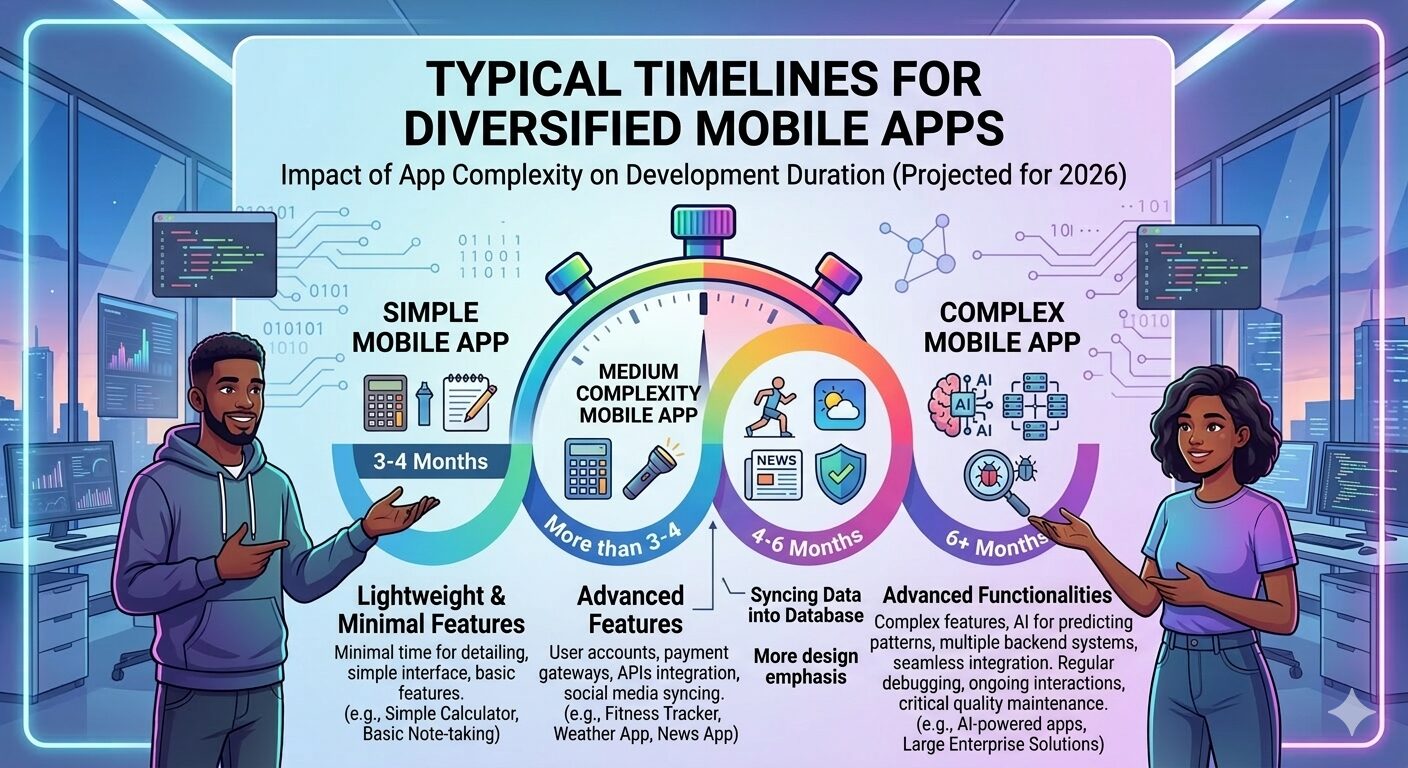
The complexity associated with the app directly impacts the timeline for the app development. Here is a complete breakdown of different types of mobile apps and the time required for developing them.
-
Simple Mobile App – Quicker Development:
Mobile apps like simple calculators, flashlights, and basic note-taking mobile apps are lightweight and have minimal features.
Since the functionalities are simple, the development time is relatively short. And you may expect such a mobile app to be completed in 3 to 4 months. Whereas, a simple mobile app requires less time to detail as the interface is simple and basic features are required within the mobile app.
-
Medium Complexity Mobile App – Advanced Features = More Time:
Android mobile apps with moderate complexity, like payment gateways or API integration, would require slightly more time than a simple Android app. Apps like fitness trackers, weather apps, and news mobile apps that have features like user authentication, social media integration, or local databases integration would require more time than a simple mobile app.
These apps require the app designing team to emphasize more on the design and development. Therefore, the timeframe will be extended.
The development process for these kinds of mobile apps would include the creation of user sign-in accounts and syncing the data into the database for better performance and experience.
-
Complex Mobile App — Advanced Functionalities
Lastly, Android apps that are complex with advanced features require more time than a simple mobile app. AI-powered mobile apps analyse the data for predicting the patterns, and indeed, it increases the timeframe for the development of apps.
Development of these kinds of mobile apps takes longer than 6 months or more; therefore, it is directly linked to the development.
These kinds of mobile apps would involve multiple backend systems and seamless integration. Regular testing, debugging, and ongoing interaction are critical for maintaining the quality of the mobile app to meet performance.
Trends Impacting the Development Time in 2026
Here are several trends that impact the timeline for the development of Android apps. Here is a quick breakdown:
-
Adoption of AI Automation:
AI and automation tools are now speeding up the development process by handling the critical data quickly. It allows the app developers to speed up the development process and cut down the overall development time by 2X.
-
Low Code vs No Code:
Low-code or no-code development techniques allow app developers who are more into development but don’t know about development. It allows people with no prior development techniques to build mobile apps with simple drag-and-drop platforms.
-
Agile Methodologies:
Lastly, agile methods are now becoming more popular with teams to work in shorter time and stay connected with each other through daily scrums. It leads to faster progress and quicker app deliveries, promoting better collaboration.
Strategies to Accelerate the Development Time
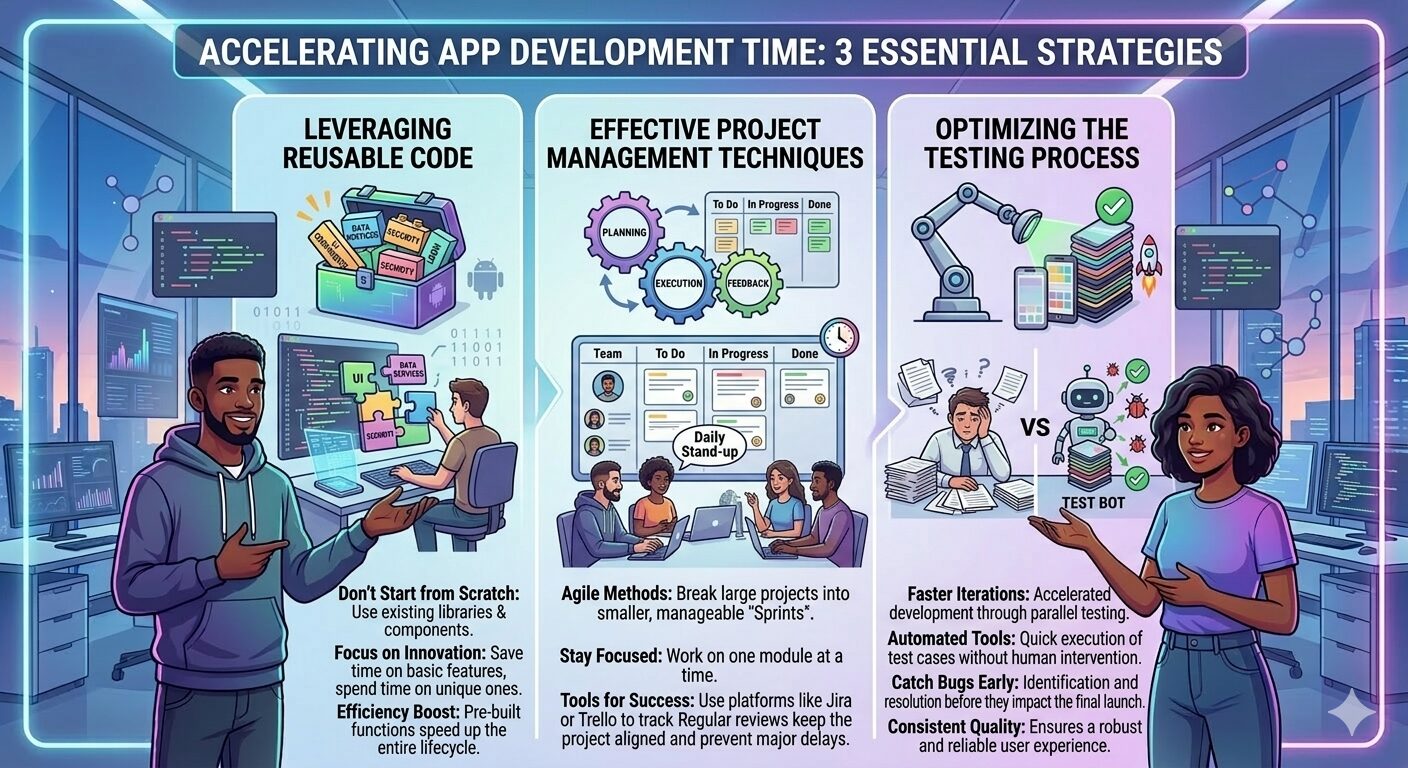
There are strategies required to speed up the development process time:
-
Leveraging Reusable Code:
App developers can save up a lot of time by using pre-built code and libraries. Avoiding the need for creating a new code or feature from scratch would save up time and speed up the development process.
-
Effective Project Management Techniques:
Agile methods easily break the projects into smaller tasks, keeping the app developers focused on one module at a time. Regular feedback and tools like Jira or Trello help keep the project on track and prevent delays.
-
Optimizing the Testing Process:
Automated testing tools or platforms would result in faster mobile app development, quicker identification, and resolution of bugs.
Wrapping Up
And we are done for the day. We hope you enjoyed reading about the timeline that is required for development of an Android app. We also discussed the features that impact the timeline for the development of the android app. With a basic app that can be developed in 3 months to a complex app that will take more than 5 months – it varies. If you think we have missed anything within the blog then feel free to share your thoughts in the comments section. We would love to hear it back from you.

Build Smart with The Right Team.
We bring expertise, technology, and trust you look for in your digital journey.