

Suppose you start using a mobile app, and if we ask you a question, what’s that one feature that you like? It’s the speed, the capability to make the payments online, and getting the location tracked easily. But what’s that one thing that is making you get all? It’s the API integration.
APIs act as a structural communication channel that allows users to get the desired functionalities through their software without any hassle. For enterprises, API integration is not a big task. For startups and small-scale businesses, the integration process of APIs is quite a big task.
Now take the example of API development in mobile apps – whenever a user clicks on the login feature, they get options, either they wish to log in through Gmail or social media platforms. So, what’s that one thing that’s connecting their account with the social media platforms? It’s basically APIs.
So, now you must be clear with the function of APIs, and today we are going to explore the APIs development terminologies, features, use-cases, and a lot more exciting things.
Let’s get started then…
API Development Terminologies – A Quick Overview
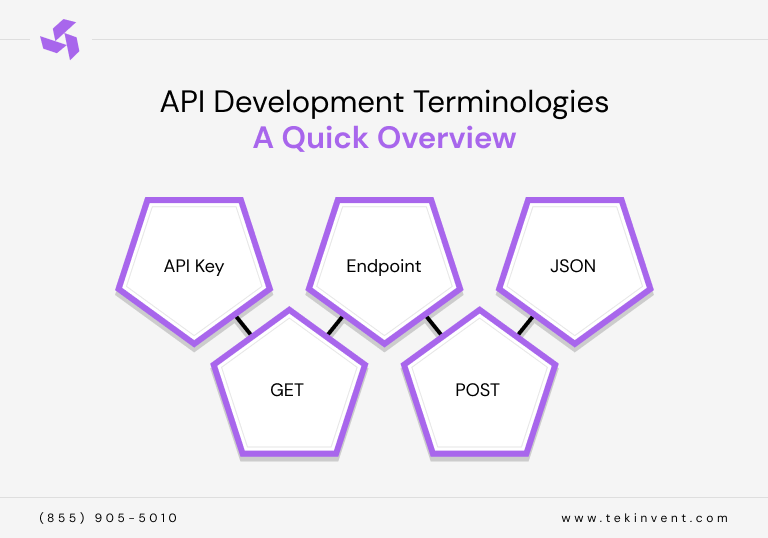
In this section, we are going to learn about the most basic API concepts to help you navigate through the terms easily:
-
API Key –
Whenever an API request is made through the header or a parameter to recognize the requester, the authorized code is passed into the request, which is called the API Key.
-
Endpoint –
When an API interacts with the system, one of the communication channels is termed an endpoint.
-
JSON –
JavaScript Object Notation is a data format for the API request parameters.
-
GET –
The RESTful application programming interface’s HTTP method for obtaining the resources.
-
POST –
The RESTful APIs use HTTP methods for building the resources.
API Development Tools and Technologies
There are tons of API design and development tools that app developers should know. A mobile app development company always trains its developers with these API technologies to outline the popular API development seamlessly.
Here’s a quick overview of the API development technologies:
-
Apigee
It’s a Google API management provider that assists users in triumphing the digital transformation by establishing the API Integration development processes.
-
APIMatic and API Transformer
These API development tools offer advanced automation capabilities to the users.
-
API Science
These tools are used for evaluating the performance of both internal and external data.
-
API Serverless Architecture
API serverless architecture assists the users in designing, building, and publishing APIs using cloud-based servers.
-
API Platform
It’s one of the open-source PHP frameworks that is used for web API integration development.
-
Auth0
It’s one of the most widely used API development tools for authentication and authorizing APIs.
How Do APIs Operate?
APIs, also known as Application Programming Interfaces, facilitate the communication between two software applications seamlessly by defining the set of rules and protocols for the interaction. In this process, we are following a request-to-response cycle that is often operated within the client-server architecture.
The entire process for API communication begins when a Client Request (from a mobile app, web browser, etc.) is sent to a specific API endpoint (URL). This request specifies the desired action and may include parameters and authentication.
Next, the API processes the request, acting as an intermediary. It validates the client, authenticates credentials, and translates the request into a format suitable for the backend.
The Server Processes and responds by executing the required action or retrieving the data. The server then generates a response, typically formatted as JSON or XML.
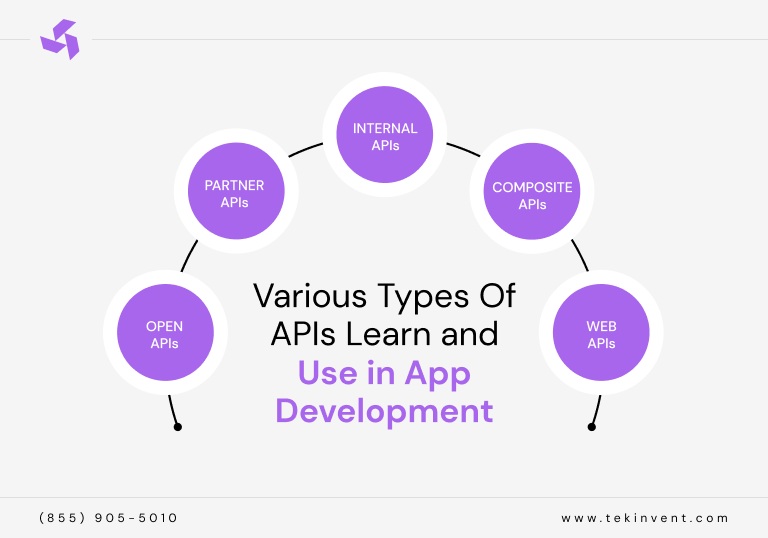
Various Types Of APIs – Learn and Use in App Development
There are different forms of API that we are going to discuss within this section. Each of the API is designed for addressing the connectivity challenge, and whether you are open to providing services to the public or streamlining the internal operation, you will always need the API for every functionality.
Let’s get started with the discussion:
-
Open APIs, also known as Public APIs
The first type of API is Open API that is known as public APIs fully accessible to developers and businesses with minimal restrictions. These APIs are used for expanding the reach and accelerating the third-party integration quickly.
Most of the enterprises that focus on API software development use Open APIs to quickly scale themselves and their services for building a broader ecosystem.
-
Partner APIs
The second type of API that we are going to discuss is the Partner API. It is designed for building secure, controlled access to external partners, unlike public APIs available for everyone. These APIs allow businesses to collaborate with vendors on restricted terms and control. The data can’t be shared easily through partner APIs.
-
Internal APIs
The third category of API is internal APIs that are often called the private APIs used within the organisation. It’s used for improving the efficiency within the enterprises. It’s used by organizations for different capabilities like internal system features, tools, and apps for seamless interaction.
-
Composite APIs
The composite APIs combine multiple service calls into a single request, and it makes it easier to execute the complex processes. It reduces the number of round-trip requests and helps in improving the system’s responsiveness and overall user experience.
-
Web APIs
Lastly, we have web APIs, and you can predict from the name what it’s all about. Web APIs are enabling communication between applications over the Internet using standard protocols like HTTP. They are playing a crucial role in modern application development that allows services like payment gateways, cloud storage, and customer portals to integrate seamlessly.
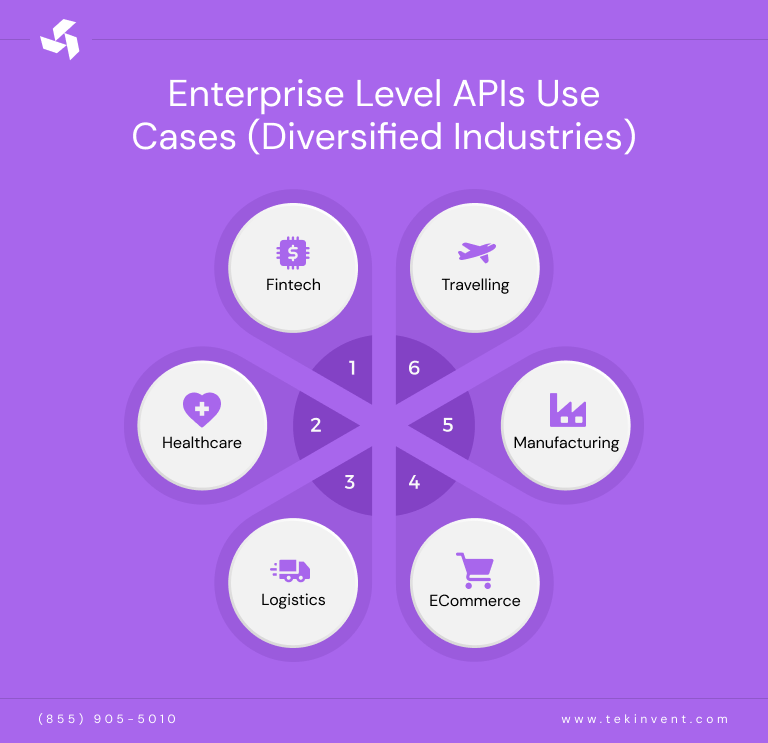
Enterprise Level APIs Use Cases (Diversified Industries)
APIs are not just developed for businesses to get done with the complex operation, but they are growth enablers for a lot of industries. Bringing in efficiency, scalability, and revenue across multiple industries.
Here is a quick overview of the API development powering the success across industries:
-
Fintech –
The first industry that we are going to explore is fintech, which comes with real-time payment processing, open banking APIs, and fraud detection APIs within the banking sector.
-
Healthcare –
The second industry where API development is used is healthcare. It helps with secure health records, EHR, integration of telemedicine, wearable devices, data like smart watches for heartbeat, body temperature, and number of steps taken in a day.
-
Logistics –
The third API that we are going to explain is logistics that comes with real-time shipment tracking, route optimisation, and warehouse management APIs for better consideration.
-
Retail and eCommerce –
The fourth API that we are going to explain is used within the retail and ecommerce domain. Multi-channel inventory sync, personalized recommendation and online payment gateway integrations. These APIs enable users to place orders online and even pay for them.
-
Manufacturing –
IoT devices integration APIs that come with supply chain management, predictive maintenance APIs, and a lot more.
-
Travelling and Hospitality –
The travel and manufacturing APIs are used for booking engines, multi-channel pricing, CRM integration, and online payment gateways.
APIs Development Challenges
There are certain challenges that businesses face while developing any kind of API. We have discussed it below for you.
- The first challenge is designing flexible yet consistent APIs. Mostly, businesses struggle with inconsistent naming conventions and unpredictable endpoint structures that make the API calling process tough.
- Most businesses struggle with API security concerns. APIs handle sensitive data and serve as an integration point for the external platforms. It’s vital to work on the security practices for a secure connection.
- APIs’ inability to handle rapid traffic growth without performance degradation. Such issues cause slow response time, downtime, and system failure that frustrate the end users.
- Not meeting the compliance requirements, such as failure in handling financial transaction data, healthcare records, and personal data.
Get Your API Development Done By TekInvent’s Team Of Professionals
APIs are an integral part of app development. Most of the businesses now focus on hiring app developers who are hands-on with seamless API integration. You can connect with us and discuss your app ideas to get an estimate on how many APIs would be required to achieve those functionalities.
We are a premium provider of API development, specialised in designing a secure and scalable API tailored to meet your business needs.

Build Smart with The Right Team.
We bring expertise, technology, and trust you look for in your digital journey.