

Planning a mobile app the right way is the first step to success. As a mobile app development company Houston, TekInvent has seen many businesses struggle because of poor planning, unclear goals, and lack of structure. Without a clear process, app development can quickly become confusing, costly, and stressful. A simple roadmap helps businesses stay focused, manage budgets, meet timelines, and build apps that users actually want to use.
Mobile apps are no longer just an extra business tool. They are now a core part of how companies grow, connect with customers, and improve operations. Some businesses build apps to reach customers and generate revenue, while others use them to improve internal processes, reduce costs, and increase efficiency. No matter the goal, understanding the mobile app development process makes the journey smoother and more successful.
In this guide, we break down the full mobile app development process in a clear and simple way. You will learn how apps are planned, designed, built, tested, and launched, and why each step matters. This blog will help Houston businesses understand how to turn an idea into a real, working app that delivers value, meets user needs, and supports long term growth.
Why is Mobile App Development Important in 2026?
Investing in mobile app development is now essential for businesses that want to stay competitive in a mobile first world. User behavior has clearly shifted toward mobile, with people spending most of their digital time on apps across areas like shopping, health, finance, learning, and entertainment. This change has made mobile apps one of the most powerful tools for improving customer experience and supporting business growth.
Mobile apps offer real advantages for businesses. They allow direct communication through push notifications, in app messages, and personalized experiences that keep users connected. Apps also create higher engagement and stronger retention compared to mobile websites. Since apps stay on users’ devices, they help build long term brand loyalty and constant visibility. They also deliver better performance through faster loading, smoother interactions, and offline access.
For growing businesses, mobile apps go beyond user engagement. They provide valuable insights through user behavior data and analytics. These insights help companies improve features, personalize services, understand customer needs, and optimize daily operations. In simple terms, mobile apps are not just digital tools anymore. They are long term business assets that support growth, efficiency, and customer satisfaction.
What is the Mobile App Development Process: Understanding the 2026 Framework

The mobile app development process in 2026 follows a structured and strategic approach that includes planning, design, development, testing, and deployment. Today, this process is supported by AI powered tools, modern frameworks, and smart automation that make app creation faster, more efficient, and more reliable.
The app development process has evolved to meet the growing needs of modern businesses. It now blends proven software development principles with mobile specific strategies to deliver high quality user experiences across all devices and platforms. With advanced technologies and smarter workflows, businesses can now build scalable, secure, and user friendly apps that perform well in real world conditions.
The Seven Main Phases of Mobile Application Development
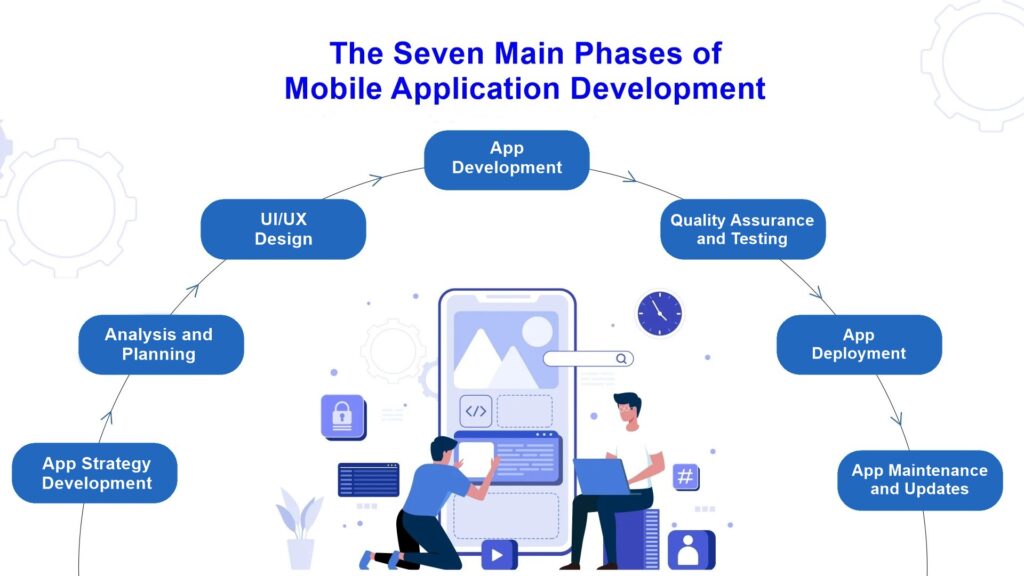
Developing a mobile app in 2026 requires strategic planning, selecting the right development approach, designing user-focused interfaces, coding with modern frameworks, rigorous testing, and intelligent app store optimization. The step-by-step mobile app development process in 2026 follows a structured, scalable approach that balances speed, quality, and innovation, ensuring your application meets modern standards while delivering exceptional user experiences.
Phase 1: App Strategy Development
The mobile app development journey begins with a strong strategy. This phase focuses on defining your app’s purpose, aligning it with business objectives, and establishing how it will deliver real value to users. Identifying the target audience is critical. This involves demographic and psychographic research, user behavior analysis, and the creation of detailed user personas that represent real user needs, goals, and challenges.
Once users are clearly defined, the app’s structure, features, and design approach are shaped around their expectations. Competitor research follows, helping identify market gaps, strengths, weaknesses, and opportunities for differentiation, along with understanding platform-specific differences between iOS and Android that influence design, development, and technology choices.
This phase also includes prioritizing MVP (Minimum Viable Product) features to ensure the app launches with essential functionality that solves core problems while allowing room for future growth based on real user feedback. Finally, monetization models are selected, such as subscriptions, freemium access, in-app purchases, or ad-based revenue, ensuring the revenue strategy aligns with both user behavior and business goals.
Phase 2: Analysis and Planning
This phase builds a clear operational roadmap for the entire project. Functional and non-functional requirements are defined to ensure the app performs efficiently, securely, and reliably while delivering the necessary features users expect. Market analysis and user research validate demand, identify competitive gaps, and refine the product vision using real user insights, interviews, surveys, and usability studies.
A detailed product roadmap is then created, outlining timelines, milestones, and deliverables to keep development aligned with business objectives. At the same time, the technology stack is selected based on scalability, performance, security, and long-term maintenance needs, whether through native development or cross-platform frameworks.
This phase also includes designing the technical architecture, defining system integrations, backend infrastructure, data flows, and user interaction use cases to ensure all components work together seamlessly.
Phase 3: UI/UX Design
The design phase focuses on creating a user-centric experience that balances aesthetics with functionality. It begins with structuring information architecture and user workflows to ensure intuitive navigation and logical content flow.
Wireframes are then created to define layout, structure, and user flow without visual distractions, allowing teams to validate usability before visual design begins. High-fidelity mockups transform these structures into visually polished designs that reflect branding, consistency, and usability principles.
Interactive prototypes simulate real user interactions, enabling usability testing and early feedback from real users and stakeholders. This phase also establishes branding guidelines and design systems, ensuring visual consistency across the app through defined typography, color schemes, UI components, and interaction styles, creating a cohesive and recognizable brand identity.
Phase 4: App Development
This stage transforms designs into a fully functional application. Frontend development brings the user interface to life using modern frameworks and languages, ensuring responsiveness, performance, and cross-device compatibility.
Backend development powers the app’s core logic, handling data processing, storage, authentication, and system operations through secure server-side architectures and databases. API integrations connect the app to external services such as payment gateways, social platforms, enterprise tools, and internal systems, enabling seamless data flow and system communication.
Security is embedded throughout development, ensuring user data protection, encrypted transactions, and secure authentication mechanisms across all layers of the application.
Phase 5: Quality Assurance (QA) and Testing
Testing ensures the app is stable, secure, and ready for real users. This phase includes functional and performance testing to validate features, speed, and scalability. It also covers compatibility, usability, and security testing to ensure smooth performance, strong user experience, and protection from vulnerabilities.
Automated testing and CI pipelines streamline repetitive testing processes, allowing early bug detection and faster development cycles. Continuous testing ensures the application remains reliable, stable, and high-performing throughout development and pre-launch stages.
Phase 6: App Deployment
Once the app is ready, it moves into deployment. This involves preparing the app for public or private distribution, optimizing metadata, meeting platform guidelines, and ensuring compliance with regulatory standards for smooth approval processes.
App Store Optimization (ASO) strategies improve discoverability, while marketing efforts across SEO, social media, paid campaigns, and digital channels drive visibility and downloads. A structured launch strategy ensures maximum reach, engagement, and early user adoption.
Phase 7: App Maintenance and Updates
Post-launch, the focus shifts to long-term success and growth. Performance tracking through analytics tools monitors KPIs such as user retention, engagement, and acquisition. User feedback is continuously collected through reviews, surveys, and usability testing to guide future improvements.
Regular updates introduce new features, fix bugs, improve performance, and enhance security. Ongoing compliance with data protection regulations and regular security audits ensure user trust and platform reliability. This continuous improvement cycle keeps the app competitive, relevant, and scalable in the evolving digital ecosystem.
Mobile App Development Timeline

A structured development timeline helps ensure your mobile app project stays on track, on budget, and aligned with business goals.
While every project may vary based on complexity and features, this 16-week timeline represents a realistic and efficient roadmap for building a high-quality mobile application.
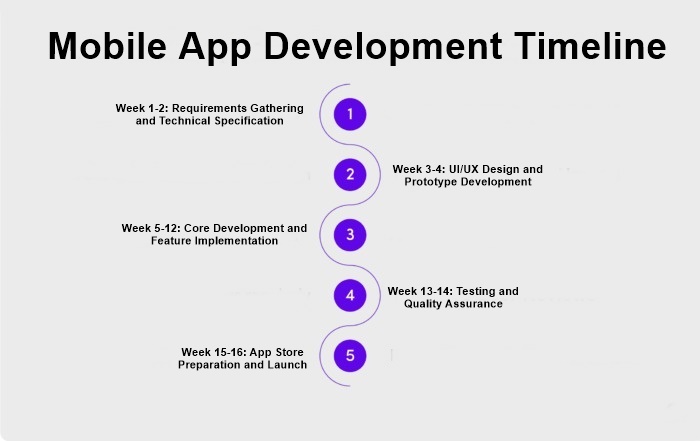
Week 1-2: Requirements Gathering and Technical Specification
This phase focuses on understanding business objectives, user needs, and project scope. The team gathers functional and non-functional requirements, defines core features, identifies target users, and documents technical specifications.
This step includes stakeholder discussions, market research, platform selection, and early planning of the technology stack. A clear project roadmap is created to avoid scope creep and ensure alignment across all teams.
Week 3-4: UI/UX Design and Prototype Development
During this stage, the app’s structure and user experience take shape. Designers create wireframes, visual layouts, and user flows, followed by interactive prototypes that simulate real user interactions.
This allows early validation of usability, navigation, and design logic before development begins. Feedback is collected and improvements are made to ensure the design is intuitive, engaging, and aligned with brand identity.
Week 5-12: Core Development and Feature Implementation
This is the main build phase where the app becomes a working product. Frontend and backend development happen in parallel, transforming designs into functional features. Core modules, integrations, APIs, databases, authentication systems, and business logic are implemented.
Regular testing and internal reviews take place throughout development to ensure stability, performance, and scalability as features are added.
Week 13-14: Testing and Quality Assurance
Once development is complete, the app goes through comprehensive testing. This includes functional testing, performance testing, security testing, device compatibility testing, and usability testing.
Bugs are fixed, performance is optimized, and stability is ensured across devices and platforms. This phase ensures the app is reliable, secure, and ready for real-world users.
Week 15-16: App Store Preparation and Launch
The final stage focuses on preparing the app for release. This includes app store listing optimization, metadata creation, screenshots, compliance checks, and platform guideline approvals.
Deployment strategies are finalized, and the app is published to the relevant app stores or enterprise distribution platforms. Post-launch monitoring begins to track performance, user feedback, and early engagement metrics.
This structured timeline provides a clear development path while allowing flexibility for feedback, improvements, and scalability. It ensures your mobile app is built efficiently, launched smoothly, and positioned for long-term success.
Cost of Mobile App Development in 2026
The cost of building a mobile app in 2026 can vary greatly from one project to another. There is no fixed price because every app is shaped by business goals, user needs, and technical requirements.
What truly matters is understanding how the budget is distributed and how different decisions impact the overall cost. When businesses understand these factors clearly, they can plan better, avoid unnecessary expenses, and invest in the areas that bring the most value.
Key Factors That Influence App Development Cost
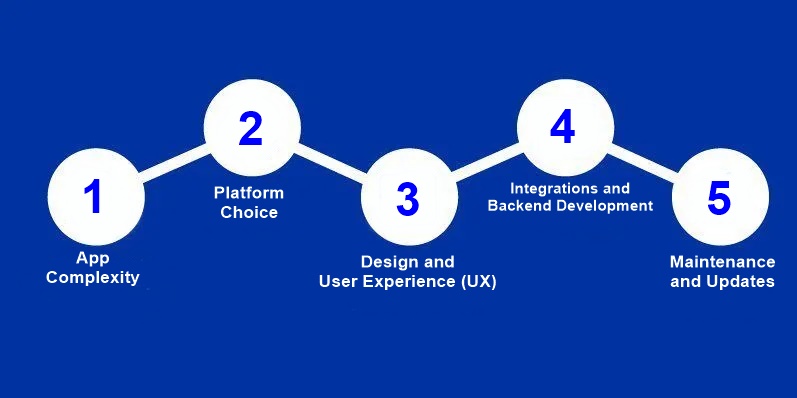
Several elements play a direct role in determining how much a mobile app will cost to build. From technical complexity to long-term maintenance, each decision affects the final budget. Understanding these factors helps businesses make smarter choices and build apps that are both cost-effective and scalable.
1. App Complexity
App complexity is one of the biggest cost drivers. Simple apps with basic features and limited screens take less time and fewer resources to develop. In contrast, apps that include advanced features such as real-time chat, AI-based recommendations, geolocation, or in-app purchases require more development time, deeper testing, and stronger infrastructure.
Every extra feature adds to the cost, which is why it is important to focus on core features first and plan future upgrades in phases.
2. Platform Choice
In 2026, businesses usually choose between iOS, Android, or cross-platform development. Native apps built separately for iOS and Android offer high performance and full device access, but developing two platforms increases cost
Cross-platform development using frameworks like Flutter or React Native allows one codebase to run on multiple platforms, which reduces development time and overall expenses. However, some advanced features may still need platform-specific work, which also affects the budget.
3. Design and User Experience (UX)
Strong design is no longer a luxury, it is a necessity. Users expect fast loading, smooth navigation, and an easy-to-use interface. Investing in professional UI/UX design improves user satisfaction and retention.
Custom animations, interactive elements, and accessibility features increase development effort and cost, but they also improve engagement and long-term app value.
4. Integrations and Backend Development
Modern apps rely heavily on integrations. Payment systems, CRMs, ERPs, analytics tools, and third-party APIs all require backend development and secure system architecture. A scalable and well-structured backend allows the app to grow without performance issues.
The more complex the integrations, the higher the cost, but these systems enable automation, data flow, and business efficiency.
5. Maintenance and Updates
App development does not end after launch. Ongoing updates, security patches, bug fixes, and feature improvements are essential for long-term success. In 2026, continuous maintenance is a core part of mobile app strategy.
Planning a maintenance budget protects your investment, keeps the app secure, and ensures it stays compatible with new devices and platform updates as your user base grows.
This cost structure helps businesses understand where their investment goes and how to plan a smart, scalable, and sustainable mobile app development strategy.
Final Thoughts
Understanding the mobile app development process is no longer optional for businesses that want to grow, compete, and succeed in a digital-first world. In 2026, mobile apps are not just technology products, they are business assets that drive customer engagement, improve operations, and create long-term value. A clear development process helps businesses avoid confusion, control costs, reduce risks, and build solutions that truly serve users.
For Houston businesses, having a structured roadmap makes the entire journey simpler and more predictable. From idea validation and planning to design, development, testing, launch, and long-term maintenance, every stage plays a role in building a successful mobile app. When each phase is handled properly, businesses gain better quality, stronger performance, and higher user satisfaction.
At TekInvent, we believe great apps start with clear thinking, smart planning, and the right technical strategy. Whether your goal is customer growth, digital transformation, or operational efficiency, understanding the mobile app development process gives you the foundation to build scalable, secure, and future-ready solutions. With the right approach, your mobile app can become a powerful tool that supports long-term business growth, strengthens your brand, and creates real value for your users and organization.

Build Smart with The Right Team.
We bring expertise, technology, and trust you look for in your digital journey.