

Choosing between a custom software development company in Dallas and an in-house team is a critical decision for growing businesses. Software Development plays a major role in shaping product quality, scalability, and long-term success, making this choice more strategic than ever. Companies must evaluate factors such as budget, technical expertise, development speed, and ongoing maintenance before committing to either approach.
While in-house teams offer direct control and internal collaboration, outsourcing provides access to specialized skills and flexible resources. Understanding the strengths and limitations of both options helps organizations align their development strategy with business goals and market demands.
With that said, in today’s guide we will discuss all you need to know about outsourced and in-house custom software development teams. By the end, you’ll have a clear picture of which one is the best option for you.
What is Outsourcing Custom Software Development?

Outsourcing custom software development in Dallas involves hiring an external company to design, build, and maintain software tailored to your business needs. Instead of relying on an internal team, businesses partner with experienced developers who bring specialized skills, proven processes, and scalable resources. This approach helps reduce costs, speed up development, and access the latest technologies without long-term hiring commitments.
Advantages of Outsourcing Custom Software Development
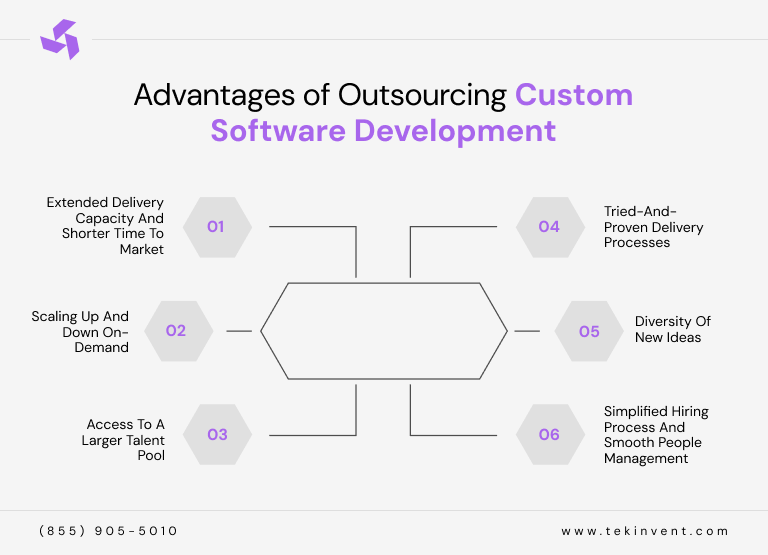
Outsourcing custom software development in Dallas offers businesses flexibility, efficiency, and access to global expertise. By partnering with an experienced development company, organizations can focus on core operations while ensuring high-quality software delivery. This approach reduces operational burdens, accelerates project timelines, and provides scalable resources without long-term commitments, making it ideal for startups and growing enterprises.
1. Extended Delivery Capacity and Shorter Time to Market
Outsourcing expands your development capacity instantly by adding skilled professionals to your project. With dedicated teams working across time zones, development continues without delays. Established workflows and technical expertise help complete projects faster, enabling businesses to launch products sooner, respond quickly to market demands, and gain a competitive edge without overloading internal teams.
2. Scaling Up and Down On-Demand
One of the biggest advantages of outsourcing is the ability to scale resources based on project needs. Businesses can quickly add developers during peak phases and reduce team size once objectives are met. This flexibility prevents unnecessary overhead costs while ensuring the right expertise is available at every stage of the software development lifecycle.
3. Access to a Larger Talent Pool
Outsourcing provides access to a global network of experienced developers, designers, and engineers. Businesses are no longer limited by local hiring challenges or skill shortages. This broader talent pool allows companies to leverage specialized expertise, emerging technologies, and industry best practices that may not be readily available within an in-house team.
4. Tried-and-Proven Delivery Processes
Custom software development companies rely on tested methodologies, structured workflows, and quality assurance practices. These proven delivery processes minimize risks, improve consistency, and ensure projects stay on schedule and within budget. From planning to deployment, experienced teams follow standardized frameworks that lead to predictable outcomes and reliable software solutions.
5. Diversity of New Ideas
Outsourced teams bring fresh perspectives gained from working across industries and projects. This diversity of experience encourages innovation, creative problem-solving, and improved product design. External developers often suggest better architectures, features, or workflows that internal teams may overlook, helping businesses build more efficient and user-focused software solutions.
6. Simplified Hiring Process and Smooth People Management
Outsourcing eliminates the complexities of recruiting, training, and managing an internal development team. The service provider handles hiring, onboarding, performance management, and retention. This allows businesses to avoid administrative overhead while maintaining consistent productivity, reducing HR challenges, and ensuring smooth collaboration throughout the development process.
Disadvantages of Outsourcing Custom Software Development
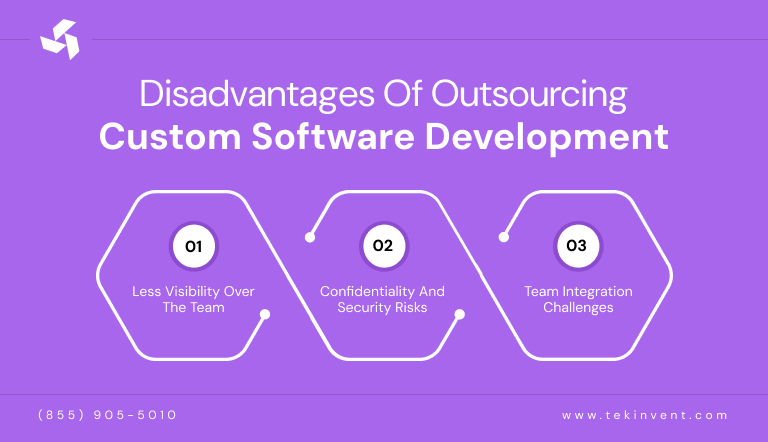
While outsourcing custom software development offers many benefits, it also comes with potential challenges that businesses must consider. Understanding these drawbacks helps organizations plan mitigation strategies, maintain project quality, and ensure smooth collaboration with external teams. Awareness of these issues allows companies to make informed decisions about when and how to outsource effectively.
1. Less Visibility Over the Team
Outsourcing can limit direct oversight of the development team, making it harder to monitor daily progress, workflows, and productivity. Businesses may need to rely on regular updates, reports, and communication tools to stay informed. Reduced visibility can sometimes lead to misunderstandings, delayed issue detection, or misalignment with project goals if not managed carefully.
2. Confidentiality and Security Risks
Sharing sensitive business data with external vendors introduces potential confidentiality and security risks. Proprietary information, intellectual property, or customer data may be exposed if the outsourcing partner lacks strict security measures. Companies must implement robust agreements, non-disclosure contracts, and cybersecurity protocols to protect their assets while collaborating with external developers.
3. Team Integration Challenges
Integrating an outsourced team with internal staff can be challenging due to differences in work culture, time zones, and communication styles. Misalignment in processes or expectations may impact collaboration, project flow, and team cohesion. Clear onboarding, regular meetings, and defined workflows are essential to bridge gaps and ensure smooth teamwork between in-house and outsourced developers.
Resources Needed for Outsourcing Custom Software Development

Outsourcing custom software development requires careful planning and resource allocation to ensure project success. While external vendors bring expertise and manpower, internal teams must provide guidance, strategy, and oversight. Identifying and organizing the necessary resources upfront helps businesses maintain control, streamline processes, and achieve desired outcomes efficiently.
1. Planning and Conceptual Resources (Internal)
Before outsourcing, internal teams must define the project vision, objectives, and requirements. This includes drafting detailed specifications, setting milestones, and identifying desired outcomes. Clear planning ensures that the external team fully understands the project scope and aligns with business goals, reducing misunderstandings and delays during development.
2. Human Resources (External Vendor)
Outsourcing relies on the external vendor to provide skilled developers, designers, testers, and project managers. Selecting the right team with the appropriate technical expertise is crucial for delivering quality software on time. Clear role definitions and accountability help ensure smooth collaboration between internal stakeholders and the outsourced team.
3. Technical and Infrastructure Tools
External teams require access to development tools, platforms, and infrastructure to work efficiently. This may include project management software, code repositories, testing environments, and collaboration tools. Ensuring both internal and external teams are equipped with compatible tools helps maintain productivity and seamless workflow.
4. Legal and Security Resources
Legal and security considerations are critical when outsourcing. Businesses must establish contracts, non-disclosure agreements, and intellectual property protections. Security resources such as secure data transfer methods, access controls, and compliance measures safeguard sensitive information throughout the development process.
5. Essential Steps for Successful Allocation
Effective resource allocation begins with mapping internal and external responsibilities, defining workflows, and setting clear expectations. Regular communication, progress tracking, and risk management are key steps to ensure resources are used efficiently and the project stays on track from planning to deployment.
Examples of Outsourcing Custom Software Development
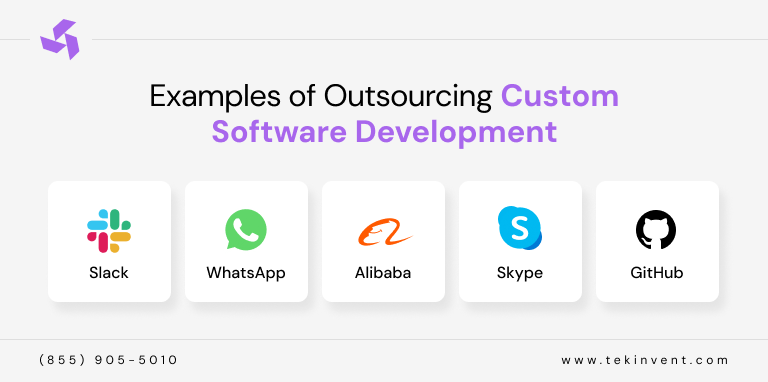
Many well-known technology companies have successfully used outsourcing to accelerate development, reduce costs, and access specialized expertise. By partnering with external development teams, these organizations were able to focus on core business goals while building scalable and high-performing software solutions. Below are real-life examples that highlight how outsourcing supported growth and innovation.
1. Slack
Slack outsourced parts of its early software development to external teams to speed up product launch. This allowed the company to focus on user experience and core functionality while maintaining development momentum. Outsourcing helped Slack scale efficiently before transitioning key development functions in-house as the product matured.
2. WhatsApp
WhatsApp relied on outsourced developers during its early stages to support backend development and system scalability. With a small internal team, outsourcing enabled efficient resource use while maintaining high performance. This approach helped WhatsApp manage rapid user growth and build a reliable platform ahead of its acquisition.
3. Alibaba
In its initial phase, Alibaba outsourced website development to quickly establish its eCommerce platform. This decision reduced time to market and provided access to experienced developers. Outsourcing allowed Alibaba to focus on business strategy while building a strong technical foundation for future global expansion.
4. Skype
Skype outsourced critical components of its software development, including backend infrastructure, to specialized external teams. This reduced development costs and improved technical efficiency. Outsourcing played a key role in enabling Skype to scale rapidly and support a growing international user base.
5. GitHub
GitHub outsourced select design and development tasks during early growth to enhance platform usability and scalability. This helped the company deliver new features faster while focusing internally on product vision and community engagement. Outsourcing contributed to GitHub’s strong adoption within the developer ecosystem.
What is the Best Time to Outsource Custom Software Development?
Outsourcing custom software development is most effective when it aligns with your business stage, goals, and internal capabilities. Rather than being a one-size-fits-all decision, the right timing depends on specific scenarios where external expertise adds the most value. Below are key case-based situations that clearly indicate when outsourcing is the smarter choice.
1. When You’re Launching a New Product or MVP
Case Scenario: A startup wants to validate an idea quickly but lacks a full technical team.
Outsourcing is ideal at this stage because it allows rapid MVP development without long-term hiring. External teams bring ready-to-use processes and expertise, helping you test the market faster and pivot early based on user feedback.
2. When Internal Teams Lack Specialized Skills
Case Scenario: A company needs AI integration or blockchain features, but in-house developers lack experience.
Outsourcing provides immediate access to specialists without months of training or recruitment. This ensures higher-quality implementation while internal teams focus on their strengths.
3. When Time-to-Market Is Critical
Case Scenario: A business must release software before competitors to capture market share.
Outsourcing speeds up development through parallel workflows, larger teams, and proven delivery models. Faster launches can directly impact revenue, brand visibility, and competitive positioning.
4. When Scaling Becomes Costly or Unmanageable
Case Scenario: A growing company experiences fluctuating development needs throughout the year.
Outsourcing allows on-demand scaling without increasing fixed costs. Businesses can expand teams during peak demand and scale down afterward, maintaining cost efficiency and operational control.
5. When You Need to Reduce Operational Overhead
Case Scenario: An enterprise wants to optimize budgets without compromising software quality.
Outsourcing eliminates expenses related to hiring, training, infrastructure, and employee retention. Vendors handle people management, allowing businesses to focus on strategy and growth.
6. When Maintenance and Support Overwhelm Internal Teams
Case Scenario: An internal team spends more time fixing bugs than building new features.
Outsourcing ongoing maintenance frees in-house developers to focus on innovation. Dedicated external teams ensure updates, monitoring, and support are handled efficiently.
What is In-House Custom Software Development?
In-house custom software development involves building and managing software using an internal team of developers employed by the company. The organization controls the entire development process, including planning, execution, and maintenance, allowing close collaboration, direct communication, and alignment with internal business goals.
Advantages of In-House Custom Software Development
In-house custom software development allows organizations to build software using their own internal teams, offering greater oversight and long-term strategic alignment. This approach is especially valuable for businesses that require continuous development, strict data control, or deep integration with internal systems. Below are the key advantages of maintaining an in-house development team.
More Control Over the Development Process
With an in-house team, businesses have complete control over planning, priorities, and execution. Decisions can be made quickly without relying on external approvals or contracts. Direct supervision ensures better quality control, faster issue resolution, and closer alignment with evolving business requirements throughout the development lifecycle.
Streamlined Communication and Reduced Cultural Fit Risks
In-house teams work within the same organizational culture, time zone, and communication structure. This reduces misunderstandings, improves collaboration, and enables faster feedback loops. Face-to-face interactions and shared company values help teams stay aligned, increasing productivity and minimizing risks related to miscommunication or cultural differences.
Accumulated Knowledge Inside the Team
Over time, in-house developers gain deep knowledge of internal systems, workflows, and business logic. This institutional knowledge improves development efficiency, simplifies maintenance, and reduces dependency on external vendors. Long-term familiarity with the product enables faster enhancements, better scalability planning, and consistent software quality.
Disadvantages of In-House Custom Software Development
While in-house custom software development offers control and long-term alignment, it also presents challenges that can impact cost, speed, and flexibility. These disadvantages are especially relevant for startups and growing businesses that must balance technical needs with limited resources and changing market demands.
Lack of Experts in Home Markets
Finding highly specialized software experts locally can be difficult, particularly in competitive or emerging markets. Businesses may struggle to hire professionals with niche skills such as AI, cloud architecture, or cybersecurity. This skills gap can limit innovation, slow development, and force teams to work with less-than-optimal technical solutions.
Recruitment, Onboarding, Retention, and Management Overhead
Building an in-house team involves significant time and financial investment. Recruitment, training, salaries, benefits, and ongoing management increase operational costs. Retaining skilled developers is also challenging due to high industry demand, and employee turnover can disrupt projects and reduce overall development efficiency.
Scalability Issues
In-house teams are not easily scalable. Expanding the team requires lengthy hiring processes, while downsizing can lead to resource waste and morale issues. This lack of flexibility makes it harder to adapt to fluctuating project demands, tight deadlines, or sudden changes in business priorities.
Resources Needed for In-House Custom Software Development
In-house custom software development requires a strong foundation of people, technology, and financial commitment. Unlike outsourcing, all responsibilities from hiring to infrastructure management remain within the organization. Properly allocating these resources ensures consistent development, long-term sustainability, and the ability to maintain and scale software effectively.
1. Human Resources (The Team)
An in-house team typically includes software developers, UI/UX designers, QA testers, project managers, and system architects. Recruiting skilled professionals and maintaining team collaboration is essential. Continuous training and knowledge sharing help keep the team updated with evolving technologies and industry best practices.
2. Technological Resources (Tools and Infrastructure)
In-house development requires investment in development tools, code repositories, testing environments, servers, security systems, and collaboration platforms. Maintaining reliable infrastructure ensures smooth workflows, data security, and efficient deployment. Regular upgrades and maintenance are necessary to support modern software development standards.
3. Financial Resources (Budget & Time)
Building an in-house team involves long-term financial planning. Costs include salaries, benefits, training, infrastructure, and ongoing maintenance. Additionally, development timelines may be longer due to hiring and onboarding processes. Businesses must allocate sufficient budget and time to sustain productivity and achieve desired outcomes.
Examples of In-House Custom Software Development
Many organizations choose in-house custom software development to maintain full control, protect sensitive data, and build long-term technical expertise. Below are real-life examples of companies that successfully developed and managed their software internally.
1. Google
Google develops most of its core products in-house, including Search, Gmail, and Google Maps. Internal teams enable rapid innovation, strict quality control, and deep integration across services while protecting proprietary algorithms and user data.
2. Netflix
Netflix relies heavily on in-house development to manage its streaming platform, recommendation engine, and cloud infrastructure. Internal teams continuously optimize performance, personalization, and scalability to support millions of global users.
3. Amazon
Amazon builds and maintains its eCommerce platform, logistics systems, and AWS services using in-house teams. This approach allows tight integration, rapid experimentation, and continuous improvement across its vast digital ecosystem.
4. Microsoft
Microsoft develops major products like Windows, Office, and Azure in-house. Internal development ensures strong security, seamless product integration, and long-term innovation aligned with the company’s strategic goals.
5. Facebook (Meta)
Meta develops its core platforms such as Facebook, Instagram, and WhatsApp primarily in-house. This enables control over data, scalability, and feature development while supporting rapid updates and evolving user needs.
What is the Best Time to Hire An In-House Custom Software Development Team?
Hiring an in-house custom software development team is a strategic decision that works best when software is central to your business and long-term ownership matters. The timing depends on the growth stage, budget stability, and ongoing development needs. Below are practical case scenarios that highlight when building an in-house team makes the most sense.
1. When Software Is Your Core Product or Competitive Advantage
Case Scenario: A SaaS company relies entirely on its platform for revenue.
An in-house team ensures full control over product direction, architecture, and roadmap. Developers deeply understand the product, enabling faster iterations, better performance optimization, and continuous innovation aligned with business goals.
2. When You Have Long-Term and Continuous Development Needs
Case Scenario: An enterprise requires constant feature updates, integrations, and maintenance.
Hiring in-house developers becomes cost effective over time. The team builds institutional knowledge, reduces dependency on external vendors, and ensures consistent development without recurring outsourcing costs.
3. When Data Security and Compliance Are Critical
Case Scenario: A healthcare or fintech company handles sensitive customer data.
In-house teams provide stronger control over data access, security practices, and compliance requirements. This reduces risks related to data sharing and helps meet strict regulatory standards.
4. When You Have Stable Funding and Budget Predictability
Case Scenario: A well funded company plans multi year product development.
In-house hiring is ideal when budgets can support salaries, tools, training, and retention. Predictable funding allows teams to focus on quality and innovation rather than short-term delivery pressure.
5. When Fast Internal Collaboration Is Essential
Case Scenario: Product, marketing, and engineering teams must work closely.
In-house teams enable real-time communication, quicker decision-making, and better alignment. Shared culture and time zones improve productivity and reduce delays caused by coordination gaps.
6. When You Want to Build Long-Term Technical Expertise
Case Scenario: A company plans to evolve its platform over several years.
An in-house team accumulates deep system knowledge and architectural understanding. This makes future upgrades, scaling, and optimization faster and more reliable while strengthening internal technical leadership.
What Is More Expensive, Outsourcing Or In-house Development?
The cost of software development depends on project scope, duration, and business priorities. Both outsourcing and in-house development have unique expenses, and the “more expensive” option varies based on context.
In-House Development Costs
Building an internal team requires hiring salaries, benefits, training, recruitment, and infrastructure setup. Over time, ongoing costs include employee retention, workspace, software licenses, and hardware upgrades. While in-house development offers long-term control and accumulated knowledge, it often involves higher fixed costs, especially for specialized talent.
Outsourcing Costs
Outsourcing usually involves project-based or hourly fees paid to external vendors. While initial costs can be lower than building an internal team, outsourcing may include additional expenses for project management, communication, revisions, or security measures. However, outsourcing avoids long-term overhead, making it cost-effective for short-term or highly specialized projects.
Cost Comparison by Scenario
- Short-term projects or startups: Outsourcing is generally cheaper and faster.
- Long-term, continuous development: In-house teams may provide better value despite higher upfront costs.
- Specialized skills not available internally: Outsourcing avoids costly hiring and training.
Final Thoughts
Choosing between a custom software development company and an in-house team depends on your business goals, project scope, and long-term strategy. Outsourcing offers flexibility, specialized skills, and faster time-to-market, making it ideal for short-term projects, startups, or specialized requirements. In-house development provides control, deep product knowledge, and continuous innovation, which is best for businesses with long-term development needs, strict data security, and stable budgets.
By carefully evaluating costs, resources, and strategic priorities, companies can select the approach that maximizes efficiency, quality, and business growth. Good luck with your pick!

Build Smart with The Right Team.
We bring expertise, technology, and trust you look for in your digital journey.